
A colon cancer pathology report can contain several unfamiliar terms. If tumor budding in colon cancer appears on yours, it is easy to assume that another tumor has started growing beside the original cancer, or that the finding means the disease has already spread.
It means neither of those things.
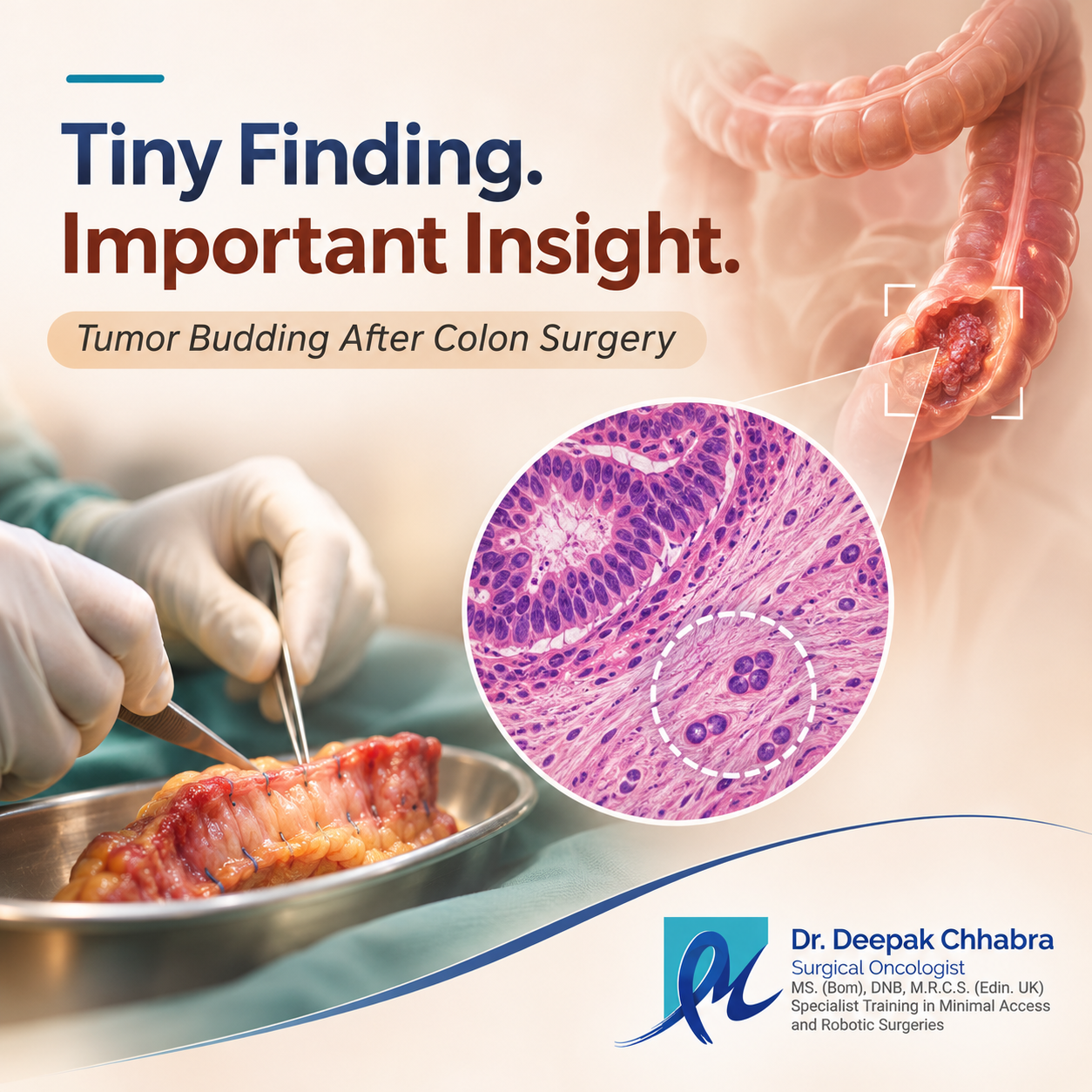
Tumor budding is something a pathologist sees under the microscope when examining the cancer tissue removed during surgery. It describes individual cancer cells, or very small groups of cells, separating from the main tumor at its advancing edge. In certain situations, particularly stage II colon cancer, the amount of budding can add useful information to the postoperative risk assessment.
For patients researching colon cancer treatment in Mumbai, findings such as this make more sense when they are read as part of the complete surgical pathology report. Dr. Deepak Chhabra’s overview of colon cancer surgery and treatment planning explains how pathology, staging and postoperative decisions fit into the wider treatment pathway.
Tumor budding refers to single cancer cells or tiny clusters of up to four cancer cells seen at the invasive edge of a colorectal tumor under the microscope. It is a feature of the original cancer and should not be confused with a second tumor, a positive lymph node or distant metastatic disease.
A pathology report may describe budding according to a standardized three-level system:
The International Tumor Budding Consensus Conference, known as ITBCC, established a standardized method for assessing this feature in colorectal cancer. Its recommendations also make an important point: budding should be interpreted alongside the rest of the clinicopathological findings rather than used on its own.
When a surgeon removes a colon cancer, the tumor may appear to be one solid mass. The pathologist sees much more detail.
At the edge where the cancer meets the surrounding tissue, some tumors remain relatively cohesive. In others, small individual cells or tiny clusters appear to separate from the main tumor. That pattern gives pathologists additional information about the biological behaviour of the cancer.
Research behind the ITBCC recommendations found tumor budding to be associated with lymph-node metastasis in early colorectal cancer and with prognosis in stage II disease. That does not allow doctors to predict what will happen to an individual patient, but it explains why the feature is now taken seriously in colorectal pathology reporting.
Because budding can only be assessed microscopically, patients generally encounter the term in the surgical pathology report, not on a CT scan, MRI or colonoscopy report.
The numbers can look intimidating when they appear on a report, but patients do not need to memorise them.
BD1 describes a relatively low amount of budding, BD2 an intermediate amount and BD3 a higher amount. The BD3 category is the one that carries particular relevance when doctors assess certain stage II colon cancers.
The category does not replace the cancer stage. It provides another layer of information within the pathology report.
This distinction matters because two patients can both have stage II colon cancer while having different pathological features and therefore somewhat different postoperative discussions.
Stage II colon cancer generally means the tumor has grown through layers of the bowel wall, but cancer has not been identified in the regional lymph nodes.
For many people, surgery remains the central treatment. The difficulty is that stage II cancers do not all behave in exactly the same way, so doctors look at features in the removed specimen that may help refine the estimate of recurrence risk.
ASCO’s guideline for adjuvant treatment in stage II colon cancer recognizes BD3 tumor budding—10 or more buds—as one of several high-risk features in stage IIA disease. The recommendation is deliberately cautious: adjuvant chemotherapy may be offered when high-risk features are present, and the decision should involve discussion of potential benefits and harms.
That wording is worth paying attention to. ASCO does not say that finding BD3 budding automatically means chemotherapy must be given.
A patient who sees the words “high tumor budding” may understandably focus on that line and worry that it changes everything.
Doctors usually read it very differently. They place the budding result beside the rest of the pathology report and ask how all of those findings fit together.
For a patient with stage II disease, that may include the depth of tumor invasion, the number of lymph nodes examined, lymphovascular or perineural invasion, tumor grade, obstruction or perforation, surgical margins and mismatch-repair or MSI status.
ASCO specifically recommends considering the number and combination of high-risk features during shared decision-making. Its guidance also treats mismatch-repair status separately because that can influence how adjuvant treatment is considered.
In practice, this means a BD3 result may change the conversation without deciding the answer by itself.
A simple example makes this easier to understand.
Imagine two patients whose colon cancers have both been completely removed. Both are classified as stage II, both have clear surgical margins, and neither has cancer identified in the examined regional lymph nodes.
The first pathology report shows low tumor budding and no other major adverse features. The second shows BD3 high-grade budding together with another recognised high-risk pathological feature.
They still share the same broad stage, but their postoperative risk assessments are not identical. The second patient may have a more detailed discussion about whether additional treatment should be considered, taking into account the complete pathology report and the individual’s health and preferences.
That is the role of tumor budding in modern colon cancer care: it helps refine an assessment that already contains several other pieces of information.
This is one of the most important distinctions for patients.
Tumor buds are found in the tissue around the primary colon tumor. A positive lymph node, on the other hand, means that cancer cells have actually been identified inside a regional lymph node.
A patient can therefore have high tumor budding while still having node-negative stage II colon cancer.
Budding may be associated with a more aggressive biological pattern, but it should not be described as proof that cancer has already spread to lymph nodes or distant organs.
That would give the finding more meaning than the pathology supports.
Pathology reports sometimes include both tumor grade and tumor budding grade, which can make the terminology confusing.
Tumor grade broadly describes how abnormal the cancer cells look and how much they resemble normal colon tissue. Tumor budding describes the small individual cells or tiny cell clusters seen at the invasive edge of the cancer.
The ITBCC consensus specifically states that tumor budding and tumor grade are separate pathological features.
So if both appear on a pathology report, one should not be interpreted as another way of saying the same thing.
Tumor budding does not, by itself, change the TNM stage.
The stage is determined mainly by how far the primary tumor has grown, whether regional lymph nodes contain cancer and whether there is distant metastatic disease.
Budding provides additional prognostic information within that framework. This is particularly useful in stage II disease, where patients with the same TNM stage can still have different combinations of pathological risk features.
It is therefore better to think of budding as additional detail within the stage, rather than as a new stage of its own.
A surgical pathology report may run for several pages, and it is tempting to search every unfamiliar phrase separately.
That can create unnecessary anxiety because each finding begins to sound like an independent prediction.
Pathology does not work that way.
The surgeon and oncology team usually consider the T stage, lymph nodes, surgical margins, lymphovascular invasion, perineural invasion, tumor grade, budding, mismatch-repair status and other relevant findings together.
The meaning of one result can also depend on what appears elsewhere in the report.
For patients seeing a colon cancer specialist in Mumbai, the useful question is therefore not simply whether tumor budding is present. It is how the budding category fits with the final stage and the rest of the postoperative pathology.
Patients seeking another opinion should ideally bring the complete pathology report rather than a photograph of one line or only the discharge summary.
A high budding score deserves attention, particularly in the appropriate stage II setting. It provides evidence that the cancer has certain microscopic features associated with higher-risk behaviour.
It does not tell a doctor exactly whether an individual patient will experience recurrence.
It does not prove metastatic disease.
And it does not independently determine whether chemotherapy will provide enough benefit to justify treatment.
Those decisions are made from the wider clinical picture, which is why interpreting the report with the treating team is more useful than treating BD1, BD2 or BD3 as a stand-alone verdict.
No. High tumor budding is associated with a higher-risk pathological profile, but it cannot predict recurrence for an individual patient with certainty. Doctors interpret the budding category together with stage, lymph nodes, margins and other pathology findings when discussing risk.
Not automatically. ASCO recognises BD3 tumor budding as one high-risk feature in stage IIA colon cancer, but treatment decisions also consider other pathological findings, mismatch-repair or MSI status, general health and the expected benefits and harms of chemotherapy.
No. Tumor budding describes individual cancer cells or tiny clusters around the primary tumor, while lymph-node metastasis means cancer cells have actually been found inside a regional lymph node. The two findings can be related to cancer behaviour, but they are pathologically different.
No. Tumor budding is a microscopic feature identified by a pathologist in tumor tissue and cannot be directly seen on routine CT imaging or colonoscopy. Patients usually encounter the term after surgery when the removed specimen has undergone detailed pathological examination.
Seeing “tumor budding” on a pathology report can be unsettling because the term is unfamiliar and the word budding sounds as though something new is growing.
That is not what the pathologist means.
Budding is a microscopic feature of the original colon cancer. Its value lies in the additional information it can provide about tumor behaviour, especially when doctors are assessing risk after surgery for stage II disease.
For patients considering colon cancer treatment in Mumbai, the most useful next step is to have the complete pathology report interpreted as a whole. Ask how the budding category fits with the stage, lymph-node findings, margins, mismatch-repair status and any other recognised risk features.
That conversation is much more informative than asking whether a single BD score is “good” or “bad.”
This article is intended for general educational and informational purposes only. It does not replace individual pathology interpretation, cancer staging, oncology consultation or treatment planning.
Tumor budding should be interpreted together with the complete pathology report, cancer stage, molecular findings, overall health and other relevant clinical factors. Patients should discuss treatment decisions with their treating cancer team rather than making decisions from an individual pathology feature.
Stay up-to-date with the latest developments in cancer research, treatment, and patient stories through our curated collection of cancer blogs and news articles. From breakthrough discoveries to inspiring survivor journeys.
Discover first hand accounts from patients who have experienced compassionate care and expert treatment at our clinic. Read their reviews to get to know their journey.

5 Out of 5 from 92 Reviews






 VIDEO CONSULTATION
 Phone Calls
 Physical visit