
After colon cancer surgery, most patients expect the next steps to revolve around the pathology report and follow-up scans.
Then another test may come up in conversation: ctDNA.
For someone hearing the term for the first time, the idea can sound confusing. If the tumour has already been removed and the scan looks clear, why would doctors need a blood test to look for cancer?
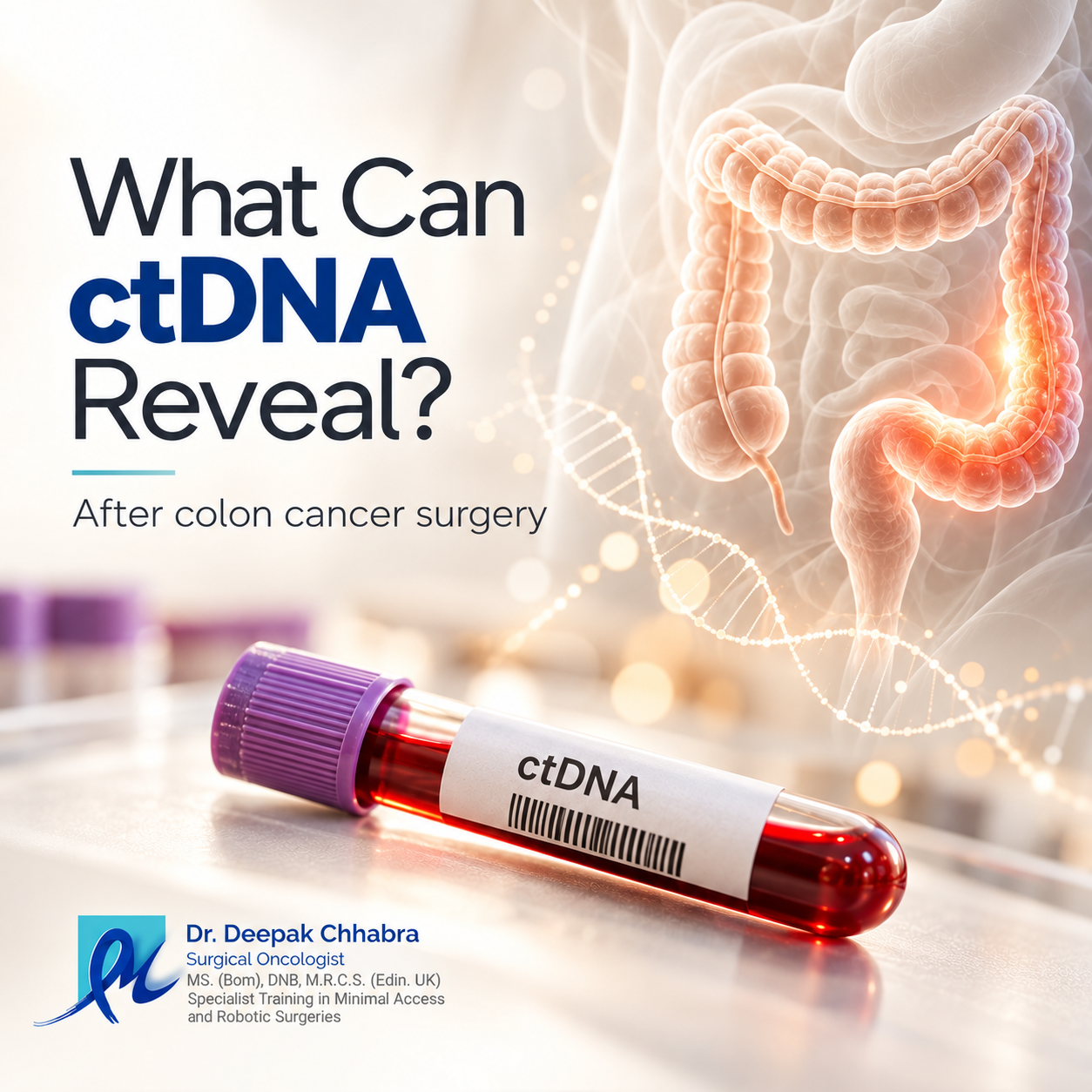
ctDNA stands for circulating tumour DNA. It refers to very small fragments of genetic material released by cancer cells into the bloodstream. After surgery, testing for ctDNA can sometimes provide information about whether a molecular trace of the cancer is still detectable, even when nothing is visible on a scan.
For patients considering colon cancer treatment in Mumbai, that result is only one part of the postoperative picture. Stage, pathology, lymph-node findings, scans, molecular features and the patient’s overall condition still need to be considered together. Dr. Deepak Chhabra’s overview of colon cancer treatment and surgical planning explains that broader pathway.
A postoperative ctDNA test looks for tumour-related DNA fragments in the bloodstream after the visible cancer has been removed.
If ctDNA is detected, it can suggest that microscopic cancer cells may still be present somewhere in the body. Research has shown that this is associated with a higher risk of recurrence.
If ctDNA is not detected, that is reassuring. It does not, however, prove that every cancer cell is gone.
A simple way to think about the result is:
The test adds another layer of information. It does not replace the rest of the cancer assessment.
A scan and a ctDNA test are looking for different things.
CT scans are designed to show structural changes in the body. They can identify a tumour, an enlarged lymph node or another abnormal area when it is large enough to be seen.
A very small number of cancer cells may be far below that level of visibility.
Those cells can still release tiny pieces of DNA into the blood.
So a patient can have a clear postoperative scan and still have detectable ctDNA.
This does not mean a hidden tumour has been located somewhere in the body.
It means the blood test has detected a molecular signal associated with the cancer.
Doctors sometimes describe this as molecular residual disease, or MRD.
The wording can sound frightening, especially when someone has just been told that surgery went well. It is better understood as a marker of risk than as proof of a visible recurrence.
Cells naturally release fragments of DNA into the bloodstream as they break down.
Cancer cells can do the same.
The portion of DNA that comes from tumour cells is known as circulating tumour DNA.
Some tests are tumour-informed. In those tests, the laboratory first studies the tumour removed during surgery and identifies specific genetic changes. The later blood test then looks for those same changes.
Other assays use broader panels.
Patients do not need to understand sequencing technology to understand the purpose of the test.
The practical question is much simpler:
Can we still detect a molecular trace of the cancer after treatment?
A positive result deserves attention, but it should not be interpreted as a certainty.
Research has consistently shown that patients with detectable ctDNA after colorectal cancer surgery have a higher risk of the disease returning compared with patients whose ctDNA is not detected.
A 2026 ASCO analysis of patients with resected colorectal cancer looked at postoperative ctDNA during an MRD window of approximately 2 to 12 weeks after surgery. Detectable ctDNA was associated with poorer disease-free survival, and in some patients the molecular signal appeared before recurrence was visible on imaging.
The same research also made an important point: how ctDNA should be used to guide chemotherapy decisions is still being studied.
So a positive result should not be translated into:
“The cancer will definitely come back.”
It means the risk is higher and the result deserves to be discussed carefully with the treating oncology team.
It does not tell us exactly when recurrence might happen, where it might occur, or whether it will become visible at all.
Patients are understandably relieved when ctDNA is not detected.
That is a favourable finding.
Still, every laboratory test has limits.
Very small amounts of tumour DNA can fall below the detection threshold. Some cancers release less DNA into the bloodstream than others. Timing can influence the result as well.
A negative ctDNA test should therefore not be used as a reason to stop routine surveillance.
Scans, clinical review and other follow-up tests remain important.
The most accurate wording is:
“No ctDNA was detected in this sample.”
That is different from saying:
“There is absolutely no cancer left anywhere in the body.”
This distinction is especially important.
A test can be useful in two different ways.
A prognostic test helps doctors estimate how likely an outcome is—for example, the risk of the cancer returning.
A predictive test helps identify whether a specific treatment is likely to benefit a particular patient.
ctDNA has become a strong prognostic marker in colorectal cancer.
Its role in deciding exactly who should receive chemotherapy, how much treatment should be given, or whether treatment can safely be reduced is still evolving.
The National Cancer Institute has discussed studies examining whether ctDNA could help identify patients who may benefit from chemotherapy after colorectal cancer surgery while allowing some lower-risk patients to avoid unnecessary treatment.
That is a promising direction, but it is still being tested.
For patients, the practical message is simple:
ctDNA can help refine the risk discussion, but it should not be treated as a stand-alone chemotherapy decision.
Because ctDNA is a newer technology, it can sometimes sound more advanced—and therefore more important—than the pathology report.
That would be a mistake.
The pathology report still provides information that ctDNA cannot replace.
It tells the team how deeply the tumour grew into the bowel wall, whether lymph nodes contained cancer, whether the surgical margins were clear and whether there were other high-risk features.
Molecular characteristics such as MMR/MSI status may also influence prognosis and treatment planning.
Then there is the patient.
Age, recovery from surgery, other illnesses, previous treatment and general fitness all influence what happens next.
ctDNA should sit beside these findings, not above them.
The timing of a postoperative ctDNA test can affect how useful the result is.
Immediately after surgery, normal healing causes a large amount of ordinary cell-free DNA to enter the bloodstream.
That is one reason these tests are generally not done immediately after the operation.
Different assays and studies use different time windows.
The 2026 ASCO analysis, for example, assessed MRD during a postoperative period of roughly 2 to 12 weeks.
Patients should follow the timing recommended by their treating team rather than arranging testing independently and trying to interpret the result without context.
A single blood sample provides information from one point in time.
Cancer biology changes.
A patient who tests negative after surgery may remain negative on later testing. Someone with a positive result may later clear ctDNA after treatment. In other cases, ctDNA may become detectable during follow-up before anything appears on a scan.
This is one reason serial testing is being studied so closely.
Patterns over time may sometimes be more informative than one isolated result.
Even then, the molecular trend needs to be interpreted with the rest of the clinical picture.
There is another detail worth knowing.
Many of the major ctDNA studies include patients with colorectal cancer, meaning both colon and rectal cancers may be represented.
That does not make the findings irrelevant to a patient with colon cancer.
It simply means the result should be interpreted in relation to the individual diagnosis, stage and treatment.
A headline about “colorectal cancer MRD” cannot tell one patient exactly what their own result means.
That judgement still belongs with the treating team.
For someone consulting a colon cancer specialist in Mumbai after surgery, ctDNA should be reviewed as part of the entire postoperative assessment.
The team may need to consider:
Patients reviewing follow-up after colon cancer surgery in Mumbai should ideally bring their full pathology report, operative records and original imaging rather than only the blood-test result.
The ctDNA report makes much more sense when it is put back into the context of the cancer it came from.
The appeal of ctDNA is easy to understand.
A scan waits for a structural abnormality to become visible.
ctDNA looks for a molecular signal.
That creates the possibility of detecting risk earlier.
But finding something earlier is only part of the story.
The harder question is whether changing treatment because of that early signal improves outcomes.
That is what current research is trying to answer.
So in 2026, the most balanced way to describe ctDNA is this:
It is a promising and increasingly useful tool for understanding recurrence risk after colon cancer surgery, but it is not yet a replacement for pathology, imaging or established follow-up.
No. A positive result means tumour-derived DNA has been detected and the risk of recurrence may be higher, but it does not prove that a visible tumour has already returned. The result should be reviewed alongside stage, pathology, imaging and the timing of the test.
A negative result is reassuring, but it cannot guarantee that no microscopic cancer cells remain. Small amounts of disease may fall below the test’s detection limit. Routine follow-up should continue even when ctDNA is not detected.
No. ctDNA provides molecular information, while scans provide anatomical information. They answer different questions and are generally used together rather than as substitutes for one another.
No. A positive result can indicate higher recurrence risk, but the evidence for making chemotherapy decisions solely from ctDNA remains under study. Treatment planning should also include stage, pathology, previous treatment and the patient’s overall condition.
ctDNA has opened a new window into what may be happening after colon cancer surgery.
It can sometimes pick up a molecular signal long before anything becomes visible on a scan.
That makes the technology valuable.
It also makes careful interpretation essential.
A positive result does not automatically mean the cancer has returned. A negative result does not eliminate every possibility of recurrence.
The real value of the test is in the extra information it can add to the postoperative picture.
For patients and families, the most useful questions are practical ones:
Why is the test being ordered? When should it be done? What would a positive result change? What would a negative result change?
Those answers matter far more than the test name itself.
Used in the right context, ctDNA can make follow-up more informed and potentially more personalised. It should remain one part of a broader colon cancer treatment plan, not a replacement for everything that came before it.
This article is intended for general educational and informational purposes only. It does not replace individual medical advice, diagnosis, cancer staging, treatment planning or follow-up from a qualified oncology team. The meaning and clinical usefulness of a ctDNA result depend on the cancer stage, pathology, type of assay, timing of testing, previous treatment and individual circumstances. Decisions about chemotherapy, surveillance or further investigation should not be based on a ctDNA result alone.
Stay up-to-date with the latest developments in cancer research, treatment, and patient stories through our curated collection of cancer blogs and news articles. From breakthrough discoveries to inspiring survivor journeys.
Discover first hand accounts from patients who have experienced compassionate care and expert treatment at our clinic. Read their reviews to get to know their journey.

5 Out of 5 from 92 Reviews







 VIDEO CONSULTATION
 Phone Calls
 Physical visit