
Being told that a colonoscopy has found one cancer is difficult enough. When the doctor says there is a second, separate tumour, the questions usually come quickly.
Has the first cancer spread? Will more of the colon have to be removed? Does having two tumours mean the disease is more advanced? Will there be two operations?
Not necessarily.
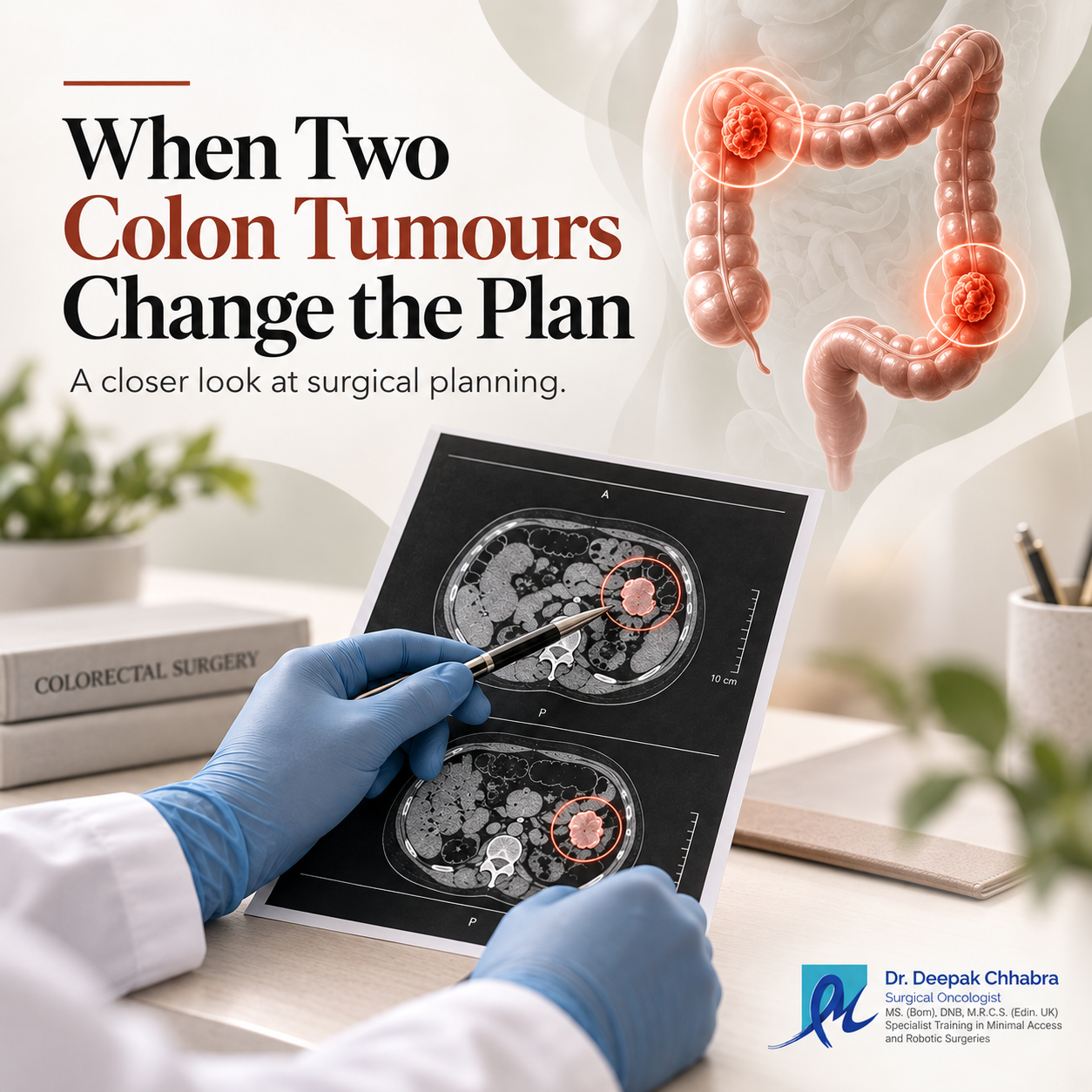
Two separate cancers arising in the colon at the same time are often described as synchronous colon cancers. Their presence can make surgical planning more detailed, but the number of tumours alone does not decide how much bowel needs to be removed.
For patients reviewing options for colon cancer treatment in Mumbai, the more useful question is: where are the two tumours, and what operation can remove them with appropriate lymph-node clearance while preserving healthy, functional bowel whenever it is oncologically safe to do so?
That is where the real planning begins.
Two primary colon cancers can sometimes be removed within the same bowel resection, while tumours located far apart may require treatment of different segments of the colon. The surgical plan depends much more on anatomy, blood supply, lymphatic drainage and cancer stage than on the simple fact that there are two tumours.
Before choosing the operation, the surgical team needs to establish:
Two people can therefore both be told they have “two colon tumours” and still require very different operations.
This distinction matters.
A second abnormal area in the colon does not automatically mean that the first cancer has spread. Sometimes two independent cancers develop separately in different parts of the colon.
At other times, imaging or pathology may reveal a different pattern of disease.
The colonoscopy report, biopsy results and staging scans need to be reviewed together before making assumptions.
When there are genuinely two primary tumours, each cancer needs to be understood in its own anatomical setting. Where is it? How deeply does it appear to involve the bowel? Which regional lymph nodes drain that part of the colon? And how does removing that segment affect the operation required for the second tumour?
That is why simply counting tumours tells us very little about the final surgery.
Imagine two tumours sitting reasonably close together within the same part of the colon.
If an oncologically appropriate resection for one tumour already includes the other tumour, its blood supply and the relevant lymphatic drainage, both cancers may sometimes be dealt with in the same specimen.
Now consider a very different situation: one cancer is on the right side of the colon and another is much farther away in the sigmoid colon.
Those tumours may involve separate vascular territories and separate groups of regional lymph nodes. The surgeon then has to decide whether treating two bowel segments, performing a more extended resection, or using another surgical strategy gives the safest cancer clearance while leaving the patient with a functional remaining colon.
This is why the exact locations shown on the colonoscopy and scans matter so much.
“Two tumours” is a diagnosis.
Their anatomical relationship is what starts defining the operation.
No.
This is one of the most common fears after a second tumour is discovered.
Standard surgery for colon cancer generally involves removing the cancer-bearing section of colon together with associated healthy bowel and regional lymph nodes. The American Cancer Society’s guidance on colon cancer surgery also explains that total colectomy—removal of the entire colon—is not routinely required for most colon cancers.
With two primary cancers, however, the surgeon has more anatomy to account for.
If both tumours can be removed through an adequate segmental operation, retaining the remaining colon may be reasonable. If the tumours are widely separated, if much of the colon is affected by polyps, or if an inherited cancer syndrome substantially changes the risk to the remaining bowel, a more extensive operation may enter the discussion.
The aim should not simply be to remove the smallest amount of bowel possible.
Nor should it be to remove extra colon “just to be safe.”
The aim is an operation that achieves appropriate cancer clearance without sacrificing healthy bowel unnecessarily.
Colon cancer surgery is not just about cutting out the visible mass.
The lymphatic tissue associated with the tumour-bearing segment is an important part of oncological surgery because cancer cells can travel to regional lymph nodes. Those nodes are removed with the surgical specimen and examined by the pathologist.
With two tumours in different areas of the colon, the relevant lymphatic drainage may not be identical.
That becomes especially important when the cancers are far apart.
The surgeon has to plan the resection around the blood vessels and mesentery serving each tumour-bearing section rather than treating the colon as one continuous piece of bowel with two spots that simply need to be cut out.
The pathology findings after surgery then help establish how deeply each cancer has grown and whether regional nodes contain tumour cells.
For patients searching for a colon cancer surgeon in Mumbai, this is a useful point to discuss during consultation: ask not only which part of the bowel will be removed, but which lymph-node territory the operation is designed to clear and why.
Patients naturally want to know how much colon will remain.
That is a sensible question.
The colon plays an important role in absorbing water and forming stool, so removing different amounts of bowel can affect bowel frequency and consistency after recovery. Most patients adapt, but the expected change depends partly on how much colon remains and which section has been removed.
For this reason, preserving healthy bowel has value.
But bowel preservation only makes sense if the cancer operation remains oncologically adequate.
A very small resection that compromises appropriate margins or lymphatic clearance is not a better operation simply because more bowel was retained.
At Dr. Deepak Chhabra’s practice, the surgical discussion therefore centres on finding that balance: remove what needs to be removed for sound cancer surgery while avoiding unnecessary loss of normal bowel whenever possible.
After a section of colon is removed, the remaining bowel can often be reconnected. This connection is called an anastomosis.
If both tumours can be removed within a single resection, the reconstruction may involve one bowel join.
When two widely separated segments have to be treated, surgical reconstruction can become more complex. Depending on the anatomy and the chosen operation, more than one join may need to be considered.
But the decision is not based on tumour count alone.
The surgeon also has to assess whether the remaining bowel ends have a reliable blood supply, whether they can be brought together without excessive tension, and whether the final arrangement will give acceptable bowel function.
If one tumour has caused obstruction, perforation or severe bowel distension, the situation may be different again. In an emergency, the safest immediate operation can take priority over the reconstruction that might otherwise have been planned for an elective procedure.
This is one reason two apparently similar scan reports can result in different surgical recommendations.
Patients sometimes assume that two tumours automatically mean a higher stage.
Cancer staging does not work that way.
When two independent primary cancers are present, the pathology of each tumour matters. The depth of invasion, regional lymph-node findings, margins and staging investigations all contribute to understanding the disease.
That is very different from finding one primary colon cancer that has spread to another organ.
So when a second lesion is discovered, one of the first jobs is to establish exactly what that second lesion represents.
This distinction can alter not only the operation but also the treatment discussion that follows surgery.
This part needs careful explanation because two different questions are often mixed together.
MMR/MSI tumour testing is relevant to colorectal cancer generally, not only when two tumours are found.
Mismatch-repair proteins—usually shortened to MMR—and microsatellite instability, or MSI, provide important molecular information about colorectal cancers. The National Cancer Institute describes universal tumour-testing approaches in which colorectal cancers are evaluated for MMR deficiency or MSI as part of identifying patients who may need further assessment for Lynch syndrome. Read the NCI’s colorectal cancer genetics guidance
Finding two independent primary colorectal cancers does, however, give the clinical team another reason to look carefully at hereditary risk.
Age at diagnosis, family history, previous cancers, the number of colorectal polyps and the tumour’s molecular findings can all contribute to that assessment.
An abnormal tumour test does not by itself prove that a person has Lynch syndrome. Some MMR-deficient or MSI-high colorectal cancers occur without an inherited syndrome, so further testing may be required before a hereditary diagnosis is made.
The distinction matters because confirmed hereditary risk may influence surveillance for the patient and sometimes for close family members. In selected situations, it can also influence the discussion about how much colon should remain after surgery.
When we discuss a case involving two colon tumours, the most useful conversation is usually anatomical rather than technical.
Patients understandably ask whether surgery will be laparoscopic, robotic or open. Those are reasonable questions, but they come after deciding what cancer operation is required.
A more informative conversation starts with: Where exactly is each tumour? Can they be removed within one oncological resection? If not, which sections need treatment? Which lymph nodes are included? How much functioning colon should remain? How many bowel joins are anticipated?
It is also reasonable to ask the surgeon to show both tumour locations on a simple diagram of the colon.
That one discussion can make a complicated operation much easier to understand.
Finding two colon cancers at the same time understandably sounds more alarming than finding one.
But the discovery does not automatically mean that the entire colon must be removed, that two separate operations will be needed, or that the cancer has already spread.
The surgery is built around the relationship between the two tumours.
Sometimes they can be addressed within the same resection. Sometimes their distance, vascular supply and lymphatic drainage make separate segmental treatment more appropriate. In selected patients, a more extensive colectomy may make better sense.
The right answer comes from reviewing the colonoscopy, biopsies, staging scans, tumour locations, expected bowel function and molecular or hereditary-risk information together.
For someone considering colon cancer surgery in Mumbai, bringing the complete colonoscopy report, pathology report and available scan images—not only the written scan summary—can make the surgical consultation much more useful.
The question worth asking is not simply:
“I have two tumours. How much bowel will you remove?”
It is:
“Why is this particular operation the safest oncological plan for where my two tumours are located?”
That answer should make sense before surgery.
Yes, two primary colon cancers can often be treated during the same operation when both are surgically removable. Whether they require one resection or treatment of separate bowel segments depends mainly on their locations, vascular territories and lymphatic drainage. Reviewing the colonoscopy, biopsy and staging scans together helps define the appropriate operation.
No, finding two colon tumours does not automatically require a total colectomy. A more extensive operation may be considered when the tumours are widely separated or when other factors, such as extensive polyps or hereditary cancer risk, change the safety of retaining the remaining colon. The proposed extent of bowel removal should therefore be explained in relation to the location of both cancers.
Not necessarily. The number of anastomoses depends on which bowel segments are removed, the blood supply of the remaining bowel and the safest way to reconstruct the colon. Your surgeon should be able to explain the expected reconstruction once the operative plan has been mapped.
No, two primary colon cancers do not by themselves diagnose Lynch syndrome. MMR/MSI tumour testing is relevant to colorectal cancers generally, while multiple primary cancers, age and family history can provide additional reasons for hereditary-risk assessment. If tumour testing or the clinical history raises concern, genetic counselling and appropriate germline testing can clarify the risk.
Medical Disclaimer: This article is intended for patient education and general information. It does not replace individual medical advice, diagnosis or treatment planning. The appropriate operation for colon cancer depends on pathology, tumour location, staging, imaging, overall health and multidisciplinary clinical assessment.
Stay up-to-date with the latest developments in cancer research, treatment, and patient stories through our curated collection of cancer blogs and news articles. From breakthrough discoveries to inspiring survivor journeys.
Discover first hand accounts from patients who have experienced compassionate care and expert treatment at our clinic. Read their reviews to get to know their journey.

5 Out of 5 from 92 Reviews







 VIDEO CONSULTATION
 Phone Calls
 Physical visit