
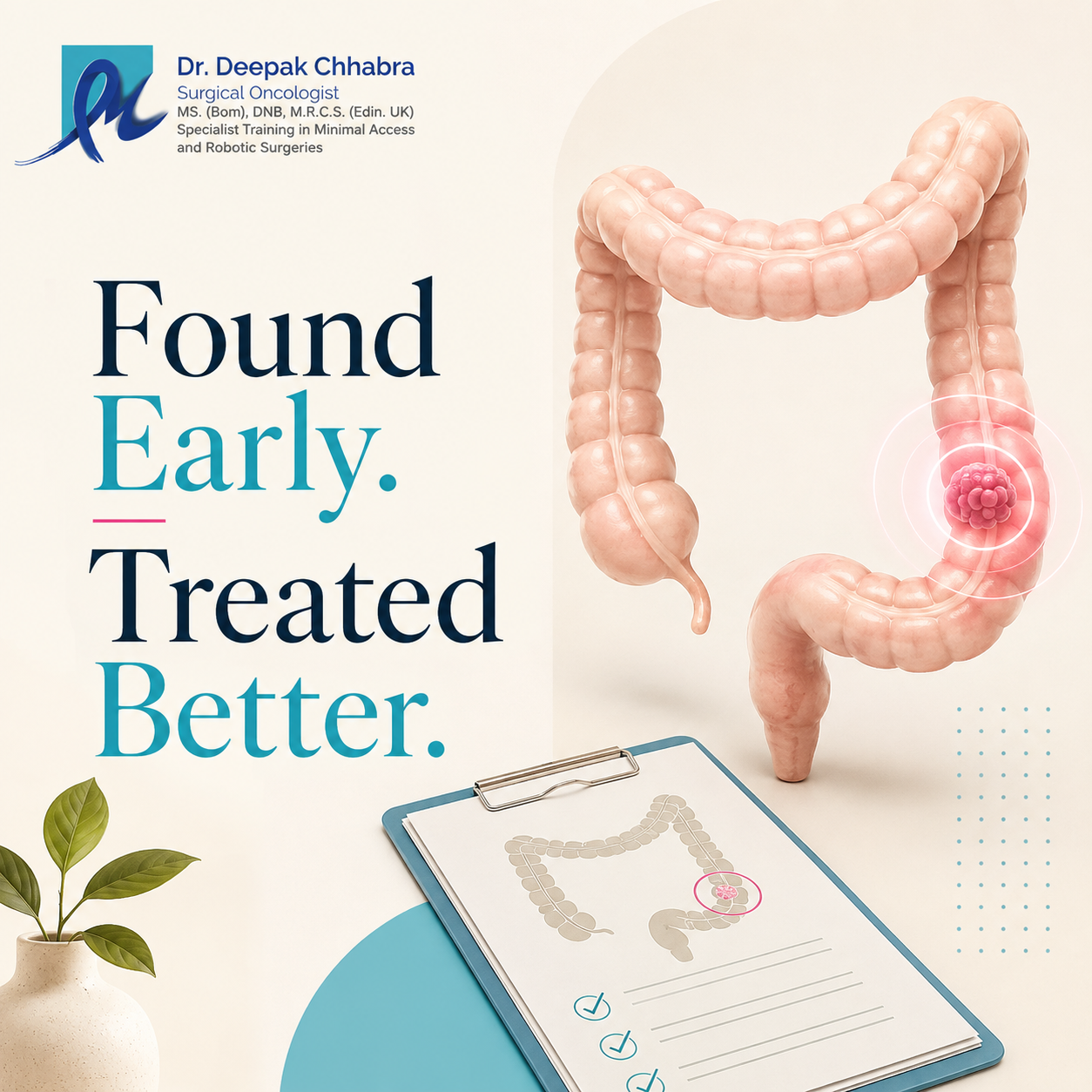
Hearing the word colon cancer is frightening. Hearing that it has been found early can bring a different feeling — hope, but also confusion.
For many families exploring colon cancer treatment in Mumbai, the first question is direct: “If it is early, can surgery remove it completely?” In many early-stage cases, surgery is the main treatment and may control the disease well when the tumour is removed fully and the final reports are favourable.
At Mumbai Cancer, we usually explain this carefully. Early diagnosis is a good opportunity, but it still needs proper staging, surgical planning, lymph node assessment, and follow-up. Patients trying to understand biopsy reports, colectomy, lymph node testing, recovery, and chemotherapy decisions can read more about colon cancer surgery planning after an early diagnosis before discussing the next step with their doctor.
Early colon cancer can often be treated successfully with timely surgery when the disease is limited and the patient is fit for an operation. Surgery removes the cancer-affected part of the colon, and the pathology report then helps confirm whether follow-up is enough or chemotherapy needs to be discussed.
A practical early-stage plan usually checks whether:
This is why early diagnosis should not lead to delay. It should lead to organised treatment planning.
“Early” usually means the cancer appears limited and has not spread widely to distant organs. In some patients, it may be found inside a polyp. In others, it may have grown deeper into the colon wall but still may not have reached lymph nodes.
That difference matters.
A very early cancer inside a polyp may sometimes be managed differently from a tumour that has grown into the colon wall. A cancer with clear lymph nodes may need a different plan from one where lymph nodes show cancer cells.
So, when a report says early colon cancer, patients should feel encouraged — but they should still get the stage confirmed properly. The word “early” is not the full treatment plan. It is the starting point for the plan.
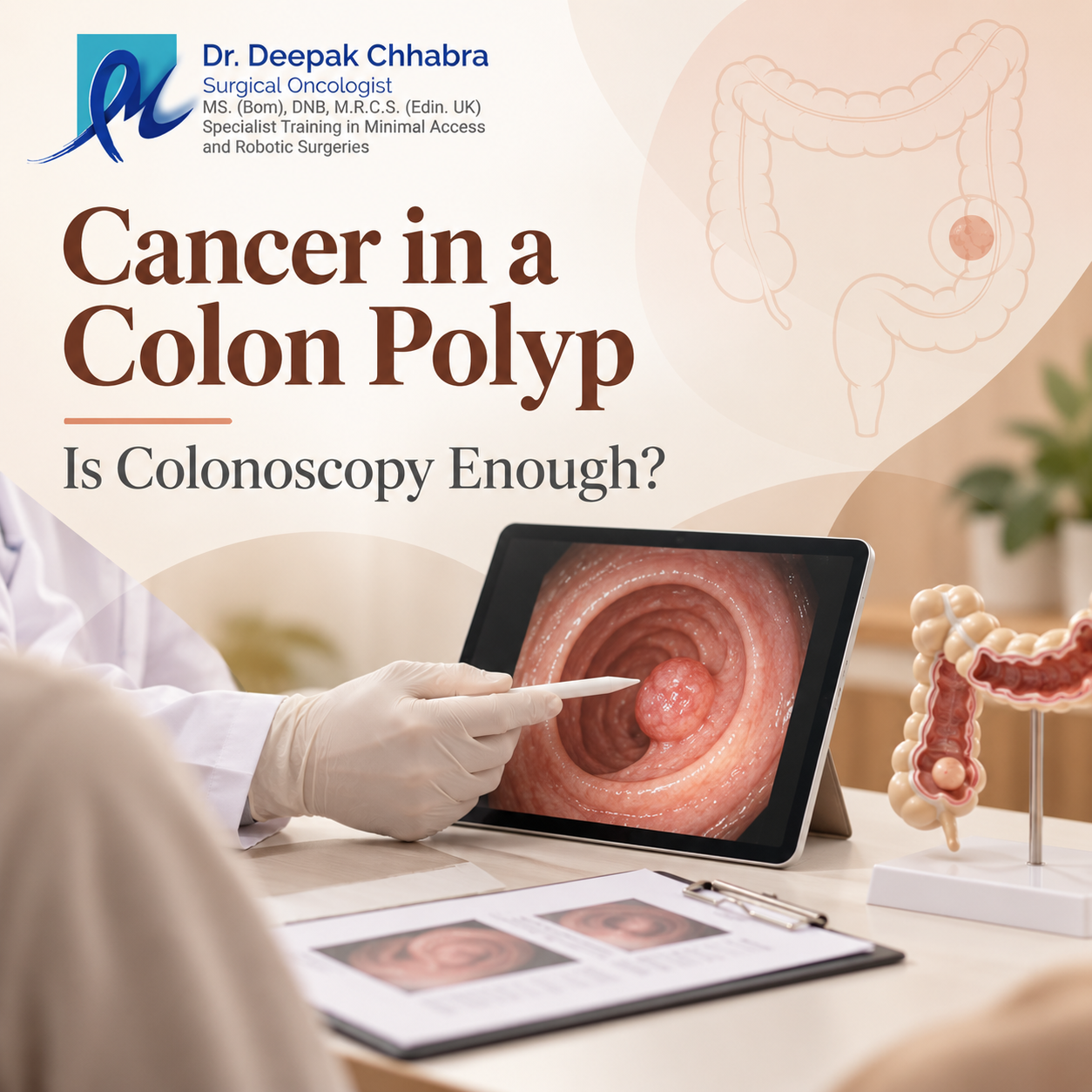
The American Cancer Society explains that surgery is often the main treatment for early-stage colon cancers, and some very early cancers or polyps may be removed during colonoscopy in selected cases.
Many patients think surgery only means removing the visible tumour. That is only part of the story.
Colon cancer surgery also gives doctors the clearest staging information. After the tumour-bearing part of the colon is removed, the tissue is examined in detail. The pathology report tells the team how deep the tumour had grown, whether the margins are clear, how many lymph nodes were removed, and whether any of those nodes contain cancer cells.
This is why surgery often decides the next step.
A family may feel relieved after the tumour is removed. That relief is natural. But the final treatment decision usually becomes clearer only after the pathology report comes back.
The common operation for colon cancer is called a colectomy. In simple language, the surgeon removes the part of the colon affected by cancer, along with a small margin of healthy tissue and nearby lymph nodes.
After that, the two healthy ends of the bowel are usually joined together. This joining is called anastomosis.
A stoma may be needed in some cases, but it is not automatic for every colon cancer patient. The need depends on tumour location, bowel condition, infection risk, emergency presentation, general fitness, and surgical judgment.
The National Cancer Institute describes partial colectomy as removing the cancer with a small amount of healthy tissue around it, and states that nearby lymph nodes are usually removed and examined under a microscope.
For patients, this means the operation has two aims: remove the disease safely and give the team the information needed for the next decision.
Lymph nodes are small immune structures near the colon. Colon cancer cells can sometimes reach these nearby nodes before spreading elsewhere.
This is why lymph nodes are removed during surgery.
Sometimes scans do not clearly show lymph node involvement. A node may look normal but still contain microscopic cancer cells. The pathology team checks these nodes carefully after surgery.
If the nodes are clear, chemotherapy may not be needed in selected early-stage cases. If cancer is found in the nodes, the stage changes, and chemotherapy is more likely to be discussed.
This is often the point where patients understand why surgery was needed even when the cancer looked early. The operation removes the tumour, but the lymph node report helps decide whether the body needs further treatment support.
Chemotherapy is not automatic after early colon cancer surgery.
In some stage I cases, surgery alone may be enough. In selected stage II cases, chemotherapy may not be advised when the tumour has been fully removed, lymph nodes are clear, and high-risk features are absent.
The final pathology report guides this decision.
High-risk features may include deeper tumour invasion, bowel blockage, perforation, poor tumour grade, lymphovascular invasion, perineural invasion, or too few lymph nodes examined. Patients do not need to remember all these terms. What matters is that the treating doctor explains whether any of these findings are present.
This is why the post-surgery visit is often where families finally understand whether the operation was the full treatment or whether another step is needed.
Early colon cancer usually gives doctors a better window to plan treatment properly. That does not mean the patient must rush into surgery without preparation. It also does not mean the patient should keep waiting because they feel physically well.
Colon cancer can be quiet in the beginning. Some patients have bleeding, altered bowel habits, unexplained anaemia, abdominal discomfort, or weight loss. Others may have very few symptoms.
Once cancer is confirmed, the next step should be structured: complete staging, fitness evaluation, surgery planning, and clear counselling about recovery. For patients planning colon cancer surgery in Mumbai, the most useful consultation is one where the surgeon explains both tumour removal and what the lymph node report may decide afterward.
That gives the family a real pathway, not just a procedure date.
Recovery after colon cancer surgery happens in stages.
In the hospital, doctors monitor pain control, bowel movement, diet tolerance, wound healing, fever, infection, and signs of leakage. Food is usually restarted gradually, depending on how the bowel begins working again.
At home, tiredness is common. Appetite may take time to return. Bowel habits can change for a while. Walking, hydration, protein intake, wound care, and follow-up visits all matter.
The recovery period is also when the final pathology report is reviewed. That report decides whether the next step is follow-up alone or a chemotherapy discussion.
Patients should not treat the first follow-up visit as a routine wound check. It is often the visit where the long-term treatment plan becomes clearer.
After an early diagnosis, the patient’s next step should be practical.
Carry the colonoscopy report, biopsy report, CT scan images, blood tests, CEA report if done, current medicines, and details of diabetes, blood pressure, heart disease, kidney disease, blood thinners, or previous abdominal surgery.
A colon cancer specialist in Mumbai can review these details and explain whether surgery should be planned first, whether another test is needed, and what recovery may involve.
This helps avoid two common mistakes.
One mistake is delaying treatment because the patient feels well. The other is rushing into surgery without complete staging and fitness assessment.
The right approach is neither panic nor delay. It is proper planning.
Dr. Deepak Chhabra is associated with surgical oncology and gastrointestinal cancer care. His relevance becomes important when patients need clarity on early colon cancer surgery, lymph node removal, pathology reports, and whether chemotherapy may be needed after surgery.
At Mumbai Cancer, the focus should not be only on saying, “The cancer is early.” The more useful discussion is what the stage suggests, what surgery will remove, what the lymph node report may decide, and how follow-up will be planned.
For someone searching for a colon cancer doctor in Mumbai, this kind of explanation can reduce confusion and help the family take the next step with more confidence.
Early colon cancer can often be treated successfully with surgery when the tumour is removed completely and the cancer has not spread to lymph nodes or distant organs. The final outlook depends on tumour depth, clear margins, lymph node findings, pathology features, and overall fitness. Patients should review the final surgery report with their treating team before assuming whether follow-up or chemotherapy is needed.
Colon cancer surgery should usually be planned without unnecessary delay once staging tests, fitness checks, and pre-surgery preparation are complete. Emergency symptoms such as bowel blockage, severe bleeding, perforation, or infection may change the timeline. Patients should ask what must be completed before surgery and whether any pending test changes the plan.
Tests before surgery commonly include colonoscopy biopsy, CT scan, blood tests, anaesthesia fitness assessment, and sometimes CEA tumour marker testing. The exact workup depends on tumour location, symptoms, age, medical history, and whether spread is suspected. Patients should carry printed reports and scan images for a proper surgical opinion.
Everyone does not need chemotherapy after colon cancer surgery. Chemotherapy is considered based on final stage, lymph node involvement, high-risk pathology features, margins, and overall fitness. Patients should discuss the pathology report carefully before deciding the next step.
An early colon cancer diagnosis is frightening, but it can also create a real opportunity for timely treatment.
The patient does not have to decide alone whether surgery will cure the cancer. The better step is to confirm staging, meet a qualified cancer surgeon, understand what the operation will remove, and review the final pathology report before deciding whether chemotherapy is needed.
A consultation with Dr. Deepak Chhabra through Mumbai Cancer may help patients and families understand the next step with more clarity, especially when colon cancer has been found early and surgery is being considered.
Medical Disclaimer:
This article is for general educational purposes only and should not replace medical advice, diagnosis, or treatment. Colon cancer treatment decisions depend on tumour location, stage, biopsy findings, scan reports, lymph node involvement, pathology features, age, fitness, and multidisciplinary medical evaluation. Please consult a qualified surgical oncologist, colorectal surgeon, medical oncologist, or treating cancer team for personalised guidance.
Stay up-to-date with the latest developments in cancer research, treatment, and patient stories through our curated collection of cancer blogs and news articles. From breakthrough discoveries to inspiring survivor journeys.
Discover first hand accounts from patients who have experienced compassionate care and expert treatment at our clinic. Read their reviews to get to know their journey.

5 Out of 5 from 92 Reviews




 VIDEO CONSULTATION
 Phone Calls
 Physical visit