
“I’m still eating, so why am I losing weight?”
It is a question that can come up when pancreatic cancer surgery is being planned. Some patients notice that their appetite has fallen, but others feel they are eating reasonably well and are still losing weight or becoming physically weaker.
That is one reason nutrition before pancreatic cancer surgery deserves attention. Pancreatic cancer can affect how much a person eats, how well food is digested and absorbed, and how much muscle and physical reserve remain before a major operation.
For patients researching pancreatic cancer treatment in Mumbai, nutritional assessment is only one part of a broader surgical evaluation. Dr. Deepak Chhabra’s overview of pancreatic cancer surgical care explains how staging, resectability and treatment planning fit together. Pancreatic cancer surgical care
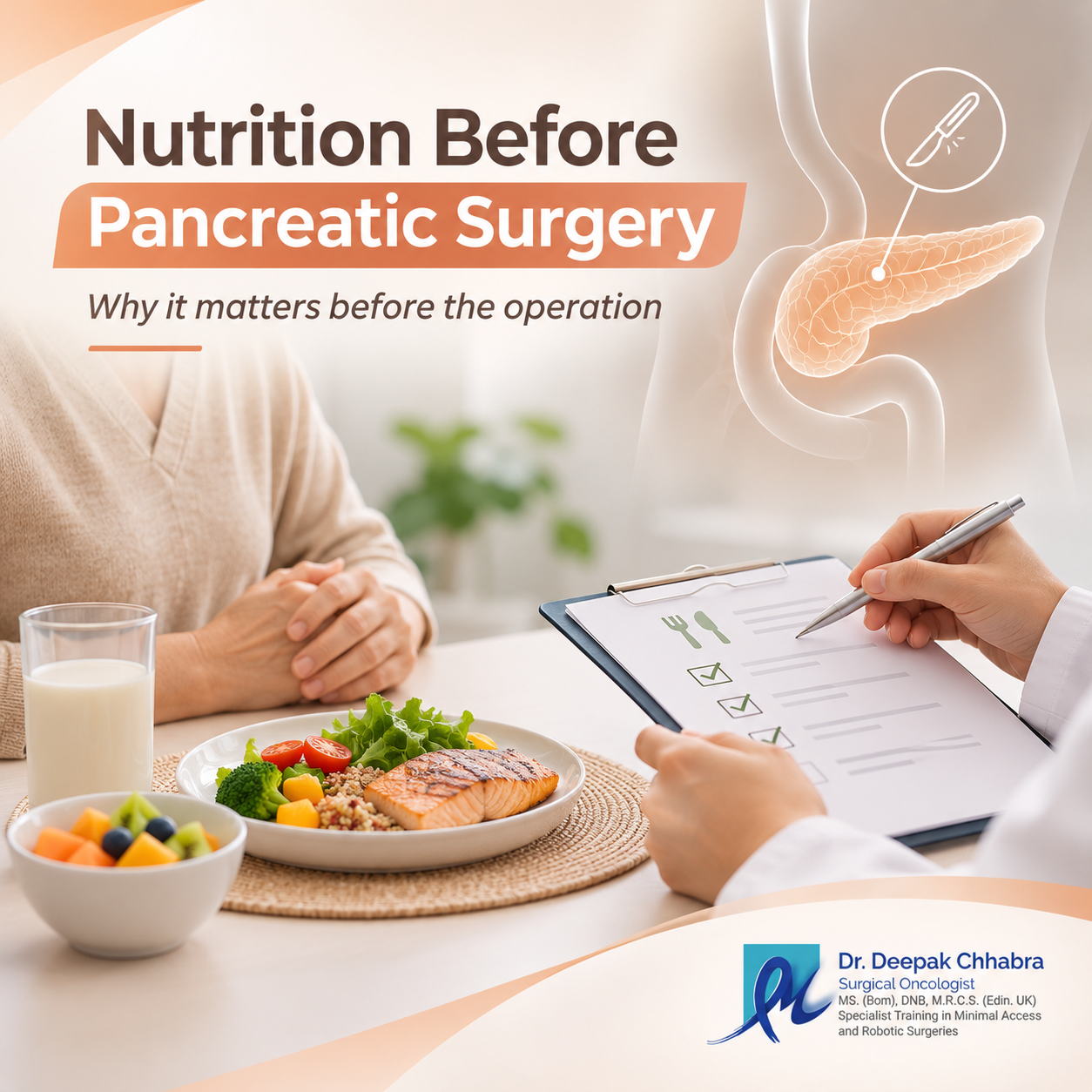
Doctors assess nutrition before pancreatic surgery because the disease can affect appetite, digestion, body weight and muscle reserve even before the operation takes place. Finding significant weight loss, poor intake, or impaired digestion early gives the team a chance to understand the cause and decide whether anything can reasonably be improved before surgery.
The assessment may include:
Doctors are not trying to make every patient reach an “ideal” weight before surgery. They are looking for problems significant enough to affect preparation, recovery or postoperative nutritional care.
Weight loss in pancreatic cancer is often more complicated than simply “not eating enough.”
Poor appetite, nausea, pain, chemotherapy, anxiety and fatigue can all reduce food intake. The tumour itself may also interfere with digestion because the pancreas normally releases enzymes that help the body break down fats, proteins and carbohydrates.
If too few of these enzymes reach the intestine, food may not be digested and absorbed normally. This is called pancreatic exocrine insufficiency, or PEI.
The National Cancer Institute notes that exocrine insufficiency can cause malabsorption and contribute to malnutrition in pancreatic cancer, and that pancreatic enzyme replacement can help address this problem in appropriate patients.
That is why telling a patient simply to “eat more” may miss part of the problem.
Imagine a patient who says they are still eating close to their usual amount but have lost six kilograms over the past two months. They have also noticed more frequent bowel movements and stools that sometimes look oily, float or are difficult to flush.
Adding extra calories may help if intake is inadequate, but those symptoms also raise a different question: is the patient digesting and absorbing the food normally?
PEI cannot be diagnosed from symptoms alone. Current European guidance recommends considering the overall clinical picture, including symptoms and nutritional status, with appropriate testing where necessary. Pancreatic enzyme replacement therapy is a cornerstone of treatment when PEI is present.
This is a good example of why a nutrition review needs to look at more than the number on the weighing scale.
Two patients can lose the same amount of weight and be affected very differently.
Someone may still fall within a “normal” BMI range but have lost a meaningful amount of muscle during diagnosis or chemotherapy. The change often becomes obvious in ordinary activities before it is obvious in a photograph or weight chart.
Walking takes more effort. Stairs become harder. Getting out of a chair feels different. A short outing that was easy a few months earlier leaves the patient exhausted.
These details give the team information about functional reserve—how much physical capacity the patient has going into a demanding operation.
Current perioperative nutrition guidance recognises malnutrition and underfeeding as risk factors around major surgery and recommends beginning nutritional therapy when nutritional risk becomes apparent rather than waiting until after the operation.
A reduced appetite can have several causes in pancreatic cancer, and the right response depends on which of them is affecting the patient.
Pain may make meals unpleasant. Chemotherapy can alter taste or cause nausea. Some patients feel full after only a few mouthfuls, while others avoid particular foods because they seem to worsen bloating or diarrhoea.
A dietitian can help work through these patterns and find practical ways to improve intake. That might involve smaller meals, changes in meal timing, increasing energy or protein density, or adjusting food choices around symptoms.
If digestion appears to be impaired, however, simply adding protein drinks may not address the underlying issue. Pancreatic enzyme insufficiency may need to be considered separately.
This distinction makes nutritional care much more useful than giving every surgical patient the same list of foods.
A preoperative dietitian assessment is usually practical rather than complicated.
The dietitian may review recent weight change, usual meals, protein and calorie intake, digestive symptoms and whether the patient can realistically meet nutritional needs through normal food.
Some people require only small dietary adjustments. Others may benefit from oral nutritional supplements because they are unable to eat enough. A smaller group of higher-risk patients may require more structured nutritional support.
The updated ESPEN guideline on clinical nutrition in surgery recommends integrating nutrition into the overall management of major surgical patients and starting nutritional therapy early when nutritional risk is identified.
That is different from prescribing supplements simply because someone has cancer.
A Whipple procedure is a major operation usually performed for selected tumours in the head of the pancreas. It involves removal of the tumour-bearing pancreatic head together with connected structures, followed by reconstruction of the digestive tract.
By the time surgery is planned, some patients have already been through weeks or months of jaundice, reduced appetite, chemotherapy, digestive symptoms or weight loss.
The nutritional starting point therefore matters.
The team may want to know whether the patient is maintaining food intake, whether there is evidence of PEI, how much muscle or strength has been lost, and whether significant deficiencies can be addressed within the available preoperative period.
Current perioperative nutrition literature also recognises pancreatoduodenectomy as one of the upper gastrointestinal operations in which high-risk or malnourished patients may require more structured nutritional support.
The objective is not to postpone surgery until every nutritional measurement becomes normal. It is to recognise clinically important problems early enough to plan around them.
Distal pancreatectomy is different from a Whipple procedure because it removes the body or tail of the pancreas rather than the pancreatic head.
The operation does not involve the same digestive reconstruction, but preoperative nutrition can still matter. Some patients have already experienced weight loss or poor intake, and pancreatic function may already be affected before surgery.
The amount of functioning pancreas that remains afterwards also varies from patient to patient.
For that reason, doctors do not treat all pancreatic operations as nutritionally identical. The assessment should reflect the individual patient, the tumour, the planned procedure and what digestive or metabolic problems are already present.
There is no supplement that should be presented as a treatment for pancreatic cancer or as a guarantee of a better surgical outcome.
That distinction is particularly important because patients often receive well-meaning recommendations from relatives, social media or online support groups. High-protein drinks, vitamins and various “immune” supplements can quickly accumulate.
If a patient is unable to meet nutritional requirements through normal food, an oral supplement may be useful. If a specific deficiency is identified, replacing it may also be appropriate.
But the reason for using a supplement should be clear.
Patients should also tell the surgical team about herbal remedies, vitamins and non-prescription products. Some can interact with medicines, affect blood clotting or create problems around surgery.
Not automatically.
If significant nutritional problems are found, doctors have to balance the potential benefit of improving them against the need to keep cancer treatment moving.
Sometimes there is a natural window during staging, chemotherapy or routine surgical preparation in which food intake, enzyme insufficiency or another nutritional issue can be addressed without changing the treatment timeline.
In other cases, waiting several additional weeks may offer little benefit.
The decision therefore depends on the severity of the nutritional problem, how quickly it can reasonably improve, the type of operation being planned and the urgency of the cancer treatment.
A nutrition assessment should support cancer care, not create an arbitrary delay.
Patients do not need to arrive with detailed nutrition calculations.
Simple observations are often more useful. Tell the team how much weight has been lost and roughly when the loss started. Mention if appetite has changed, meals have become much smaller or certain foods now cause discomfort.
Changes in bowel movements matter too. Oily, floating, pale or unusually difficult-to-flush stools may be relevant, particularly when they occur alongside weight loss.
Also mention whether normal activity has changed. A patient who previously walked comfortably but now struggles with routine activity may have lost physical reserve even if body weight has not changed dramatically.
A pancreatic cancer specialist in Mumbai assessing someone for surgery should consider these changes alongside imaging, staging, previous treatment and general fitness.
For patients seeking another opinion from a pancreatic cancer doctor in Mumbai, it is useful to bring recent weight records, current medication details and information about pancreatic enzymes or nutritional supplements already being taken.
Yes, weight loss can occur in pancreatic cancer, but it should still be assessed rather than dismissed as inevitable. Reduced intake, treatment effects, inflammation and pancreatic exocrine insufficiency can all contribute, sometimes at the same time. Tell the treating team about unintentional weight loss or a noticeable decline in appetite or strength.
Symptoms can include oily or floating stools, diarrhoea, bloating and unexplained weight loss, but symptoms alone cannot confirm the diagnosis. PEI is assessed using the clinical picture, nutritional status and, where appropriate, testing.
There is no single target weight that every patient needs to reach before a Whipple procedure. Doctors are more interested in recent weight loss, food intake, muscle reserve and whether important nutritional problems can reasonably be addressed within the treatment timeline.
Not automatically. Oral nutritional supplements can help selected patients who are unable to meet their needs through food, but they are not required simply because pancreatic surgery is planned. A dietitian or treating team can advise whether supplementation is useful in your particular situation.
Nutrition can seem like a secondary issue when the main concern is pancreatic cancer and a major operation is approaching. In practice, weight loss, digestive problems and loss of strength can tell the surgical team a great deal about how the patient is coping before surgery.
For someone considering pancreatic cancer treatment in Mumbai, the useful question is not simply, “Which foods should I eat before the operation?”
A better discussion is about whether weight has been falling, whether normal meals are still manageable, whether digestion appears to be impaired and whether muscle or physical function has changed.
Those details help the team decide whether anything needs attention before surgery and what nutritional support may be useful afterwards.
That is a much more individual and medically meaningful approach than following a generic “cancer diet.”
This article is intended for general educational purposes only. It does not replace personalised nutritional assessment, diagnosis of pancreatic exocrine insufficiency, cancer staging or surgical advice.
Patients should not delay planned pancreatic cancer treatment, start pancreatic enzymes, use high-dose supplements or make major dietary changes without discussing them with the treating medical team.
Stay up-to-date with the latest developments in cancer research, treatment, and patient stories through our curated collection of cancer blogs and news articles. From breakthrough discoveries to inspiring survivor journeys.
Discover first hand accounts from patients who have experienced compassionate care and expert treatment at our clinic. Read their reviews to get to know their journey.

5 Out of 5 from 92 Reviews











 VIDEO CONSULTATION
 Phone Calls
 Physical visit