
The days after a Whipple operation often come with a difficult wait.
The tumour has been removed, recovery has started, and then everyone waits for the final pathology report.
For many families, the first question is straightforward: “Did the surgery remove all the cancer?”
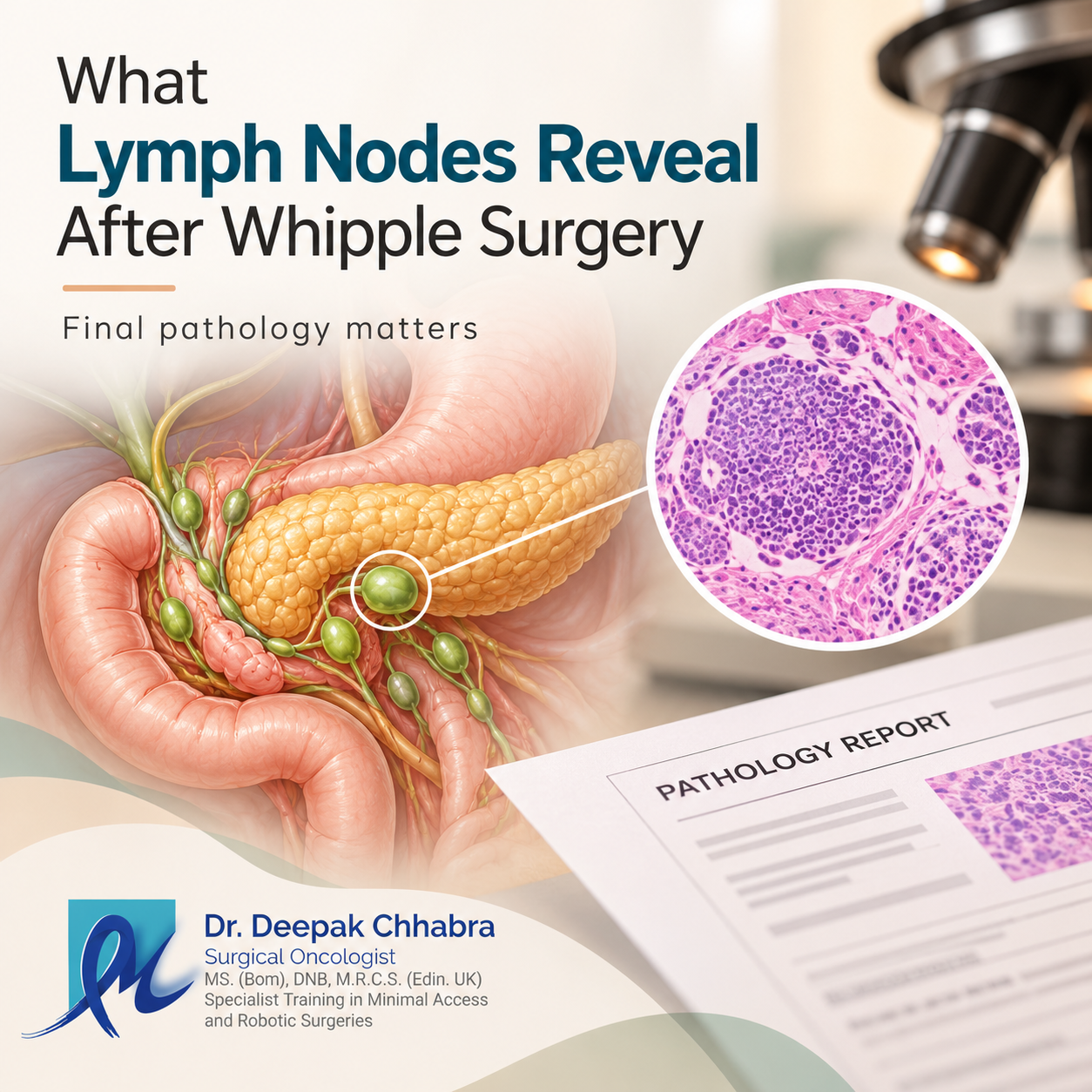
The pathology report helps answer part of that question, but it also tells doctors things that could not be known with certainty before surgery. It shows what the tumour looked like under the microscope, whether cancer cells reached the edges of the removed tissue, and whether any of the nearby lymph nodes contained cancer.
Those lymph node results after Whipple surgery matter because they help describe how far the disease had travelled locally and contribute to the final pathological stage.
For patients considering pancreatic cancer treatment in Mumbai, this report is one part of a much larger treatment pathway. Dr. Deepak Chhabra’s overview of pancreatic cancer surgery and treatment planning explains how diagnosis, surgery and postoperative care fit together.
Lymph nodes removed during a Whipple procedure are examined under a microscope to see whether pancreatic cancer cells have travelled into the nearby lymphatic system.
If cancer is found in one or more of those nodes, the disease is described as node-positive. If none of the examined regional nodes contains cancer, it is node-negative.
The report also looks at much more than the nodes. Doctors usually review the lymph-node findings alongside:
For that reason, one line in the pathology report should never be interpreted in isolation.
Lymph nodes are small structures that form part of the lymphatic and immune systems.
They are connected by tiny lymphatic channels running through tissues throughout the body.
Cancer cells can sometimes use these pathways to move away from the original tumour. In pancreatic cancer, nearby regional lymph nodes are therefore removed during surgery and sent to the pathology laboratory with the main specimen.
A surgeon cannot reliably judge lymph-node involvement simply by looking at a node.
A node may be enlarged because of inflammation and contain no cancer at all. Another may look perfectly ordinary during surgery but still contain a very small deposit of tumour cells.
The microscope gives information that the surgeon’s eye cannot.
A positive lymph node means pancreatic cancer cells were found in that regional node.
That finding contributes to the N category of pancreatic cancer staging.
According to the current TNM framework:
The National Cancer Institute explains how the tumour, regional lymph nodes and any distant spread are combined to determine pancreatic cancer stage. Read the NCI explanation of pancreatic cancer staging.
For patients, however, the practical meaning is easier to understand than the letters.
Finding cancer in nearby lymph nodes tells the medical team that tumour cells had moved beyond the original pancreatic mass into the regional lymphatic system.
It does not automatically mean that cancer has spread to the liver, lungs or another distant organ.
Those are different stages of disease.
A node-negative result is generally reassuring.
It means that the pathologist did not identify cancer in the regional lymph nodes that were examined.
Still, doctors would never use that result to promise that the cancer cannot return.
Pancreatic cancer behaviour is influenced by several factors. The characteristics of the main tumour, margin status, stage and microscopic findings all add information.
So an N0 result is good news.
It simply isn’t the only news in the report.
A pathology report may say something like:
0 of 18 lymph nodes involved
or:
3 of 21 lymph nodes involved
Patients naturally focus on how many were positive, but the total number examined provides useful context for the medical team.
It shows how much nodal tissue was available for pathological assessment.
That number should not become a competition between patients, though.
Someone else’s report may list more or fewer lymph nodes because operations, specimens and anatomy differ. A higher node count by itself does not prove that one surgery was better than another.
The useful interpretation comes from the whole specimen and the quality of the pathological assessment.
Imagine two people who both undergo a Whipple procedure.
Both operations successfully remove the visible pancreatic tumour.
Both patients recover from surgery.
The first pathology report shows clear margins and no cancer in the examined lymph nodes.
The second also shows clear margins, but several regional nodes contain cancer cells.
The operations may sound almost identical when described simply as “Whipple surgery.”
The pathology reports are telling two different stories about the biology and regional spread of those cancers.
That is why the surgeon being able to remove the tumour is only part of the information doctors need.
The tissue removed during surgery then helps reveal what imaging could not show microscopically.
Lymph nodes are only one section of the pathology report.
Another important section describes the surgical margins.
A margin is the edge of the tissue removed during surgery. The pathologist examines those edges carefully.
When no cancer cells are seen at an examined margin, it is generally described as a negative or clear margin.
When cancer cells are present at the edge, the margin is described as positive or involved.
The National Cancer Institute’s guide to pathology reports explains how margin findings and lymph-node status form part of the information used after cancer surgery.
The two findings answer different questions.
The margins tell doctors what was seen at the edges of the removed specimen.
The lymph nodes tell them whether cancer cells had reached the regional lymphatic system.
Both are important, but neither tells the whole story alone.
This is one of the most distressing misunderstandings patients can have when reading their pathology report.
If the report says that a margin is positive, it is easy to imagine that visible tumour was knowingly left behind during surgery.
Microscopic pathology does not work that way.
The surgeon operates using what can be seen, felt and assessed during the procedure. Later, the specimen is processed in the laboratory and examined in very thin sections under a microscope.
Microscopic cancer cells can therefore be found at an edge even when there was no visible tumour left at the end of the operation.
That information then becomes part of the postoperative treatment discussion.
Before an operation, doctors use scans, biopsy findings and other investigations to estimate the cancer stage.
This is the clinical stage.
After surgery, the pathologist can examine the tumour and regional lymph nodes directly.
That gives the team a pathological stage.
Sometimes the two differ.
A lymph node that looked completely normal on a CT scan may contain microscopic cancer cells.
An enlarged node that appeared suspicious before surgery may turn out to be inflamed but free of tumour.
Neither result means the scan “failed.”
Imaging and pathology simply work at different levels.
The scan helps doctors plan treatment before surgery.
The pathology report gives microscopic information that only becomes available after tissue has been removed.
No single line in a pathology report should make that decision on its own.
Lymph-node involvement is important and can influence staging and the discussion of recurrence risk.
But postoperative treatment planning also takes into account the rest of the case.
Doctors may consider whether chemotherapy was given before surgery, what the margins show, the final pathological stage, the patient’s recovery from the Whipple procedure and whether the person is medically fit for further treatment.
The pathology report therefore guides the conversation.
It does not replace clinical judgement.
Pathology reports are written primarily for doctors.
They contain abbreviations, measurements and staging terminology that can be difficult to understand if you are reading the document alone at home.
You do not need to become an expert in pancreatic pathology.
What matters is understanding the major findings and how they fit together.
For someone seeing a pancreatic cancer specialist in Mumbai after Whipple surgery, the consultation should explain the lymph-node findings, the margins, the final stage and whether the report changes the planned next step.
If a patient is seeking a second opinion from a pancreatic cancer doctor in Mumbai, it is useful to take the complete pathology report, not only the discharge summary. The operative note and previous imaging can also help the reviewing doctor understand the full picture.
A Whipple procedure is performed to remove the tumour and the surrounding tissues that need to come with it.
Once those tissues reach the laboratory, they become a valuable source of information.
The pathologist can identify microscopic cancer in a lymph node that looked normal on a scan. The report can confirm the tumour type, measure its extent and show what was found at the margins.
This is why surgery does more than remove visible disease.
It also gives doctors the material needed to understand that disease more precisely.
For patients, that distinction can help make sense of why the treatment conversation continues even after a technically successful operation.
No. Positive regional lymph nodes mean cancer cells were found in nearby lymphatic tissue; they do not automatically prove that cancer has spread to distant organs. The final stage also considers the primary tumour and whether there is evidence of distant metastasis. Your oncology team can explain how the nodal result changes the overall staging.
Yes. No cancer being found in the examined regional lymph nodes is generally a favourable finding. Doctors still consider the tumour itself, surgical margins and other pathological features when assessing recurrence risk and planning follow-up.
A clear or negative margin means the pathologist did not identify cancer cells at the examined edge of the removed tissue. Margin status is interpreted alongside lymph-node findings and the rest of the pathology report. Your surgical team can explain which margins were assessed and what they mean in your case.
No. The pathology report is an important part of postoperative treatment planning, but one result alone should not determine therapy. Previous treatment, pathological stage, lymph nodes, margins, recovery and general health are considered together.
Waiting for pathology after a Whipple operation can feel like waiting for a single verdict.
In reality, the report gives several pieces of information.
The lymph nodes tell doctors whether cancer cells had reached the nearby lymphatic system.
The margins show what was found at the edges of the removed tissue.
The tumour itself provides further information about stage and microscopic behaviour.
Those findings make the most sense when they are read together.
For patients and families, the next step should be a conversation with the surgical and oncology team rather than trying to interpret one line of the report on its own.
The aim is to leave that consultation understanding what the pathology found, what it changes, and what the medical team recommends discussing next.
That is when the pathology report becomes more than a collection of technical terms.
It becomes part of the roadmap for the next stage of pancreatic cancer care.
This article is intended for general educational and informational purposes only. It does not replace personalised medical advice, pathology interpretation, cancer staging or postoperative treatment planning. Lymph-node findings, surgical margins and pathological stage need to be interpreted together with previous treatment, imaging, overall health and specialist clinical assessment. Decisions about chemotherapy, surveillance or additional treatment should be made with the treating pancreatic cancer team.
Stay up-to-date with the latest developments in cancer research, treatment, and patient stories through our curated collection of cancer blogs and news articles. From breakthrough discoveries to inspiring survivor journeys.
Discover first hand accounts from patients who have experienced compassionate care and expert treatment at our clinic. Read their reviews to get to know their journey.

5 Out of 5 from 92 Reviews




 VIDEO CONSULTATION
 Phone Calls
 Physical visit