
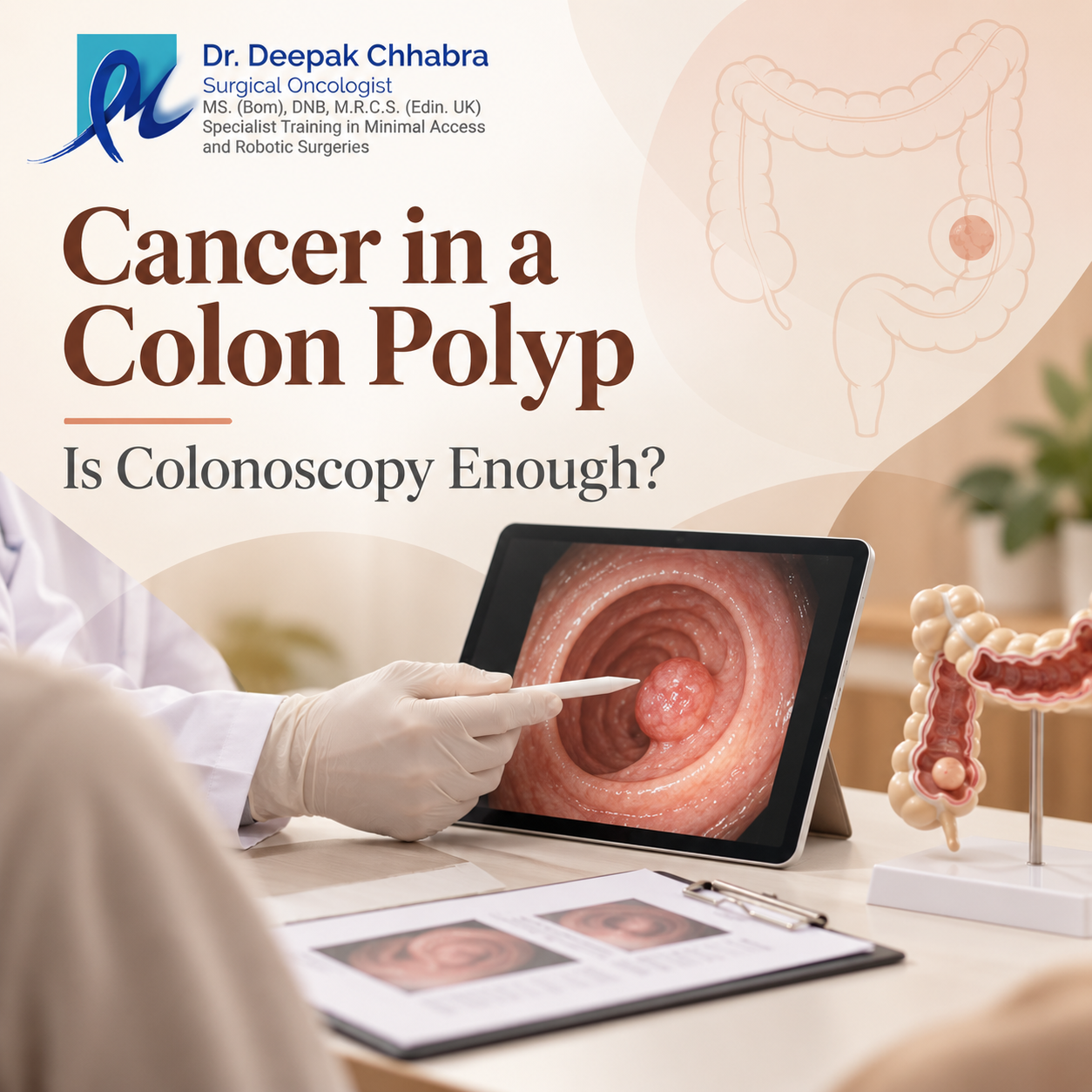
A colonoscopy finds a polyp. The doctor removes it. For a few days, the assumption is that the problem has been dealt with.
Then the pathology report comes back.
Cancer cells were found inside the polyp.
That changes the conversation very quickly. Families often arrive at the next appointment with the same question: “But if the whole polyp was already removed, why are we now talking about colon surgery?”
The answer is that some very early cancers inside a polyp can be adequately treated by complete endoscopic removal. Others carry features on the pathology report that suggest a higher chance of cancer remaining in the bowel wall or having reached nearby lymphatic channels.
The important decision is therefore not simply whether cancer was found. It is whether the removed polyp has the kind of pathology that makes colonoscopy alone a reasonable treatment.
Patients trying to understand the broader treatment pathway can also read about how colon cancer is evaluated and treated before discussing the pathology findings with their treating team.
Complete endoscopic removal may be enough for selected early cancers found inside a colon polyp when the cancer has been removed completely and the pathology shows favourable, low-risk features. If the report shows an involved or uncertain margin, lymphovascular invasion, poor differentiation, significant tumour budding or other higher-risk features, additional colon surgery may be considered.
Doctors usually look at several things together:
One finding rarely tells the whole story.
That is why two patients can both hear, “There was cancer in the polyp,” yet receive very different treatment recommendations.
After the colonoscopy, patients naturally remember what the doctor saw: the size of the polyp, where it was located, whether it looked large or small.
Once invasive cancer is found, the microscope starts to matter just as much.
A pathology report may show a tiny cancer that has been removed with a reassuring margin and none of the features associated with a higher risk of spread. In that situation, further colon surgery may not always add enough benefit to justify an operation.
Another report may look very different. The cancer may extend more deeply into the tissue, come close to the resection edge or show invasion into lymphatic or blood vessels.
Both lesions may have looked like “polyps” during colonoscopy.
Their biological behaviour is not necessarily the same.
Guidance from the US Multi-Society Task Force on Colorectal Cancer, published through the American Society for Gastrointestinal Endoscopy, recognises that malignant colorectal polyps can sometimes be managed after complete endoscopic removal, while certain adverse pathological features increase concern for residual or lymph-node disease. Read the ASGE guidance on malignant colorectal polyps.
The word margin often becomes the focus when families first read the pathology report.
A margin is the edge of the tissue that was removed. Pathologists look at whether cancer cells reach, or come very close to, that edge.
If the margin is clearly free of cancer, that is reassuring. It supports the idea that the cancer-containing tissue may have been removed completely.
If cancer reaches the margin, or the margin cannot be assessed reliably, the situation becomes less certain.
It is worth stressing that margin status should not be interpreted on its own. A clear margin does not erase every other high-risk feature, just as complicated wording around a margin does not automatically mean surgery is unavoidable.
The entire report needs to be read together.
Some polyps can be removed in one piece. Others, particularly larger or technically difficult lesions, may need to be taken out in fragments.
That difference matters when cancer is unexpectedly found afterward.
When the specimen comes out en bloc, or in one piece, the pathologist can often judge the border of the lesion and depth of invasion more confidently.
With piecemeal removal, assessment may be harder because the original orientation of the tissue has been lost.
Think of it like trying to determine whether a stain reached the edge of a sheet of paper after the sheet has already been torn into several pieces. You may still learn a great deal, but the exact border can be harder to reconstruct.
Piecemeal removal does not prove that cancer remains.
It can, however, introduce uncertainty. And uncertainty matters when doctors are trying to decide whether another operation is justified.
Not every cancer-containing polyp carries the same risk.
Certain features of pathology make doctors look more carefully at the possibility that cancer cells may exist beyond the piece that was removed.
These can include:
Lymphovascular invasion
Cancer cells are seen within lymphatic channels or small blood vessels.
Poor differentiation
The cancer cells look less like normal colon cells under the microscope and may behave more aggressively.
Tumour budding
Small groups or individual cancer cells are seen at the advancing edge of the tumour.
Deeper invasion
Cancer has grown further into the submucosal tissue beneath the lining of the colon.
An involved or uncertain margin
There is concern that the endoscopic resection may not have removed all of the invasive cancer.
The importance of individual findings can also vary according to the type and shape of the polyp. Pedunculated polyps, which grow on a stalk, and non-pedunculated or flatter lesions are not assessed in exactly the same way.
This is one reason the pathology report and original colonoscopy findings should be reviewed together rather than treated as two unrelated documents.
This is often the point at which the need for surgery finally makes sense to patients.
A colonoscopy can remove a lesion from the inside of the bowel.
It cannot remove or examine the regional lymph nodes outside the bowel.
Once cancer has invaded deeper tissue, there is a possibility—sometimes very small, sometimes more significant—that malignant cells may have travelled through lymphatic channels.
If the pathology contains high-risk features, that possibility becomes more relevant.
When colectomy is advised, the operation generally involves removing the affected segment of colon along with its associated regional lymph nodes. Those nodes can then be examined under the microscope.
The National Cancer Institute describes colon cancer surgery as removal of the affected section of colon together with surrounding tissue, with nearby lymph nodes commonly removed and examined as part of cancer treatment and staging. See the NCI colon cancer treatment guidance.
So when surgery follows removal of a malignant polyp, it is not simply about cutting out the spot where the polyp used to be.
It may also be about answering a question colonoscopy cannot answer:
Has the disease moved beyond the original polyp?
There is no single pathology word that automatically determines treatment for every patient.
Colectomy becomes more likely to enter the discussion when several features suggest that endoscopic removal alone may not provide enough confidence.
That may include an involved or uncertain resection margin, lymphovascular invasion, poor differentiation, significant tumour budding or deeper invasion into the submucosa.
The patient’s health also matters.
A recommendation that makes sense for a younger, medically fit patient may need to be weighed differently in someone with significant heart, lung or other health problems.
That does not mean age alone decides treatment. It means the potential benefit of further cancer surgery has to be balanced against the risks of undergoing it.
This is where a personalised surgical opinion matters much more than a general rule found online.
Not necessarily.
When complete endoscopic removal is considered adequate, patients usually still need an appropriate surveillance plan.
That might involve follow-up colonoscopy and other review depending on the original lesion, pathology findings and quality of the resection.
The important distinction is:
No colectomy does not mean no follow-up.
Patients should understand why surgery is not being recommended and what surveillance is expected afterward.
If those two points are not clear, the consultation has not answered the most practical questions yet.
A second opinion is much more useful when the specialist can see the original information rather than working from a short summary.
Ideally, bring the complete colonoscopy report, photographs or endoscopic images if available, and the full histopathology report.
If the decision depends heavily on a particular pathology feature, the treating team may sometimes consider whether the original pathology itself needs specialist review.
Patients often arrive carrying multiple blood reports but forget the colonoscopy images or the complete pathology wording. In this situation, those two records can be far more relevant to the surgical discussion.
For someone researching colon cancer treatment in Mumbai, a malignant polyp creates a very specific treatment decision: has the endoscopic removal already achieved enough, or is the risk of residual or lymph-node disease high enough to justify colectomy?
That question cannot be answered from the word “cancer” alone.
A colon cancer specialist in Mumbai may review how the polyp was removed, whether it was pedunculated or flat, what the margin shows, the depth of invasion and whether any higher-risk pathology features are present.
If surgery is being considered, the discussion should then move beyond “Do I need an operation?” to explaining what the operation is expected to achieve and why lymph-node assessment changes the picture.
Dr. Deepak Chhabra works in surgical oncology, including gastrointestinal cancer surgery. The purpose of reviewing a malignant colon polyp should be to make the treatment reasoning understandable—not simply to label one approach as right for every patient.
Patients who search online for the best doctor for colon cancer in Mumbai may naturally be looking for reassurance, but the more useful measure is whether the specialist can interpret the endoscopy and pathology together and explain why surveillance or surgery fits that particular case.
The word early is reassuring, and often rightly so.
But early colon cancer is not one uniform situation.
A tiny focus of invasive cancer removed completely with favourable pathology is very different from a similarly small lesion showing lymphovascular invasion, poor differentiation or uncertain margins.
The size of the original polyp does not settle that question either.
A large polyp is not automatically an aggressive cancer.
A smaller one can still contain invasive disease with features that change treatment.
This is why patients are sometimes surprised when the surgeon spends more time discussing a few lines on the pathology report than the actual centimetres written on the colonoscopy record.
Those lines can be the part that determines what happens next.
Some completely removed, low-risk malignant polyps may not require additional colon surgery. The decision depends on the margin, depth of invasion, lymphovascular invasion, differentiation, tumour budding and whether the specimen could be assessed reliably. The full endoscopy and pathology findings should be reviewed together before surveillance is chosen instead of colectomy.
A clear margin means cancer cells were not identified at the assessed cut edge of the removed tissue. It is a favourable finding, but doctors still consider other features such as depth of invasion and lymphovascular invasion before deciding whether endoscopic removal is adequate. The pathology report should therefore be reviewed as a whole rather than using margin status alone.
Regional lymph nodes are assessed because invasive colon cancer can sometimes spread through lymphatic channels beyond the original polyp. Colonoscopy removes the lesion inside the bowel but does not assess the regional lymph nodes examined during oncological colon surgery. Surgery may be recommended when the pathology suggests that the risk of nodal or residual disease is high enough to justify additional treatment.
No, piecemeal removal does not automatically mean colon surgery is required. It can make it harder for the pathologist to assess the true margin and depth of invasive cancer, which may increase uncertainty when treatment is being planned. The resection method, pathology findings and patient’s overall surgical fitness should be considered together.
Finding cancer after a polyp has already been removed creates an odd situation. The visible lesion is gone, yet the most important part of the decision may only be beginning.
For some patients, the pathology brings genuinely reassuring news. The cancer appears to have been completely removed, the risk features are favourable and careful surveillance may be the appropriate next step.
For others, the microscope raises questions that colonoscopy cannot answer on its own. The margin may be uncertain. Cancer cells may be present in lymphatic channels. The lesion may have invaded more deeply than expected.
That is when colectomy and lymph-node assessment may enter the discussion.
For patients reviewing these findings with Dr. Deepak Chhabra, bringing the original colonoscopy records and full pathology report can make the consultation much more useful. The aim is not to assume that every malignant polyp needs surgery—or that removal of every cancerous polyp means treatment is complete.
The better question is whether the pathology gives enough confidence that nothing more needs to be removed or assessed.
Medical Disclaimer:
This article is intended for general educational purposes only and does not replace personalised medical advice, pathology review, diagnosis or treatment planning. Management of cancer found in a colon polyp depends on the lesion type, depth of invasion, resection technique, margin status, tumour differentiation, lymphovascular invasion, tumour budding, patient health and other clinical factors. Individual cases should be reviewed by an appropriately qualified gastroenterologist, colorectal surgeon or surgical oncologist.
Stay up-to-date with the latest developments in cancer research, treatment, and patient stories through our curated collection of cancer blogs and news articles. From breakthrough discoveries to inspiring survivor journeys.
Discover first hand accounts from patients who have experienced compassionate care and expert treatment at our clinic. Read their reviews to get to know their journey.

5 Out of 5 from 92 Reviews





 VIDEO CONSULTATION
 Phone Calls
 Physical visit