
When a scan report says a pancreatic tumour “looks operable,” most families feel a sudden mix of hope and urgency. That is understandable. But in pancreatic cancer treatment in Mumbai, the real decision is not based on one line in a report; doctors must confirm whether surgery is safe, useful, and timed correctly.
At Mumbai Cancer, we often see patients who come with CT scans, MRI films, PET-CT reports, biopsy results, jaundice history, weight loss, stent details, blood tests, and one urgent question: “Can this cancer be removed?” Patients can also review the detailed information on pancreatic cancer care and surgery planning before meeting the doctor.
A pancreatic tumour may appear removable, but doctors usually confirm five things before advising surgery: tumour location, blood vessel contact, spread outside the pancreas, patient fitness, and response to treatment if chemotherapy has already started. These checks help decide whether surgery should happen first, after chemotherapy, or not at that stage.
The five key checks are:
|
Check |
What doctors review |
Why it matters |
| Tumour location | Head, body, or tail of pancreas | Decides whether Whipple or distal pancreatectomy may be discussed |
| Vessel contact | Relation to major arteries and veins | Can change whether surgery is upfront or delayed |
| Spread | Liver, peritoneum, distant lymph nodes, lungs | Surgery may not be useful if disease has spread widely |
| Patient fitness | Nutrition, jaundice, diabetes, organ function, stamina | A removable tumour still needs a fit patient |
| Treatment response | Repeat scans, symptoms, CA 19-9 trend where relevant | Chemotherapy response can change the surgical plan |
The National Cancer Institute explains that treatment options for resectable or borderline resectable pancreatic cancer may include neoadjuvant therapy and radical pancreatic resection, which is why timing and sequence need careful review.
This is one of the most common questions families ask.
For a patient, the word “operable” feels like a green signal. It gives relief. It also creates pressure because the family may start thinking that surgery must happen immediately.
But pancreatic cancer is different. The pancreas lies deep inside the abdomen and sits close to the bile duct, duodenum, stomach, liver, small intestine, and major blood vessels. A tumour may look removable at first glance, but the surgeon still needs to understand whether removal can be done safely and whether surgery is the right first step.
A patient may ask, “If the tumour is touching a vein, does that mean surgery is impossible?”
A caregiver may ask, “The jaundice has reduced after stenting. Can we go straight for surgery now?”
Another family may say, “One doctor advised chemotherapy first. Does that mean the cancer is worse?”
These are not casual doubts. They are treatment-defining questions. A good pancreatic cancer specialist in Mumbai should be able to explain what is clear, what is uncertain, and what needs review before deciding the next step.
The first surgical question is the location of the tumour.
A tumour in the head of the pancreas is usually planned differently from a tumour in the body or tail. This matters because the operation, reconstruction, risks, recovery pattern, digestive changes, and diabetes concerns may differ.
For cancers in the head of the pancreas, doctors may discuss a Whipple procedure, also called pancreaticoduodenectomy. For tumours in the body or tail, distal pancreatectomy may be considered. Cancer Research UK explains that distal pancreatectomy removes the body and tail of the pancreas, while surgery for cancers in the head of the pancreas involves a different operation.
This is why patients should not only ask, “Can surgery be done?” They should also ask, “What type of pancreatic operation is being considered, and why?”
The answer depends heavily on anatomy.
This is often the most sensitive part of pancreatic cancer surgery planning.
The pancreas is close to important blood vessels such as the portal vein, superior mesenteric vein, superior mesenteric artery, hepatic artery, and celiac axis. The surgeon studies whether the tumour is near a vessel, touching it, narrowing it, partly surrounding it, or fully encasing it.
These details can decide whether the case is clearly resectable, borderline resectable, locally advanced, or not suitable for surgery at that moment.
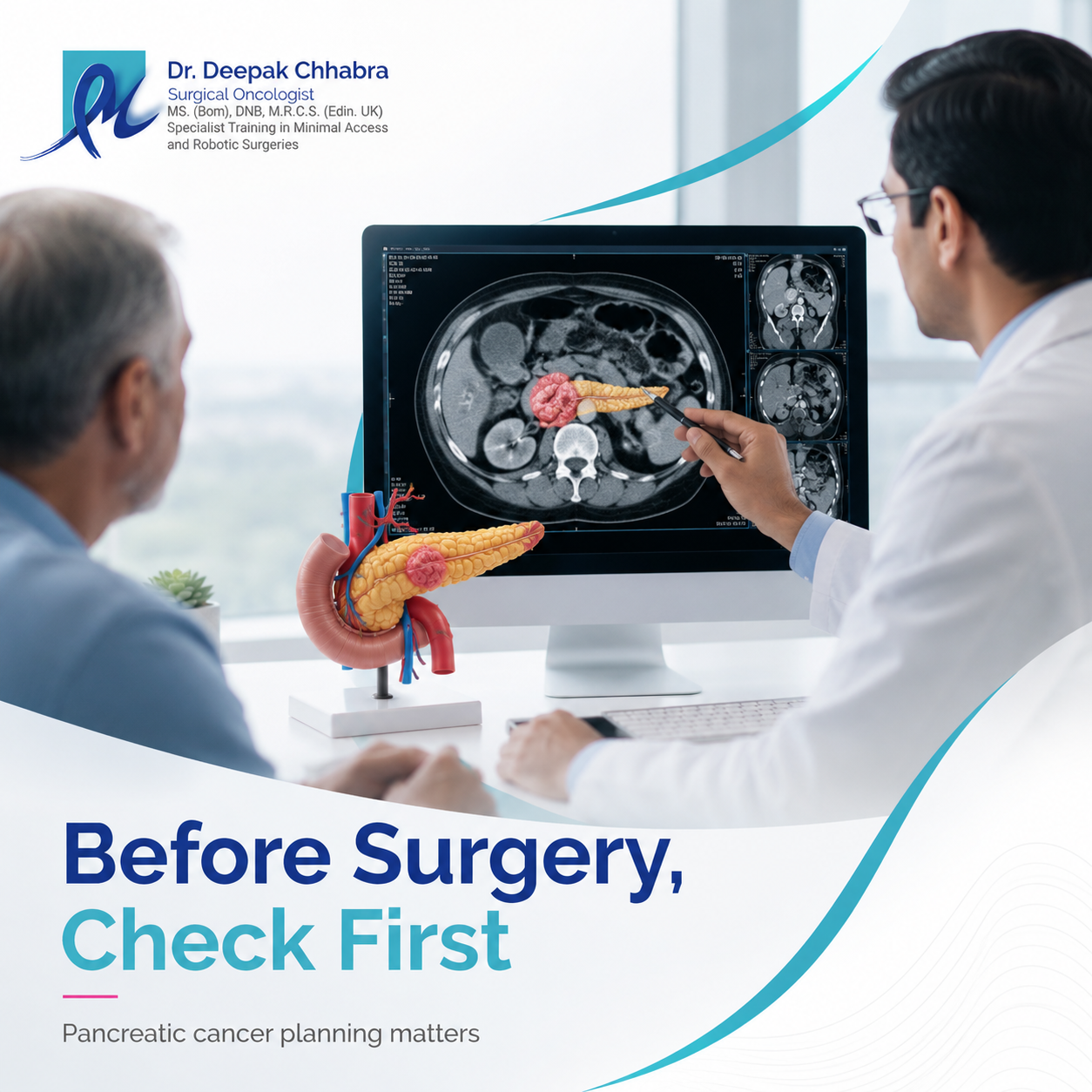
A printed scan report may use terms like “abutment,” “encasement,” or “vascular involvement.” But the final surgical judgment often needs direct CT/MRI image review, not only the written report.
A pancreatic cancer surgeon in Mumbai may ask to review the scan images directly because vessel contact is not always fully clear from the printed summary alone. That is not a delay for the sake of delay. It is a safety step.
Before planning surgery, doctors also check whether cancer has spread beyond the pancreas.
This may involve contrast-enhanced CT, MRI in selected cases, PET-CT when appropriate, blood tests, and sometimes staging laparoscopy depending on the clinical situation. The liver, peritoneum, distant lymph nodes, lungs, and other possible sites are reviewed carefully.
If spread is found, the role of surgery may change. Surgery may not be the first step. In some situations, chemotherapy, biliary drainage, symptom control, nutrition support, or another treatment plan may be safer and more meaningful.
This can be hard for families to hear, especially after being told the tumour “looked operable.” But a major operation should have a clear purpose. If surgery cannot offer meaningful disease control or safe benefit, the plan must change.
Pancreatic surgery is not minor surgery. Even when the tumour is technically removable, the patient’s body must be ready.
Doctors review weight loss, appetite, albumin level, haemoglobin, liver function, kidney function, diabetes control, heart condition, infection risk, jaundice, and general stamina. Severe weakness, uncontrolled sugar, infection, or poor nutrition can increase surgical risk.
Sometimes, the safer plan is to first improve nutrition, control diabetes, treat infection, relieve jaundice through stenting, or allow the body to recover from previous treatment.
Families often focus only on the tumour. Surgeons have to focus on both — the tumour and the patient carrying it.
That difference matters.
Chemotherapy before surgery may be advised in selected pancreatic cancer cases, especially when the tumour is close to major vessels, appears borderline resectable, or when the team wants to understand tumour biology before attempting a difficult operation.
This does not automatically mean surgery is impossible. In some patients, treatment before surgery may make the operation safer or more meaningful. In others, if the cancer progresses despite treatment, it may show that surgery is unlikely to help as expected.
Doctors may review response through repeat scans, symptoms, weight, blood tests, CA 19-9 trends where relevant, and overall performance status.
For families, this stage can feel like waiting. Medically, it is often a way of testing whether the cancer is behaving in a way that makes surgery worthwhile.
Speed matters in cancer care. But correct sequencing matters too.
The type of operation depends mainly on tumour location and surgical feasibility.
A Whipple procedure is usually discussed for cancers in the head of the pancreas or nearby region. It is a complex operation because it involves removal and reconstruction around the pancreas, bile duct, duodenum, and sometimes part of the stomach region.
A distal pancreatectomy is usually considered for tumours in the body or tail of the pancreas. Depending on the tumour’s position and blood supply, the spleen may also need to be removed.
These operations are not interchangeable. A pancreatic cancer doctor in Mumbai should explain why one operation is being considered, what structures may be removed, what risks are expected, and what recovery may involve.
The patient should leave the consultation understanding more than the operation name. They should understand the reason behind the plan.
A surgical oncology opinion is useful when pancreatic cancer is confirmed or strongly suspected and surgery is being discussed as part of treatment.
It is especially useful when the scan says the tumour may be operable, when vessel contact is mentioned, when jaundice is present, when chemotherapy before surgery has been advised, or when different doctors have suggested different treatment sequences.
Patients should also consider a second opinion before a Whipple procedure or distal pancreatectomy. That does not mean the previous advice was wrong. It means the decision is significant enough to review carefully.
During the consultation, carry the complete file: biopsy report, CT/MRI/PET-CT images, ERCP or stent details, CA 19-9 reports if done, blood tests, discharge summaries, current medicines, and records of chemotherapy or radiation if treatment has already started.
Dr. Deepak Chhabra is a consultant surgical oncologist with focused experience in gastrointestinal and hepato-pancreato-biliary cancer surgery. His role becomes relevant when the surgical decision is not straightforward — for example, when the tumour is near major vessels, when chemotherapy may be needed first, or when the family needs clarity before a major pancreatic operation.
At Mumbai Cancer, the focus is on helping patients understand whether surgery is appropriate, what kind of operation may be considered, what risks need preparation, and how surgery fits into the full treatment sequence.
For pancreatic cancer, this clarity is not optional. A tumour may look removable, but the right decision must also consider stage, biology, fitness, timing, recovery, and the possible need for further treatment.
Doctors decide whether pancreatic cancer surgery is possible by reviewing tumour location, vessel involvement, spread, patient fitness, and treatment response. Contrast CT, MRI, PET-CT in selected cases, biopsy, blood tests, and direct scan review help define whether the tumour is resectable, borderline resectable, or not suitable for surgery at that stage. Patients should bring all scan images and reports for a surgical oncology opinion.
Surgery is not always the first step even when pancreatic cancer looks operable. Chemotherapy may be advised first if the tumour is close to major vessels, appears borderline resectable, or if doctors want to assess disease behaviour before a major operation. The treating team should explain whether the plan is upfront surgery, treatment before surgery, or another approach.
Chemotherapy before surgery may be needed when the tumour is borderline resectable, locally advanced, close to major vessels, or at higher risk of incomplete removal. Doctors usually review responses using repeat scans, symptoms, CA 19-9 trends where relevant, and the patient’s general condition. A good response may make surgery safer or more meaningful in selected cases.
You should carry biopsy reports, contrast CT or MRI images, PET-CT if done, ERCP or stent details, blood tests, CA 19-9 reports, discharge summaries, current medicines, and previous treatment records. Scan images are especially useful because vessel contact and tumour location may not be fully clear from a printed report alone. A complete file helps the surgeon give a more accurate opinion on timing and surgical options.
If a pancreatic tumour “looks operable,” do not treat that phrase as the final answer. Treat it as the start of a careful surgical review.
Ask where the tumour is, how close it is to major blood vessels, whether disease has spread, whether the body is ready for surgery, and whether chemotherapy should come first. Bring the complete file, not just one report.
For patients and families considering pancreatic cancer surgery, a consultation with Dr. Deepak Chhabra at Mumbai Cancer can help turn scattered reports into a clearer, safer treatment plan.
Medical Disclaimer:
This article is for general patient education only and should not be used as a substitute for medical advice, diagnosis, or treatment. Pancreatic cancer treatment decisions depend on individual reports, scan findings, cancer stage, patient fitness, and specialist evaluation. Please consult a qualified surgical oncologist or oncology team for personalised medical guidance.
Stay up-to-date with the latest developments in cancer research, treatment, and patient stories through our curated collection of cancer blogs and news articles. From breakthrough discoveries to inspiring survivor journeys.
Discover first hand accounts from patients who have experienced compassionate care and expert treatment at our clinic. Read their reviews to get to know their journey.

5 Out of 5 from 92 Reviews





 VIDEO CONSULTATION
 Phone Calls
 Physical visit