
You may have been told that a tumour looks operable, only to hear at the next appointment that chemotherapy should come first—or that more specialists need to review the scans before surgery is confirmed.
That change can feel confusing.
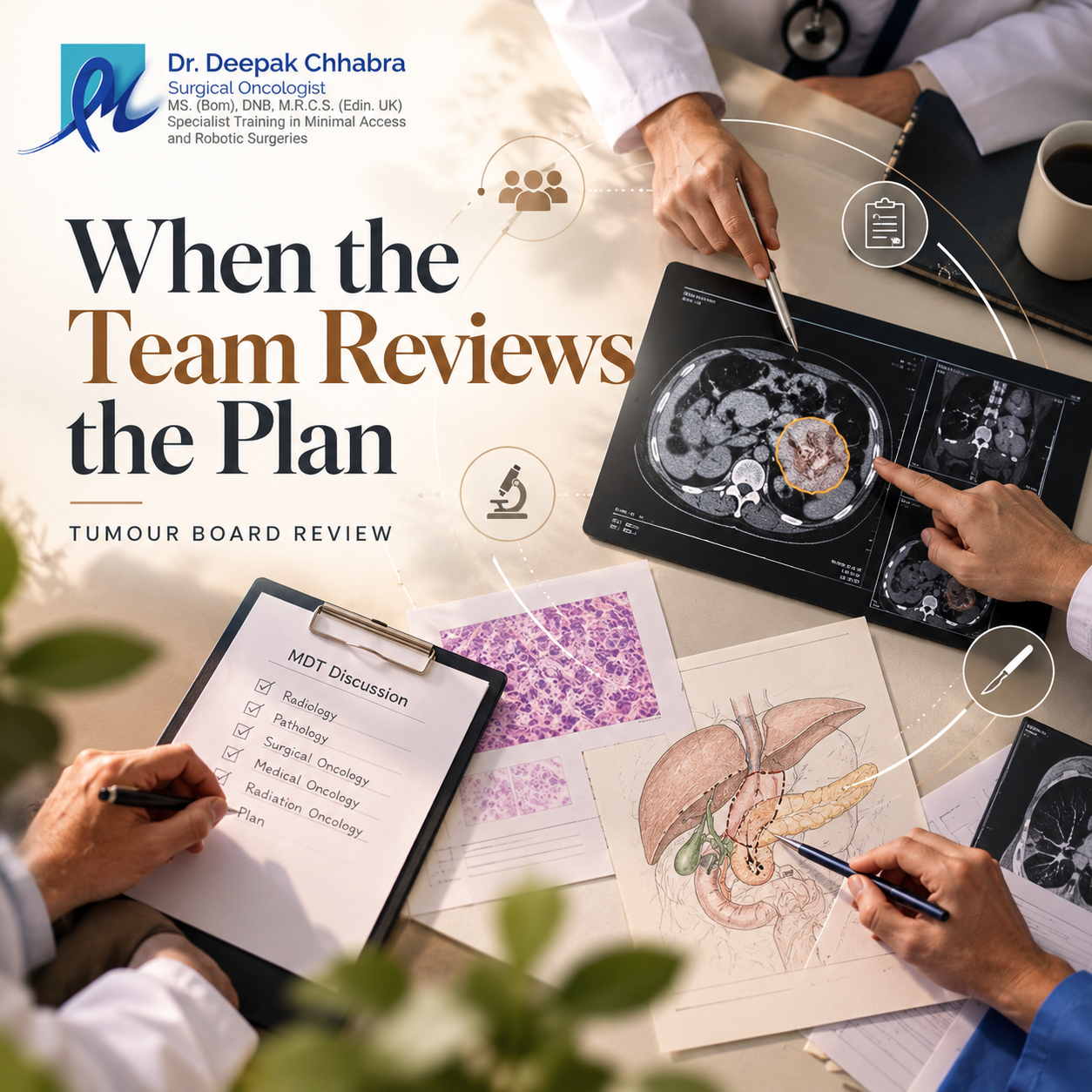
A multidisciplinary tumour board is often where those different pieces of information are brought together. Instead of deciding from one scan or one specialist’s perspective, the team reviews the stage, pathology, imaging, resectability and possible treatment sequence as a whole.
For patients considering major cancer surgery in Mumbai, Dr. Deepak Chhabra’s overview of surgical oncology consultation and treatment planning provides further context on how cancer surgery fits into the broader treatment pathway.
A multidisciplinary tumour board is a structured cancer-planning discussion involving specialists from different disciplines. Its purpose is to decide not simply whether an operation is technically possible, but whether surgery is the right treatment, at the right stage, and in the right sequence.
A review may bring together:
The National Cancer Institute defines multidisciplinary cancer care as an approach involving professionals from different specialties, with medical oncology, surgical oncology and radiation oncology among the principal cancer disciplines.
The value comes from combining information that may otherwise be reviewed separately.
This is one of the most useful distinctions for patients to understand.
A surgeon may look at a tumour and believe it can technically be removed. That still does not answer whether the operation should happen immediately.
Suppose imaging shows a pancreatic tumour touching an important blood vessel. The operation may remain possible, but treatment before surgery could improve the overall strategy.
Or consider colon cancer with a suspicious liver lesion. Removing the colon tumour first without understanding the liver finding may not be the best sequence.
In stomach cancer, staging may suggest that chemotherapy should precede gastrectomy. With a gallbladder tumour, pathology from an earlier operation may lead the team to reconsider whether another, more extensive procedure is appropriate.
The decision is therefore bigger than:
“Can the surgeon remove it?”
What the team really needs to know is:
“What sequence gives this patient the most appropriate cancer treatment?”
These terms are often discussed together, which makes them easy to confuse.
Stage describes how far the cancer has spread.
Resectability describes whether the tumour can be removed surgically in an oncologically meaningful way.
Treatment sequence determines whether surgery should happen before, after or between other treatments.
A tumour can be respectable yet still require chemotherapy before surgery.
Another may initially appear difficult to remove because of vessel involvement, then become more suitable for surgery after treatment and repeat imaging.
In a different case, staging may uncover disease elsewhere and show that a large operation would no longer achieve what everyone originally expected.
A tumour-board discussion is useful because these questions are examined together rather than as separate decisions made on different days.
This is where multidisciplinary review becomes more than an administrative meeting.
A scan report may mention possible vessel involvement or an indeterminate lesion.
During a joint review, the surgeon and radiologist can examine the actual images together. A finding that initially sounded minor may prove important to resectability—or the opposite may happen.
Cancer type, grade and other pathological features can influence treatment planning.
Occasionally, a pathology review also answers a more basic question: are two abnormal areas separate cancers, metastatic disease or different processes?
That distinction can completely change the surgical strategy.
A small abnormality in the liver, lung, peritoneum or lymph nodes may need further investigation before anyone commits the patient to a major operation.
After chemotherapy or radiation, repeat imaging may show that the relationship between a tumour and surrounding structures has changed.
That can alter what operation is being considered—or whether surgery remains appropriate.
An operation may make sense anatomically but still carry disproportionate risk for someone with poor nutrition, severe frailty or significant heart or lung disease.
Technical possibility and clinical appropriateness are not always the same thing.
Radiology in cancer surgery is not simply about confirming that a mass exists.
A surgeon may need the radiologist to answer much more precise questions.
Where exactly does the tumour begin and end? Does it contact or encase a major artery or vein? Are nearby lymph nodes suspicious? Is there a small lesion elsewhere that could represent metastatic disease? Has the tumour responded to treatment?
This becomes especially relevant in pancreatic, liver and complex gastrointestinal cancers, where a few millimetres of anatomical involvement may influence the operation being planned.
It is also why a second surgical opinion is often more useful when the patient brings the actual CT, MRI or PET images, not only the written report.
Pathology is sometimes thought of as simply the test that confirms “cancer” or “not cancer.”
In oncology, it often goes further.
Tumour type, grade and selected biological features can influence treatment sequence. A revised pathology interpretation can occasionally alter whether surgery is appropriate or whether another treatment should come first.
The surgeon therefore does not operate on an image alone.
The scan and the tissue diagnosis need to tell a coherent story.
The principles are the same, although the clinical questions differ.
The team may review whether the disease appears resectable, whether systemic treatment should come first, and whether staging laparoscopy would add useful information before gastrectomy.
A straightforward colon tumour may follow a well-established pathway. The situation becomes more complex when there is obstruction, unusual lymph-node disease or a suspicious liver or lung lesion that could affect surgical sequencing.
Here, resectability is often closely tied to major blood vessels. Radiology, surgery and medical oncology therefore need a common understanding of the tumour anatomy before deciding whether surgery should happen first or after treatment.
The operation depends on more than tumour size. The team also considers tumour location, liver function and how much healthy functional liver would remain after resection.
Some gallbladder cancers are discovered unexpectedly after surgery for presumed gallstones. Pathology and staging then determine whether another cancer operation is warranted.
These examples show why “cancer surgery” is not one decision repeated across different organs.
The anatomy, biology and stage change the question each time.
Yes.
A change in plan does not necessarily mean the original doctor was wrong.
Often, the meeting brings together details that had previously been considered separately.
For example, a radiologist may highlight a suspicious lesion that requires additional imaging. The pathologist may clarify tumour biology. The medical oncologist may recommend systemic treatment before surgery. The surgeon may then modify the type or timing of the proposed operation.
The result could be:
That flexibility is part of thoughtful cancer care, not a failure of planning.
ASCO‘s current patient-centred oncology standards explicitly include comprehensive multidisciplinary team-based care and shared decision-making among the elements of high-quality cancer care.
No.
Some cancers present in a straightforward way and follow well-established treatment pathways. A formal meeting for every clinical decision is neither necessary nor practical.
Review becomes particularly useful when uncertainty could materially change treatment.
That may include:
Complexity—not simply the word “cancer”—is what increases the value of team review.
A surgical oncologist’s job is broader than performing the operation.
The surgeon helps determine whether surgery has a meaningful role in the overall cancer strategy, what operation is appropriate and when it should happen.
That requires understanding imaging, pathology, cancer stage, previous treatment and the patient’s physical condition.
For someone searching for a cancer specialist in Mumbai or cancer surgeon in Mumbai, that distinction is useful. Choosing a specialist should involve more than checking whether a particular procedure is offered; the surgical recommendation should make sense within the whole oncology plan.
People also frequently search for the best surgical oncologist in Mumbai or best oncologist in Mumbai. Those labels are subjective. More useful indicators include the doctor’s relevant cancer-surgery experience, training, the complexity of cases managed, hospital affiliations, multidisciplinary working relationships and whether the proposed treatment is clearly explained.
Dr. Deepak Chhabra is a Consultant Surgical Oncologist in Mumbai. His published profile lists GI Surgical Oncology and Robotics fellowship training in Seoul, specialist HPB training at Nagoya University, and clinical work that includes major gastric, pancreatic, liver and colorectal resections.
People searching broadly for an oncologist doctor in Mumbai may also benefit from understanding that oncology includes different disciplines. A patient who primarily needs assessment for a major cancer operation may need surgical oncology expertise, while systemic drug treatment and radiation are managed through other oncology specialties.
This part can easily get lost in technical discussions.
The purpose of multidisciplinary review is to improve the information behind a treatment recommendation.
It does not replace the patient’s decision.
After the review, the treating doctor should still explain:
Personal priorities also matter.
Age, other illnesses, expected recovery, family responsibilities and the patient’s own goals can influence whether a technically possible treatment is acceptable.
Good cancer care still requires shared decision-making.
No. Straightforward cases can often follow established evidence-based treatment pathways without a formal multidisciplinary meeting. Review becomes more useful when stage, resectability, pathology or treatment sequencing is uncertain.
Yes. Combined review of scans, pathology, treatment response or operative risk can show that another treatment should come first or that the proposed operation needs modification. Your treating surgeon should explain exactly what new information changed the recommendation.
The core team commonly includes surgical, medical and radiation oncology together with radiology and pathology. Other specialists are added according to the tumour type and the clinical question being discussed.
No. The recommendation guides the individual consultation but does not replace informed consent or shared decision-making. The next step is to discuss the expected benefits, risks and alternatives with the treating team before making a decision.
Complex cancer surgery is rarely just a technical question of whether a tumour can be removed.
The more useful question is:
Is surgery the right treatment for this cancer, at this stage, and at this point in the treatment sequence?
A tumour-board review can help answer that by bringing imaging, pathology, systemic treatment, radiation considerations and surgical anatomy into the same discussion.
For patients considering a major operation—or receiving conflicting recommendations from different specialists—asking whether multidisciplinary review would add useful information is reasonable.
The aim is not to make the treatment pathway more complicated.
It is to avoid making a major cancer decision while an important part of the picture is still missing.
Medical Disclaimer: This article is intended for general patient education and does not replace personalised medical advice. Whether multidisciplinary review, surgery, systemic treatment or radiation is appropriate depends on the cancer type, stage, pathology, imaging, treatment history, overall health and the patient’s individual circumstances.
Stay up-to-date with the latest developments in cancer research, treatment, and patient stories through our curated collection of cancer blogs and news articles. From breakthrough discoveries to inspiring survivor journeys.
Discover first hand accounts from patients who have experienced compassionate care and expert treatment at our clinic. Read their reviews to get to know their journey.

5 Out of 5 from 92 Reviews





 VIDEO CONSULTATION
 Phone Calls
 Physical visit