
A surgeon may explain that part of the bowel, stomach, pancreas or bile duct has to be removed along with cancer. For most patients, that immediately raises another concern:
“If that part is taken out, how will my body work afterwards?”
That is a very sensible question.
Major cancer surgery is rarely just about taking something away. In many operations, the surgeon is planning two things at the same time: how to remove the cancer appropriately, and how to leave behind an anatomy that can still function safely.
Sometimes that means reconnecting two sections of bowel. Sometimes it means creating a new route for food. In pancreatic or bile-duct surgery, digestive fluids may need entirely new pathways into the intestine.
For someone considering complex surgery with a cancer surgeon in Mumbai, Dr. Deepak Chhabra’s information on complex surgical oncology planning gives broader context on how resection, reconstruction and recovery fit into one surgical strategy.
Reconstruction simply means restoring continuity or function after cancer-bearing tissue has been removed.
The details depend completely on the organ involved.
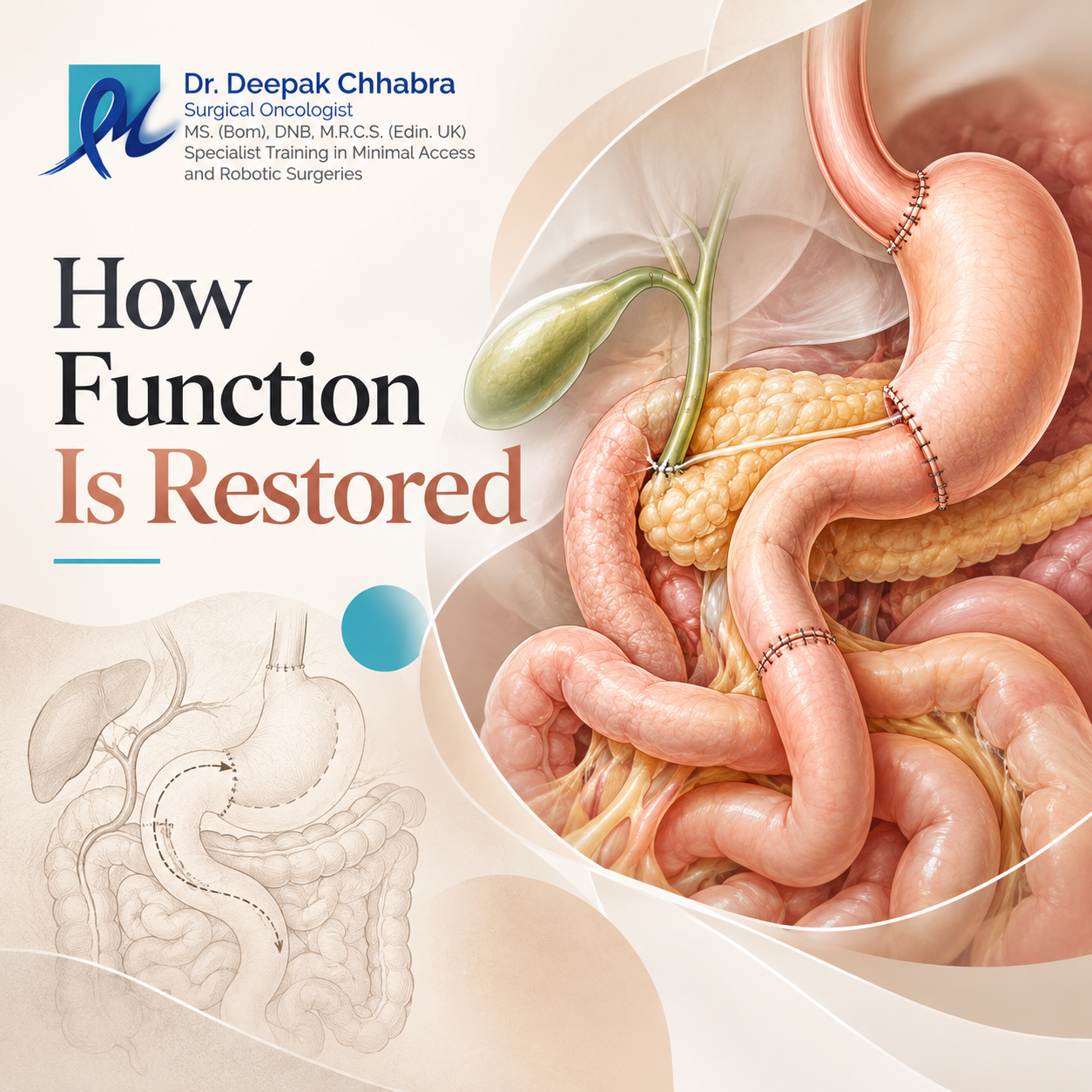
A section of bowel may be removed and the remaining ends joined. After stomach surgery, the food pathway may need to be recreated. If part of the bile duct is removed, bile still needs somewhere to drain. After certain pancreatic operations, the surgeon may need to reconnect the pancreas, bile duct and digestive tract in several different places.
The National Cancer Institute explains that cancer surgery often involves removing the tumour together with a margin of nearby tissue and, when appropriate, regional lymph nodes.
What happens after that removal is just as important.
A technically complete resection is not enough if the remaining anatomy cannot work properly.
Patients sometimes imagine that the tumour is removed first and only then does the surgeon decide how everything will be joined back together.
For planned cancer surgery, reconstruction is usually considered much earlier than that.
CT or MRI scans give the team an idea of where the tumour sits, which organs or vessels may be involved, and what healthy tissue is likely to remain.
From that, the surgeon begins planning not only the resection, but also what happens afterwards.
If a section of bowel needs removal, can the remaining ends reach each other without tension? Will they still have a good blood supply? If the stomach needs partial removal, how will food pass into the intestine? If the bile duct is involved, where will bile drain afterwards?
The answers may change during surgery because scans cannot predict every finding with absolute certainty. But the reconstruction is still part of the operation from the beginning, not an afterthought at the end.
Bowel surgery is probably the easiest example to picture.
If a tumour is confined to a section of the intestine, that segment may be removed along with the appropriate blood supply and lymph nodes. The two healthy ends can often then be joined together.
That join is called an anastomosis.
The name sounds technical. The decision itself is based on very practical factors.
Both ends need healthy circulation. They should come together comfortably, without being stretched. The surrounding tissues need to be in reasonable condition, and the patient needs to be stable enough for the connection to heal.
There are situations where joining the bowel immediately may not be the safest option.
If the bowel has perforated, is badly obstructed, is contaminated or the patient is critically unwell, the surgeon may create a temporary stoma instead.
That can be difficult for a patient to hear, particularly if a stoma was not expected.
But choosing not to make a risky bowel connection can sometimes be the safer surgical judgement—not evidence that something has gone wrong.
Stomach cancer operations can look very different depending on where the tumour is located.
If only part of the stomach is removed, the remaining stomach can usually be joined back to the intestine.
When the entire stomach has to be removed, food can no longer follow its original route. The oesophagus is then connected directly to the small intestine.
Patients often want to know whether they will still be able to eat.
Yes—but eating after major stomach surgery may feel different.
Meals are usually smaller. Fullness can come earlier. Some patients lose weight during recovery and need closer nutritional follow-up while the body adjusts to the new anatomy.
The goal of reconstruction is not to recreate the original stomach exactly. That is impossible once a portion has been removed.
The goal is to create a safe, functioning pathway for nutrition.
The liver produces bile continuously.
Bile normally travels through the bile ducts before entering the small intestine, where it helps with digestion.
If a cancer operation removes part of the bile duct, the liver does not stop making bile simply because the original pathway has gone.
A new route has to be created.
In selected biliary operations, the remaining bile duct is connected directly to the small intestine so bile can continue draining from the liver.
This is a useful way to think about reconstruction: the anatomy may change, but the surgeon is trying to preserve the function that anatomy used to provide.
Pancreatic operations can be more difficult to explain because several structures are involved in a small area.
Take the Whipple procedure.
The operation can involve removing the pancreatic head, duodenum, gallbladder, part of the bile duct and sometimes part of the stomach.
Once those structures are removed, several pathways have to be rebuilt.
The remaining pancreas still produces digestive enzymes. Those enzymes need to enter the intestine.
The liver still produces bile. The remaining bile duct also needs a route into the bowel.
And food needs to continue moving from the stomach into the small intestine.
The American Cancer Society explains that after pancreaticoduodenectomy, the remaining pancreas and bile duct are reconnected to the small intestine, and the digestive pathway is restored so food can continue through the gut.
This is why a complex cancer operation may involve just as much planning for what will remain as for what will be removed.
One of the most important parts of reconstruction is also one of the least visible to patients: blood flow.
A newly created connection needs living, healthy tissue on both sides.
If blood supply is poor, healing becomes less reliable.
That is why surgeons pay close attention to which blood vessels remain after the cancer-bearing tissue is removed.
Tension matters too.
Two pieces of bowel may technically reach each other, but if the join is pulled too tightly, that can create additional risk.
So preserving the maximum amount of tissue is not always the safest objective.
The better aim is to preserve healthy tissue that has good circulation and can function after reconstruction.
Even a detailed CT scan is still a picture taken before the operation.
Once surgery begins, the surgeon can directly assess the tumour, surrounding tissues and blood supply.
Occasionally, the tumour is more extensive than the scan suggested. Sometimes the opposite happens and a structure that looked involved can be preserved.
Previous surgery or inflammation may also change the anatomy.
So a patient may hear before surgery that a bowel reconnection is expected but that a temporary stoma remains a possibility.
Or the planned extent of stomach, pancreatic or biliary reconstruction may need modification.
This is why surgical consent often includes both the expected plan and realistic alternatives.
That is not vague planning. It is acknowledging that the final anatomy can only be fully assessed during the operation itself.
This is usually more important to patients than the technical name of the connection.
A reconstructed digestive system may work well, but it may not behave exactly as it did before surgery.
After bowel surgery, stool frequency can change temporarily or, in some cases, for longer.
After stomach surgery, smaller and more frequent meals may be easier.
After pancreatic surgery, some patients need pancreatic enzyme replacement to help digest food.
A temporary stoma brings another period of adjustment, although reversal may be possible later in selected patients.
Nutrition is often part of the recovery discussion because major gastrointestinal surgery can affect appetite, weight and absorption.
Recovery is therefore not just about waiting for the wound to heal.
It is also about learning how the new anatomy works in day-to-day life.
Cancer names can make treatment sound more standardised than it really is.
Two patients can both have colon cancer, but their tumours may sit in completely different parts of the bowel.
Two stomach cancers may be separated by a large amount of healthy stomach.
Pancreatic and bile-duct cancers can differ by only a small anatomical distance yet require very different operations.
That is why comparing your surgery with another patient’s experience can sometimes create more confusion than clarity.
The plan is based on the exact location of the tumour, the stage, surrounding anatomy and what can safely remain.
The diagnosis gives the operation a category.
The anatomy gives it its actual shape.
The consultation should not leave you knowing only what the surgeon intends to remove.
You should also understand what happens afterwards.
A useful discussion should cover:
Patients searching for a cancer specialist in Mumbai or best surgical oncologist in Mumbai often focus first on names, rankings or the complexity of procedures performed.
Those things do not tell the whole story.
A more useful assessment is whether the surgeon has relevant experience with the specific cancer and operation, whether treatment is being planned in a multidisciplinary setting, and whether the proposed resection and reconstruction can be explained clearly.
Dr. Deepak Chhabra is a Consultant Surgical Oncologist in Mumbai whose published clinical work includes gastrointestinal, hepatobiliary, pancreatic and colorectal cancer surgery.
For a patient, one of the best signs of a well-planned consultation is surprisingly simple:
you should understand why the operation is being done and how your body is expected to function afterwards.
Yes, bowel continuity can often be restored by joining the healthy ends after the tumour-bearing segment is removed. Whether that is safe depends on blood supply, tissue condition, the location of the operation and the patient’s clinical condition. Your surgeon should also explain whether a temporary stoma is a realistic possibility.
A temporary stoma can be safer when an immediate bowel join is considered too risky. Infection, contamination, obstruction, poor tissue condition or the patient’s general health can influence that decision. In selected patients, bowel continuity may be restored during a later operation.
Many patients can eat after stomach or pancreatic surgery, although eating and digestion may work differently. Smaller meals, nutritional support or pancreatic enzyme capsules may sometimes be needed depending on the operation. Follow-up should include weight, digestion and nutritional recovery.
Yes. Imaging helps plan the procedure, but tumour extent, tissue quality and blood supply are confirmed directly during surgery. A good pre-operative discussion should therefore cover the expected reconstruction and the main alternatives that might become necessary.
Cancer surgery is not only a question of:
“What has to be removed?”
There is another question that deserves just as much attention:
“How will everything work afterwards?”
For one patient, the answer may involve a straightforward bowel connection.
For another, it may mean rebuilding the food pathway after stomach surgery.
In pancreatic or biliary surgery, several digestive routes may need to be recreated.
Those are not secondary details added at the end of an operation.
They are part of how complex cancer surgery is planned from the beginning.
Before surgery, patients should leave the consultation understanding both parts of the plan: what needs to come out and how the remaining anatomy is expected to function once the operation is over.
Medical Disclaimer: This article is intended for general patient education and does not replace personalised medical advice or surgical planning. The extent of cancer surgery and reconstruction depends on tumour location and stage, individual anatomy, overall health, previous treatment and findings during surgery.
Stay up-to-date with the latest developments in cancer research, treatment, and patient stories through our curated collection of cancer blogs and news articles. From breakthrough discoveries to inspiring survivor journeys.
Discover first hand accounts from patients who have experienced compassionate care and expert treatment at our clinic. Read their reviews to get to know their journey.

5 Out of 5 from 92 Reviews




 VIDEO CONSULTATION
 Phone Calls
 Physical visit