
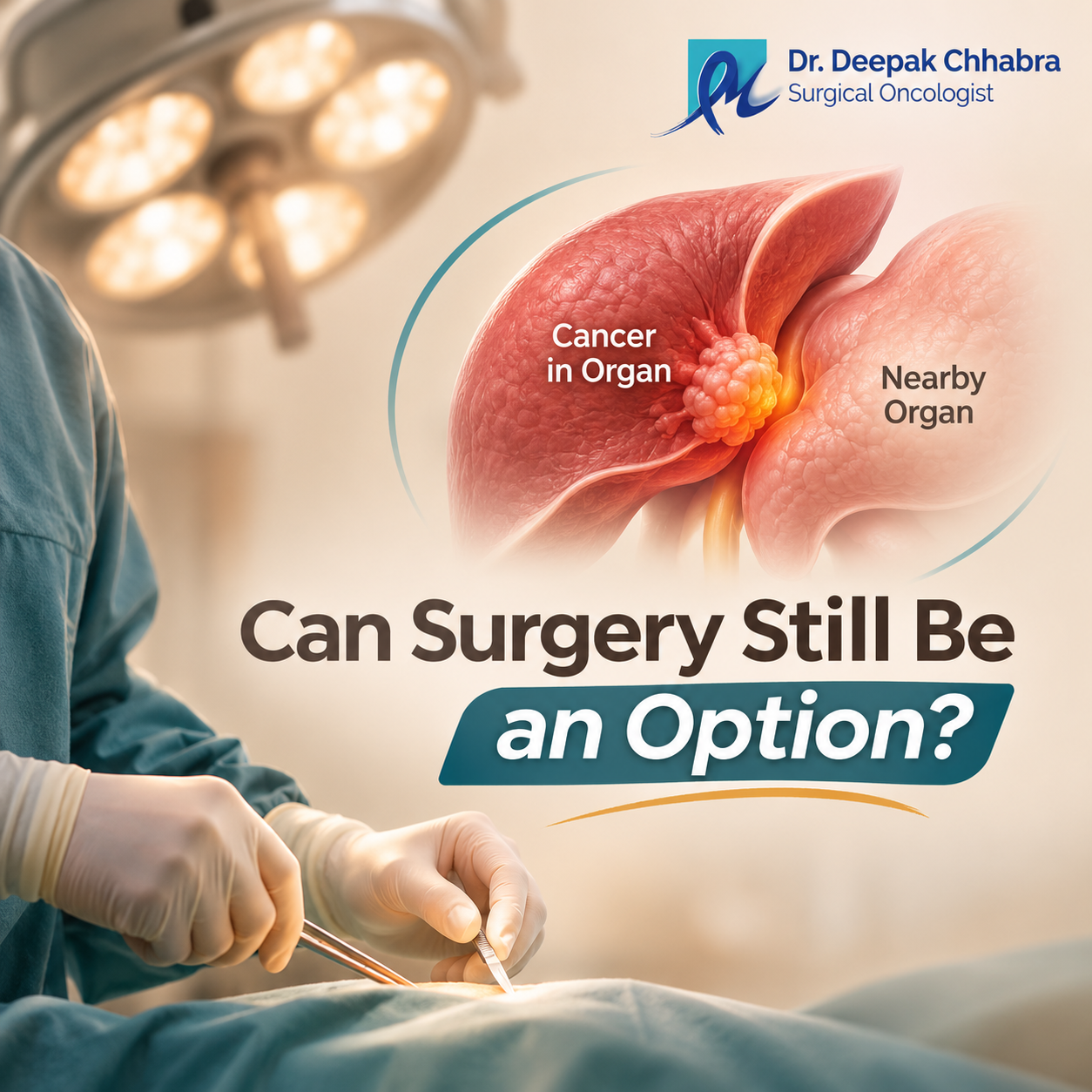
A scan report saying that cancer has grown into a nearby organ can be frightening. Many patients read that sentence and immediately assume that surgery is no longer possible.
That is not always the case.
Cancer growing directly from one organ into a neighbouring structure is different from cancer that has travelled to a distant part of the body. Both are serious findings, but they do not mean the same thing, and they do not automatically lead to the same treatment plan.
The decision about surgery depends on where the tumour started, exactly what it has grown into, whether there is disease elsewhere, how completely it may be possible to remove the cancer, and whether the patient can safely tolerate the operation.
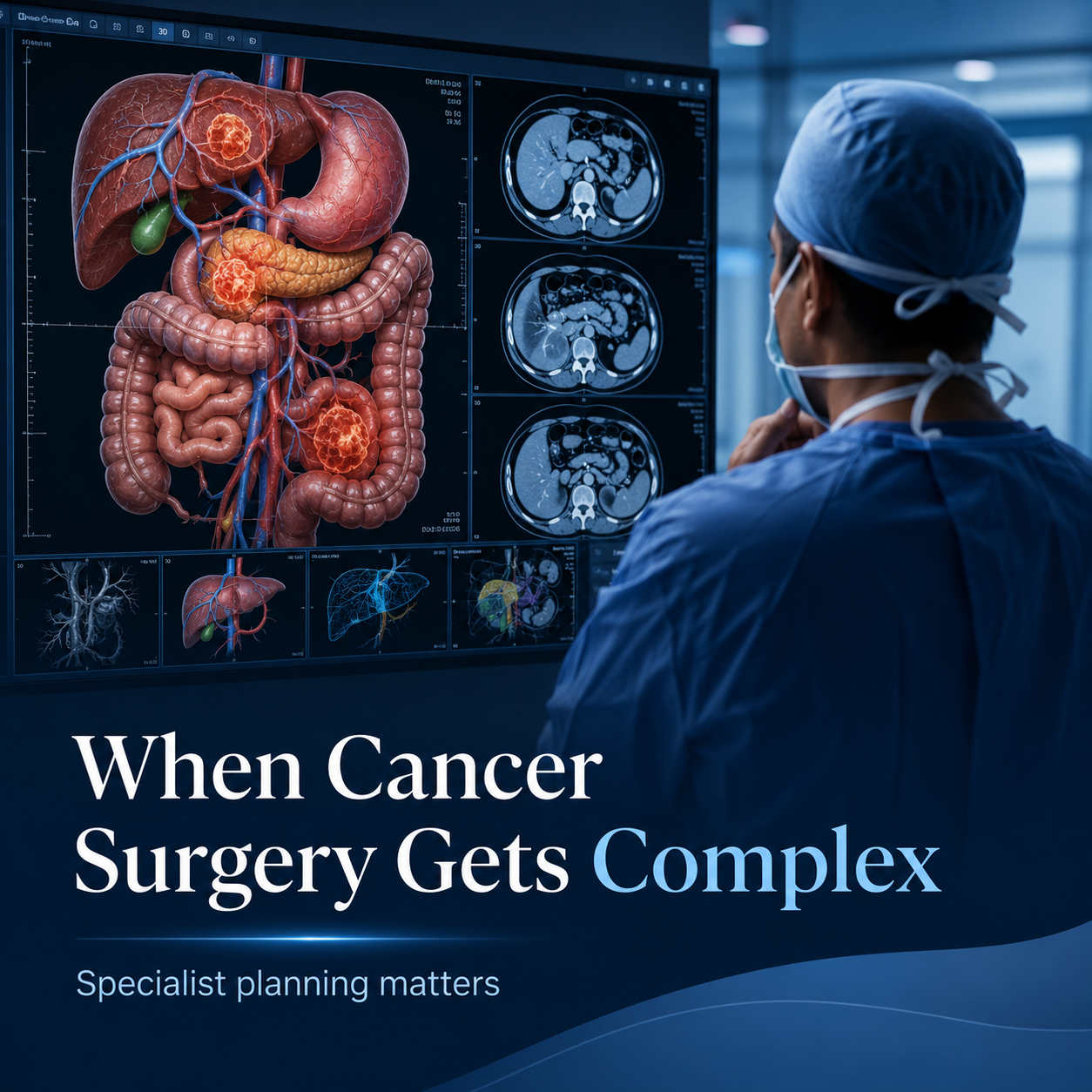
For patients trying to understand a complex scan or surgical recommendation, Dr. Deepak Chhabra’s overview of specialist cancer surgery planning provides broader information on how imaging, staging and surgical assessment fit together.
No. A tumour that has grown directly into a neighbouring organ may still be considered for surgery in selected situations. The decision depends on the cancer type, whether there is distant disease, which structures are involved, the possibility of adequate tumour removal and the patient’s overall fitness for a potentially larger operation.
Surgeons usually need to understand several things before recommending an operation:
The phrase “another organ is involved” is therefore only the beginning of the discussion.
Patients often use the word spread to describe both situations, which can make scan reports even more confusing.
In cancer staging, direct growth into nearby tissue and disease in a distant organ are treated differently.
The TNM system illustrates this clearly. T describes the primary tumour and how far it has extended into nearby tissues. N describes regional lymph-node involvement. M refers to distant metastasis.
The National Cancer Institute explains that a higher T category can reflect greater local tumour extent, while Stage IV generally refers to cancer that has spread to distant parts of the body.
The exact staging rules are different for different cancers, so patients should not try to assign a stage from one phrase in a scan report.
Still, the distinction is useful: direct local growth does not automatically mean distant metastatic disease.
Sometimes a surgeon may discuss removing the tumour together with the part of a neighbouring organ that appears to be involved.
The medical term is en-bloc resection, but the principle is easier to understand than the terminology.
Suppose a colon tumour is firmly attached to a nearby structure. If the surgeon tries to peel the tumour away, there is a risk of cutting through tissue that actually contains cancer.
In an appropriate situation, it may make more sense to remove the tumour and the involved tissue together as one specimen.
This does not mean that every tumour touching another organ requires a bigger operation. Close contact on a scan can sometimes be caused by inflammation or scar tissue rather than true tumour invasion.
That uncertainty is one reason the whole case needs to be reviewed rather than one line of imaging being considered in isolation.
Imagine two patients with colon cancer.
In both cases, the scan suggests that the tumour is closely related to a nearby organ.
The first patient has no evidence of disease elsewhere. The surgeon believes that the affected section of colon and the involved neighbouring tissue can reasonably be removed together.
The second patient has the same local finding, but additional imaging shows extensive disease in distant organs.
The phrase “tumour involving a nearby organ” may appear in both reports, yet the treatment discussion can be completely different.
This is why the question is not simply whether another organ is involved.
The wider disease pattern matters.
A locally advanced stomach cancer may occasionally grow into a nearby structure such as the colon, spleen or pancreas.
In selected patients, removing more than one involved structure may be considered if the disease pattern and patient’s condition make that approach reasonable.
A systematic review of multivisceral resection for locally advanced gastric cancer found that such surgery may be feasible in carefully selected patients, while also documenting substantial postoperative risks. The authors stressed the importance of evaluating both tumour and patient characteristics when selecting candidates.
That evidence should not be interpreted as saying that a larger operation is automatically better.
It shows why selection matters.
The gallbladder, liver, pancreas and bile ducts sit close to several important structures.
A relatively small change in the direction of tumour growth can therefore make a significant difference to the proposed operation.
A gallbladder tumour growing directly into nearby liver tissue, for example, raises a different surgical question from gallbladder cancer that has established distant deposits.
Similarly, a pancreatic or bile-duct tumour that involves an important blood vessel may require a very different assessment from one that is merely touching a neighbouring organ.
These cancers need tumour-specific review because there is no single rule that applies to every form of local extension.
Scan reports contain phrases that can sound alarming:
abutting, contacting, loss of fat plane, possible invasion, or infiltration cannot be excluded.
They are not interchangeable.
A tumour can sit against another structure without actually growing into it. Inflammation may also make two organs appear stuck together. At other times, the imaging findings are much more convincing for direct tumour invasion.
The radiologist’s wording therefore needs to be interpreted in context.
If a report says that invasion “cannot be excluded,” that is different from saying invasion has definitely been demonstrated.
A cancer operation is not simply an attempt to remove the greatest possible amount of tissue.
The surgeon is trying to remove the tumour in a way that provides an appropriate cancer operation while avoiding unnecessary harm.
One part of that discussion is whether an R0 resection appears achievable.
In plain language, that means removing the tumour without cancer being found at the examined surgical edges.
It cannot always be predicted perfectly before surgery, and the final margin assessment comes from pathology.
But if the team believes adequate removal is extremely unlikely, the potential value of a very extensive operation has to be questioned.
Anatomy is only part of the story.
Two patients can have tumours that look similar on a CT scan but behave very differently over time.
Doctors may look at how quickly the disease has progressed, whether there has been a response to treatment given before surgery, pathology findings and other cancer-specific indicators.
In some cancers, treatment before surgery also provides time to see how the disease behaves.
If distant disease appears despite apparently favourable local anatomy, the role of a major operation may need to be reconsidered.
The surgeon is therefore not assessing only “Can I technically remove this?”
The more useful question is whether the proposed operation is likely to make sense within the overall treatment strategy.
Removing part of a neighbouring organ can make surgery longer and recovery more demanding.
The patient’s physical condition therefore matters.
Nutrition, recent weight loss, muscle strength, frailty, heart and lung health, diabetes, previous treatment and general day-to-day function may all influence whether a larger operation is reasonable.
An operation that is technically possible in one patient may carry an unacceptable level of risk in another.
Age contributes to that assessment, but age alone does not decide it.
Patients seeing a cancer specialist in Mumbai after being told that another organ is involved should first ask what the scan actually shows.
Is the tumour touching the organ, probably invading it, or clearly growing into it? Is the disease otherwise localized? Would another organ or part of it have to be removed?
A cancer surgeon in Mumbai reviewing the case should also be able to explain what the operation is intended to achieve and what additional risks come with a wider resection.
For someone consulting a surgical oncologist in Mumbai, one of the most useful discussions is whether the proposed operation still offers a reasonable balance between cancer control and surgical risk.
Those explanations are much more useful than simply being told that a tumour is either “operable” or “inoperable.”
Patients understandably want a definite answer as soon as they receive the scan.
Complex cancer surgery does not always allow one from a single report.
The surgeon may need to compare imaging over time, review pathology, discuss the case with other specialists and assess the patient’s general health before making a recommendation.
Occasionally, even after careful planning, the findings during surgery provide additional information.
That is not uncertainty for its own sake. It reflects the fact that a major operation has consequences, and the decision needs to be based on more than whether the tumour can physically be reached.
Yes, some cancers that grow directly into a neighbouring organ can still be considered for surgery. The decision depends on the cancer type, distant spread, structures involved, possibility of adequate removal and the patient’s ability to tolerate the operation. A specialist surgical review is needed before deciding whether a wider resection is appropriate.
No. Direct extension into nearby tissue and distant metastatic disease are different staging concepts, although the exact stage depends on the type of cancer. The treating team should interpret the finding using the tumour-specific staging system rather than one scan phrase alone.
A multiorgan operation is generally more complex and may carry additional risks, but the level of risk depends on which structures are involved and the patient’s overall condition. Surgeons consider those risks alongside the likelihood of achieving the intended cancer operation. The individual risk-benefit discussion should happen before treatment whenever possible.
No. Modern imaging provides detailed information, but close contact, inflammation and scar tissue can sometimes make true invasion difficult to determine with complete certainty. The team may use additional imaging, treatment response, multidisciplinary review and, in selected situations, findings during surgery to clarify the picture.
Being told that cancer has grown into a nearby organ is serious, but it does not answer the question of surgery by itself.
The team needs to know where the cancer has spread, what would need to be removed, whether adequate tumour clearance appears realistic, how the cancer is behaving and whether the patient can tolerate the operation being proposed.
For one person, that assessment may still support surgery.
For another, the same type of local extension may point toward a different treatment strategy.
The most useful question for patients is therefore not simply:
“Can the tumour be operated on?”
It is:
“What would this operation need to achieve, how extensive would it be, and does the expected benefit justify that operation in my particular situation?”
That conversation gives patients far more meaningful information than the word operable on its own.
This article is intended for general educational and informational purposes only. It does not determine whether an individual cancer is operable and does not replace cancer-specific staging, multidisciplinary assessment, imaging review or personalised surgical advice.
The possibility and extent of surgery depend on the cancer type and stage, structures involved, tumour biology, previous treatment, patient fitness and the expected risks and benefits of the proposed procedure.
Stay up-to-date with the latest developments in cancer research, treatment, and patient stories through our curated collection of cancer blogs and news articles. From breakthrough discoveries to inspiring survivor journeys.
Discover first hand accounts from patients who have experienced compassionate care and expert treatment at our clinic. Read their reviews to get to know their journey.

5 Out of 5 from 92 Reviews







 VIDEO CONSULTATION
 Phone Calls
 Physical visit