
A surgeon may tell a patient that enough liver appears to remain after removing a tumour and then recommend further tests before agreeing to the operation. That can be confusing. If the liver looks large enough on the scan, what else needs to be checked?
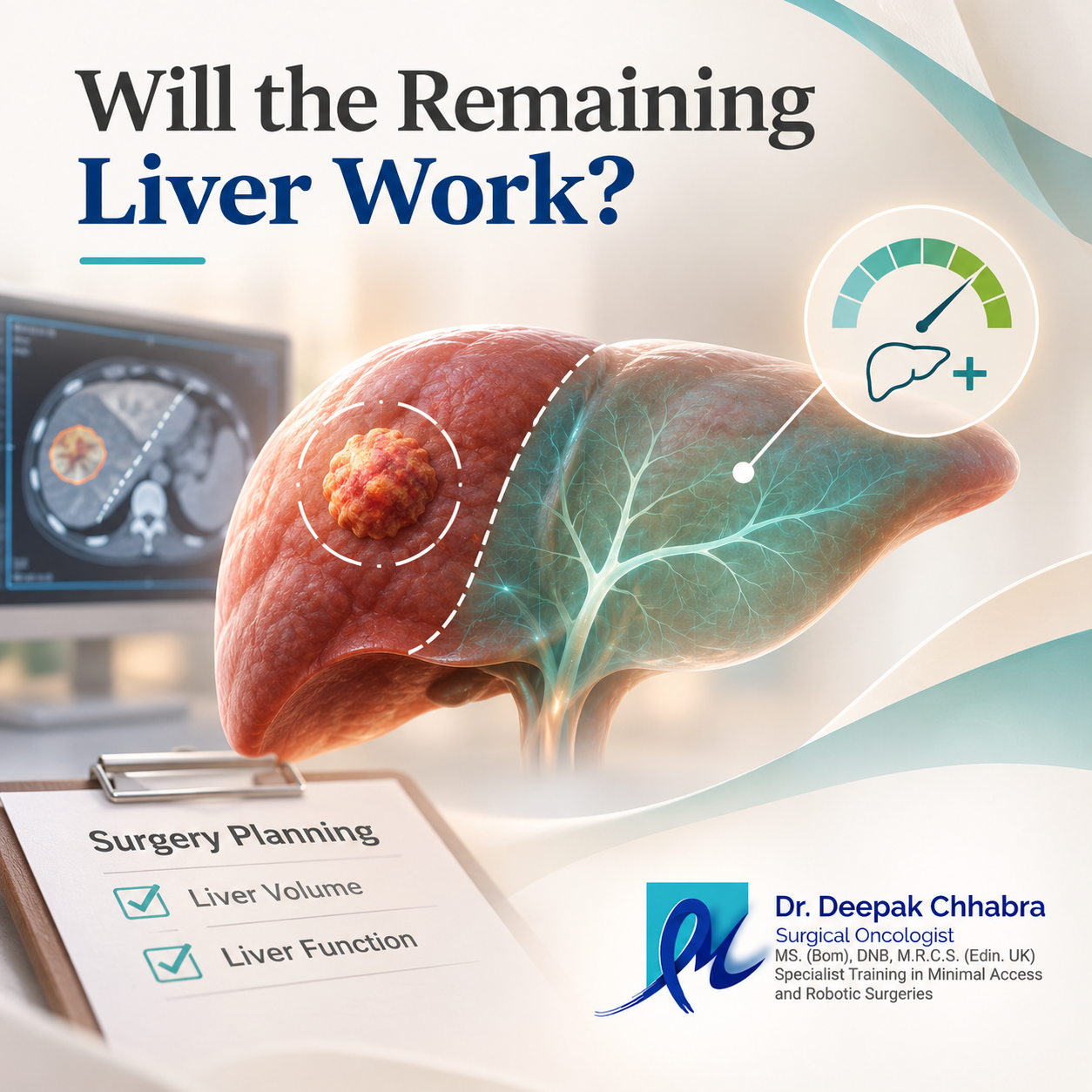
Before liver cancer surgery, the amount of liver left behind is only part of the calculation. Doctors also need to understand whether that remaining liver is healthy enough to carry out its work during recovery. Fibrosis, cirrhosis, portal hypertension, previous chemotherapy and other forms of liver injury can all reduce functional reserve even when the liver still looks reasonably large on CT or MRI.
For patients researching liver cancer treatment in Mumbai, this distinction is an important part of surgical planning. Dr. Deepak Chhabra’s overview of liver cancer treatment and surgical planning explains how tumour location, stage and the condition of the remaining liver are considered together.
Surgeons need to know both how much liver will remain after an operation and how well that liver is likely to function. A future liver remnant can appear adequate by volume but still provide less reserve than expected if the underlying liver has been damaged.
The assessment may therefore consider:
European consensus guidance treats future-liver-remnant volumetry as the foundation of preoperative assessment, while recommending additional functional evaluation for complex resections and when underlying liver disease or treatment-related liver injury is suspected.
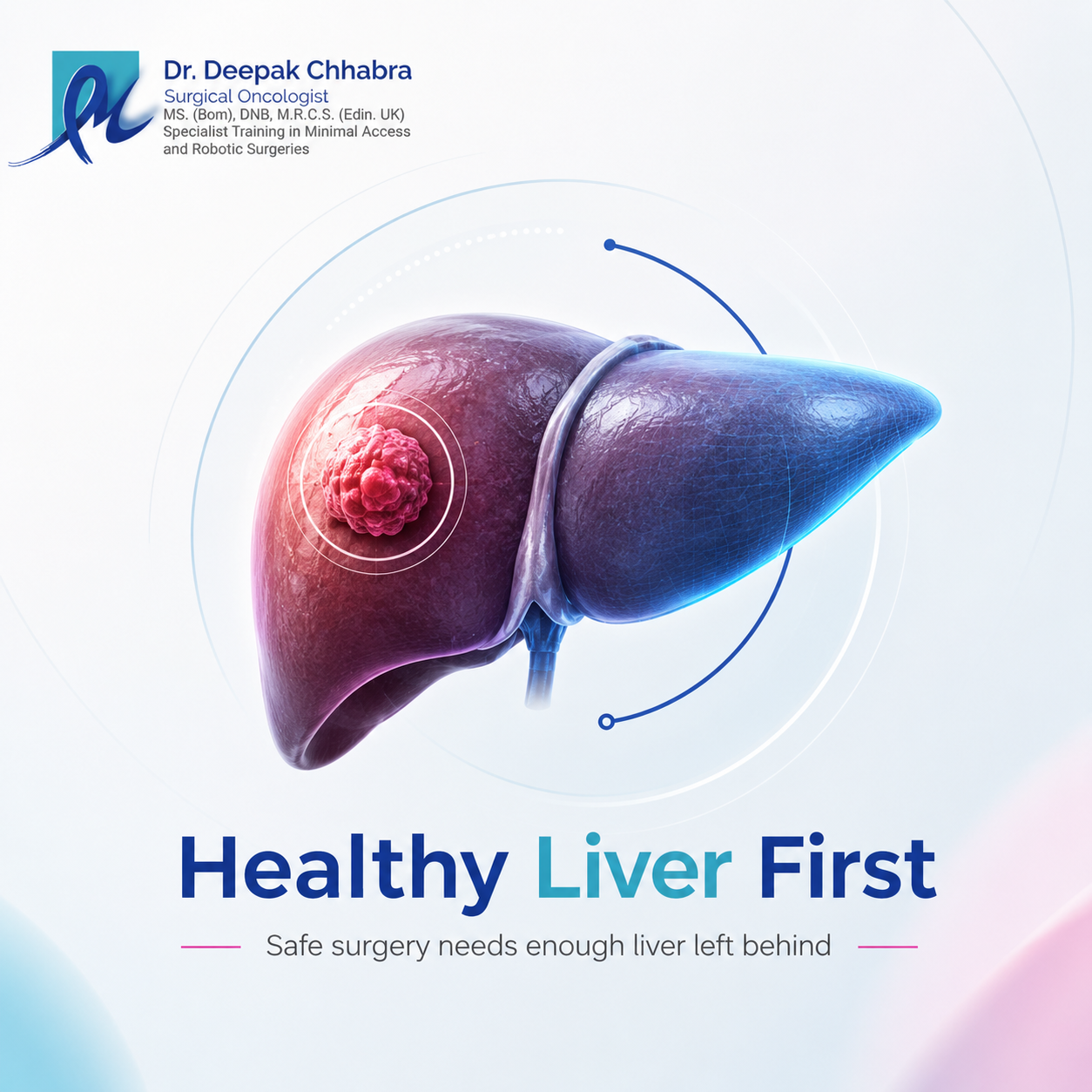
The future liver remnant, often shortened to FLR, is the portion of liver expected to remain after the tumour-bearing part has been removed.
CT or MRI can be used to calculate its volume before surgery. This gives surgeons an estimate of how much liver tissue will be available to carry out essential functions once the operation is complete.
The liver has a remarkable ability to regenerate, but that process takes time and varies between patients. The tissue left behind must therefore be capable of supporting the body during the early postoperative period while recovery and regeneration take place.
The question is not simply how much liver the surgeon plans to remove. The more important calculation is whether what remains is sufficient for that particular patient.
A simple example makes the difference between volume and function easier to understand.
Imagine two patients who are both expected to retain about 40% of their liver after surgery. The first patient has otherwise healthy liver tissue. The second has significant cirrhosis after years of chronic liver disease.
On the scan, the volume may look similar. Functionally, those two future liver remnants may not be equivalent.
Healthy liver tissue can often tolerate resection differently from scarred liver tissue. A surgeon therefore cannot take one percentage and apply it safely to every patient without considering the condition of the liver itself.
This is why patients should be cautious about interpreting future-liver-remnant percentages they find online. The number becomes meaningful only when it is considered alongside liver quality, the extent of surgery and the patient’s overall condition.
Fibrosis develops when scar tissue accumulates within the liver. Cirrhosis represents more advanced structural damage and can affect both liver function and the way blood flows through the organ.
This becomes especially relevant in primary liver cancers such as hepatocellular carcinoma because the tumour may arise in a liver that already has chronic disease.
A patient with cirrhosis can sometimes have blood-test results that appear relatively stable and still have reduced capacity to tolerate a major resection. For that reason, surgeons do not assess the tumour separately from the liver surrounding it.
The condition of the background liver can influence how much tissue needs to remain and whether surgery is appropriate at all.
Blood from much of the digestive system reaches the liver through the portal vein. When scarring makes it difficult for blood to pass through the liver, pressure can rise within this system, producing portal hypertension.
Doctors may look for several clues that portal pressure is elevated. These can include platelet count, spleen enlargement, imaging findings and other clinical information.
Portal hypertension is relevant because it can be a sign that the liver is already under physiological stress. It may therefore influence how the risks and potential benefits of a liver resection are judged.
Its presence does not automatically mean surgery is impossible. The significance depends on the cancer, liver function, extent of resection and the rest of the patient’s assessment.
Some patients are considered for liver surgery after receiving chemotherapy. This is particularly common when cancer has spread to the liver from another organ and systemic treatment has been given before an operation is considered.
Certain chemotherapy regimens can affect liver tissue. The pattern and clinical importance of that injury vary depending on the treatment, duration of exposure and individual patient.
A CT scan may still show an apparently adequate volume, while the liver’s reserve has been affected by treatment-related injury.
A 2026 review of hepatic functional reserve specifically identifies chronic liver disease, chemotherapy-associated liver injury, cholestasis and portal hypertension as situations in which functional assessment becomes particularly relevant before liver resection. It also concludes that current evidence supports an individualised, multimodal approach rather than one universally superior test.
For a detailed evidence overview, see the 2026 review of liver-function assessment in oncology.
Routine blood tests are an important part of liver assessment, but they need to be interpreted carefully.
Tests such as bilirubin, albumin and liver enzymes give doctors useful information about overall liver health. Clinical scoring systems can combine laboratory values with other findings to help estimate risk.
However, these tests usually reflect the liver as a whole.
They do not necessarily tell the surgeon exactly how well the specific portion of liver that will remain after surgery is functioning. That distinction becomes more relevant when disease or damage is unevenly distributed across the liver or when a large resection is planned.
Blood tests are therefore one piece of the assessment rather than a substitute for imaging and surgical planning.
In straightforward cases with healthy liver tissue and a limited planned resection, standard assessment may provide enough information.
More complex situations can require a closer look at functional reserve.
Depending on the clinical setting and available expertise, doctors may consider methods such as indocyanine-green clearance, LiMAx testing, hepatobiliary scintigraphy or MRI using liver-specific contrast.
Some of these tests assess the liver globally, while others can provide information about regional function. That can be particularly valuable when the surgeon wants to understand how well the future liver remnant itself is likely to work.
The European consensus recommends considering preoperative liver-function assessment before complex resections and in patients with known or suspected liver disease or treatment-related injury. It also supports combining volumetry with selected functional methods according to the clinical situation and local expertise.
The two approaches answer different questions.
Volumetry tells the surgeon how much liver is expected to remain. Functional assessment tries to provide information about how well that liver works.
Neither makes the other unnecessary.
The 2026 evidence review found that CT/MRI-based future-liver-remnant volumetry remains central to surgical planning, while functional testing can add useful information according to the extent of the planned resection, underlying liver disease and previous treatment. No single method—or fixed combination of methods—can currently be considered universally superior.
For patients, this means that having more tests is not automatically better. Additional testing is most valuable when it helps resolve a genuine uncertainty that could change the surgical plan.
Newer imaging approaches are being studied because conventional measurements cannot capture every aspect of liver quality.
Radiomics can extract patterns from CT or MRI images that may not be obvious during routine visual interpretation. Machine-learning models may also combine imaging, laboratory and clinical variables in an attempt to predict postoperative liver function or complications.
These approaches are promising, but they remain decision-support tools rather than replacements for established assessment.
The 2026 review notes growing research interest in radiomics and artificial intelligence while also emphasising the need for further prospective validation.
For now, these techniques may supplement clinical judgment in selected settings. They do not independently determine whether an operation is safe.
An assessment suggesting insufficient liver reserve does not always mean that surgery is permanently ruled out.
The team may reconsider how much the liver needs to be removed, whether the operation can be modified or whether another treatment sequence would be more appropriate.
In selected cases, surgeons may also consider strategies designed to increase the future liver remnant before a major resection. The appropriate option depends heavily on the tumour, liver condition and anatomy.
What matters is that these decisions are made before removing a large amount of liver, rather than discovering after surgery that the remaining liver cannot meet the body’s needs.
A consultation with a liver cancer specialist in Mumbai should help the patient understand more than whether the tumour itself can technically be removed. It should also clarify what will remain and how the team has assessed the quality and reserve of that liver.
A liver cancer doctor in Mumbai may discuss whether the background liver appears healthy, whether fibrosis or portal hypertension is present, and whether previous treatment has affected the surgical calculation.
Patients do not need to understand every liver-function score or imaging technique. A few practical questions are enough: how much liver is expected to remain, does that liver appear healthy, and is any additional functional assessment needed before proceeding?
Those questions bring the discussion back to the issue that matters most—whether the liver left behind is expected to support recovery safely.
Yes. Liver volume and liver function are related but not interchangeable, particularly when fibrosis, cirrhosis, portal hypertension or treatment-related injury is present. Surgeons may therefore combine volumetry with clinical assessment, laboratory findings and selected functional testing.
No. Normal routine blood tests are reassuring but do not by themselves measure the functional capacity of the exact portion of liver that will remain after surgery. The extent of resection, background liver condition and imaging findings still need to be considered.
Yes. Some chemotherapy treatments can cause liver injury that may reduce functional reserve even when liver volume appears adequate. The significance depends on the treatment received, the condition of the liver and how much liver needs to remain after resection.
No. Current evidence supports combining information from volumetry, laboratory and clinical assessment, with additional functional tests when they are likely to answer a relevant surgical question. No single test is considered universally superior for every liver-surgery patient.
When liver cancer can potentially be removed, it is natural to focus on the tumour: where it is, how large it is and how much liver the surgeon plans to take out.
Safe planning also requires attention to the liver that will be left behind.
For someone considering liver cancer treatment in Mumbai, the useful conversation is therefore not limited to, “Can you remove the tumour?” It should also cover the condition of the background liver, how much functional liver is expected to remain and whether anything about previous treatment or liver disease changes the risk.
The most useful question may be very simple:
“After the tumour is removed, will the liver that remains be able to do the work my body needs?”
That is the question behind much of modern liver-surgery planning.
This article is intended for general educational purposes only. It does not determine whether an individual patient is suitable for liver surgery and does not replace personalised assessment of tumour extent, future liver remnant, liver function or operative risk.
Patients should discuss their own imaging, liver condition, previous treatment and surgical options with the treating liver or surgical oncology team before making treatment decisions.
Stay up-to-date with the latest developments in cancer research, treatment, and patient stories through our curated collection of cancer blogs and news articles. From breakthrough discoveries to inspiring survivor journeys.
Discover first hand accounts from patients who have experienced compassionate care and expert treatment at our clinic. Read their reviews to get to know their journey.

5 Out of 5 from 92 Reviews




 VIDEO CONSULTATION
 Phone Calls
 Physical visit