
After stomach cancer surgery, patients are often told that the digestive tract has been “reconnected.” The next question usually comes quickly: how do doctors know that this new join is healing the way it should?
There is no single test that gives the answer.
Doctors follow the whole recovery pattern—how the patient feels, temperature and heart rate, abdominal symptoms, blood-test trends, ability to tolerate fluids or nutrition and, when something does not look right, imaging.
For patients undergoing stomach cancer treatment in Mumbai, knowing what happens after gastrectomy is an important part of preparing for surgery. Dr. Deepak Chhabra’s overview of stomach cancer treatment and surgical planning explains the wider treatment pathway.
Doctors usually assess the new digestive connection by watching how the patient recovers over time rather than relying on one routine “leak test.” Stable vital signs, improving pain, returning bowel function and the ability to progress nutrition are reassuring; a change in this pattern may lead to blood tests, imaging or further assessment.
The surgical team may pay attention to:
Recovery does not have to be perfectly smooth.
A patient can feel tired, have a poor appetite and experience abdominal discomfort without there being a problem with the surgical join. What doctors are looking for is whether the overall direction of recovery makes sense.
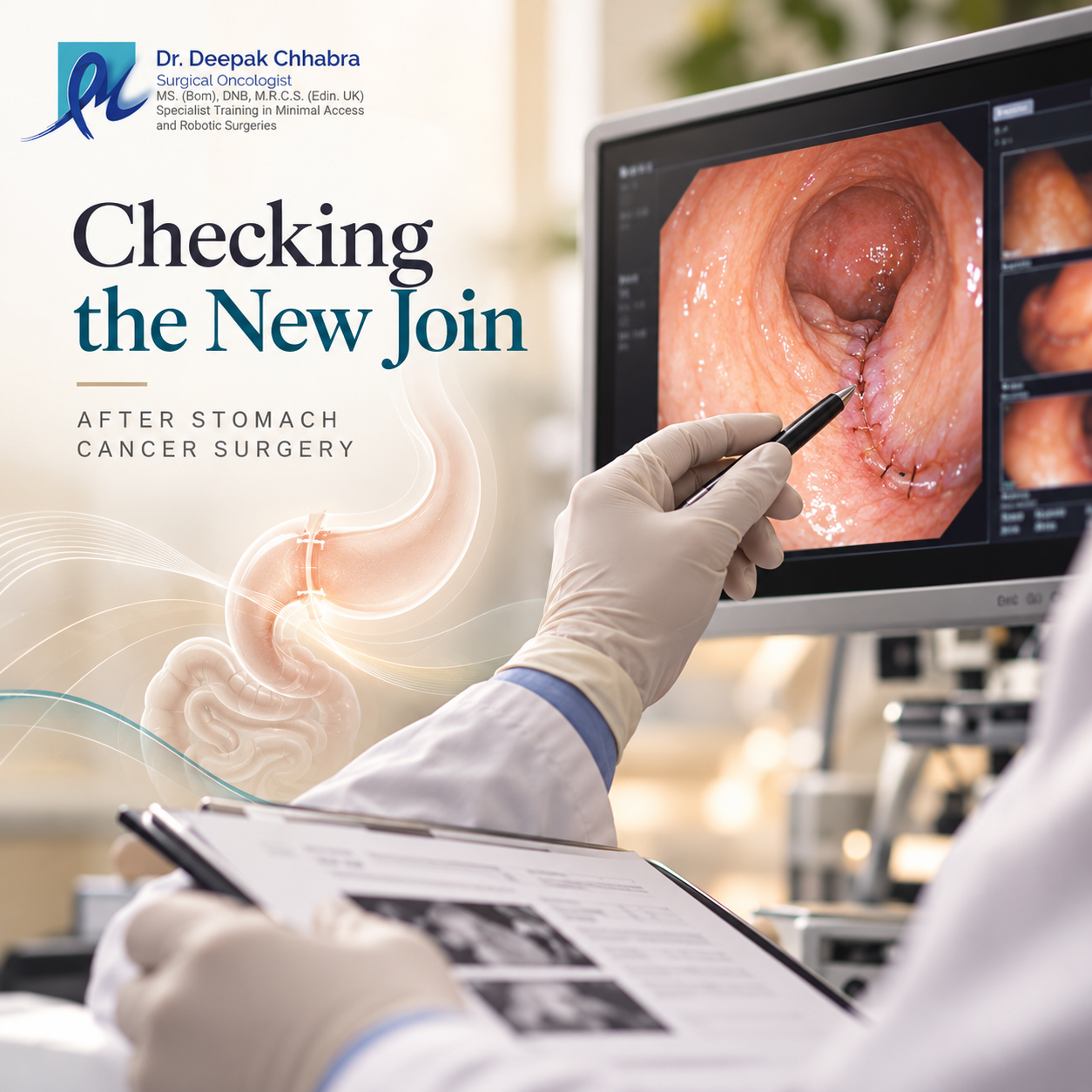
The medical word is anastomosis.
It simply describes a connection created surgically between two parts of the digestive tract.
The exact reconstruction depends on how much stomach has been removed.
After a partial or subtotal gastrectomy, some stomach remains. The surgeon reconnects that remaining portion so food can continue into the small intestine.
After a total gastrectomy, the whole stomach is removed. The oesophagus then has to be connected directly to the small intestine.
There may be more than one connection depending on the reconstruction used.
The American Cancer Society explains that after subtotal or total gastrectomy, the digestive tract is reconstructed so food can continue to pass through it. Leakage from one of these new connections is a recognised complication, although it does not occur in most patients.
For patients, understanding this anatomy makes the recovery process much easier to follow.
One of the hardest things after major abdominal surgery is knowing which symptoms are expected.
Pain is normal after gastrectomy.
So is fatigue.
Appetite can be poor, and the bowel may take time to settle after anaesthesia, surgery and pain medicines. Some patients experience nausea or feel full after only a small amount of food.
These symptoms usually become easier to manage as recovery progresses.
A useful distinction is direction.
Mild abdominal pain that is gradually becoming easier is very different from pain that suddenly becomes more severe while a fever develops or the patient begins to feel markedly unwell.
Doctors rarely interpret one symptom alone.
They look at what else is happening at the same time.
Before ordering a scan, the surgical team learns a great deal simply by reviewing the patient.
A heart rate that remains unusually fast may attract attention.
So can persistent fever, increasing tenderness in the abdomen, breathing difficulty or a patient who looks significantly less well than they did the day before.
Urine output, hydration and alertness can also provide useful information.
This is one reason regular postoperative observations matter.
A patient does not need to understand every number on the monitor. The surgical team is watching for combinations of changes that may indicate recovery is no longer following the expected course.
Blood tests can provide another layer of information.
After major surgery, inflammatory markers naturally rise because the body is responding to tissue injury and healing.
That means a raised C-reactive protein (CRP) or white blood cell count does not automatically diagnose a leak.
What can matter more is the trend.
If inflammatory markers are settling and the patient is clinically improving, that is reassuring.
If the markers remain high or rise while the patient develops fever, increasing pain or a persistently fast heart rate, the team may investigate further.
A 2026 prospective multicentre study involving 435 patients who underwent gastric cancer surgery found that people who developed an anastomotic leak showed differences in heart rate and several inflammatory markers earlier during postoperative recovery. The researchers concluded that these changing clinical and laboratory patterns may help doctors identify patients who need closer evaluation.
The important word is patterns.
No individual blood result should be interpreted in isolation.
Patients sometimes expect a scan to be performed routinely to prove that the new connection has healed.
That is not always necessary.
Postoperative protocols vary between hospitals and according to the operation performed. If the patient is recovering well, observations are stable and there are no concerning symptoms, routine imaging may not provide useful additional information.
If something raises concern, imaging becomes much more valuable.
A CT scan can help doctors look for fluid collections, inflammation, abnormal air or contrast leaking outside the digestive tract.
In selected situations, doctors may use a water-soluble contrast study, where the patient drinks contrast while imaging tracks its movement through the newly reconstructed pathway.
Endoscopy can also be useful in particular circumstances.
The choice of test depends on what the team is trying to find.
There is no universal scan that every patient must undergo simply because an anastomosis was created.
An anastomotic leak happens when digestive fluid escapes through or around a newly created connection before the tissues have healed adequately.
The term sounds alarming, but leaks vary considerably.
A small, contained leak is very different from a larger leak associated with infection or sepsis.
Treatment is therefore not identical for every patient.
Depending on the situation, management may include antibiotics, drainage of an infected collection, an endoscopic procedure or another operation.
The patient’s clinical condition matters just as much as what appears on imaging.
This is also why searching symptoms online cannot tell someone whether they have a leak—or how serious it might be.
That decision requires a medical assessment.
Recovery after gastrectomy comes with discomfort, but a few changes deserve prompt attention.
A patient should contact the treating team if there is persistent or significant fever, clearly worsening abdominal or chest pain, repeated vomiting, increasing breathlessness, inability to keep fluids down, unusual confusion or weakness, or a noticeable deterioration in overall condition.
If a drain is still present, the surgical team may also provide instructions about changes in the quantity or appearance of the fluid.
These symptoms do not necessarily mean the anastomosis has leaked.
A chest infection, urinary infection, dehydration and several other postoperative problems can produce similar symptoms.
The point is not to diagnose the cause at home.
The point is to recognise when recovery needs another medical look.
Nutrition after gastrectomy is introduced according to the operation and the patient’s clinical progress.
Some patients begin drinking relatively early. Others may follow a different feeding plan.
As nutrition is progressed, the team watches how the digestive tract responds.
Persistent vomiting, increasing abdominal discomfort or an inability to tolerate the planned intake may need assessment, although these symptoms can have many causes other than a leak.
Once the early postoperative period has passed, the focus gradually shifts toward adapting to the new anatomy.
Smaller, more frequent meals are commonly needed.
People who have had the entire stomach removed usually need greater long-term adjustment than those who retain part of the stomach.
Those nutritional changes are an expected consequence of gastrectomy and should not be confused with a problem at the surgical join.
After major surgery, it is natural to look for reassurance in a scan or blood test. A normal result can feel like confirmation that everything is healing well.
In reality, doctors do not rely on a single result.
A scan may look normal even when a problem is only beginning to develop. On the other hand, a blood test can appear abnormal simply because the body is still responding to surgery, even when the patient is recovering well.
This is why postoperative assessment is based on the overall picture.
Doctors look at how the patient is feeling, whether pain is improving or becoming worse, how the heart rate and temperature are changing, what the examination shows and whether blood-test results are moving in the expected direction.
Imaging is then used when there is a specific reason to look more closely.
The most reliable assessment comes from putting all of these findings together—not from one scan, one blood test or one isolated number.
Not every postoperative problem begins during the hospital stay.
Patients and families should therefore leave hospital knowing:
For someone recovering after stomach cancer surgery in Mumbai, these practical instructions are as important as knowing the name of the operation.
A patient seeing a stomach cancer specialist in Mumbai for follow-up should ideally bring the discharge summary, operative details and pathology report.
If another stomach cancer doctor in Mumbai is reviewing the case, the operative note can be particularly helpful because it explains exactly how the digestive tract was reconstructed.
The first days after major gastric surgery can be unpredictable.
Some patients recover quickly. Others need more time before appetite, mobility and energy begin to return.
There is no single day by which every patient should feel well.
What is more important is whether progress broadly continues.
A patient who is slowly becoming more active, tolerating nutrition better and needing less pain medication is following a very different course from someone who begins to deteriorate after initially improving.
That change in direction is often what makes the surgical team look more closely.
Doctors look at the whole recovery pattern, including symptoms, heart rate, temperature, abdominal examination, blood tests and tolerance of nutrition. Imaging may be added if something in that pattern raises concern. Patients should follow their discharge instructions and report significant changes rather than relying on one symptom.
No. Fever after major surgery can have several causes, including chest, urinary or wound infections as well as normal postoperative inflammation. Persistent fever accompanied by worsening pain, a fast heart rate or general deterioration should be assessed by the treating team.
No. The need for imaging before oral intake varies with the operation, the patient’s recovery and the hospital’s protocol. The surgical team decides when fluids and food can be introduced based on the overall clinical picture.
Yes, some leaks can be managed without another major operation. Depending on the patient’s condition and the size and location of the leak, treatment can include antibiotics, drainage or endoscopic procedures. The appropriate treatment can only be chosen after clinical and imaging assessment.
The new digestive connection is an important part of healing after gastrectomy, but patients do not need to spend recovery constantly wondering whether the join is “holding.”
Doctors are already looking for the changes that matter.
They follow symptoms, heart rate, temperature, examination findings and blood-test trends. Imaging is used when those findings suggest that something needs a closer look.
Some pain, tiredness and difficulty eating can be part of normal recovery.
A clear deterioration is different.
Persistent fever, increasing pain, repeated vomiting, breathlessness or suddenly feeling much worse deserve medical assessment—not an online diagnosis.
For patients and families, the most useful approach is straightforward: know what recovery is expected to look like, know whom to contact, and speak to the surgical team when the pattern changes.
That is far more reliable than trying to decide from one symptom whether the new connection has healed.
This article is intended for general educational and informational purposes only. It does not replace personalised postoperative advice, diagnosis or treatment from a qualified surgical team. Symptoms after gastrectomy can have several possible causes, and an anastomotic leak cannot be confirmed or excluded using online information alone. Patients with persistent fever, worsening abdominal or chest pain, repeated vomiting, breathing difficulty, inability to tolerate fluids or a significant deterioration in their general condition should contact their treating team promptly or seek urgent medical assessment.
Stay up-to-date with the latest developments in cancer research, treatment, and patient stories through our curated collection of cancer blogs and news articles. From breakthrough discoveries to inspiring survivor journeys.
Discover first hand accounts from patients who have experienced compassionate care and expert treatment at our clinic. Read their reviews to get to know their journey.

5 Out of 5 from 92 Reviews






 VIDEO CONSULTATION
 Phone Calls
 Physical visit