
If a surgeon has mentioned removing the entire pancreas, the idea can sound alarming. Many patients immediately wonder why the healthy-looking part of the gland cannot simply be left behind.
In many pancreatic cancers, it can.
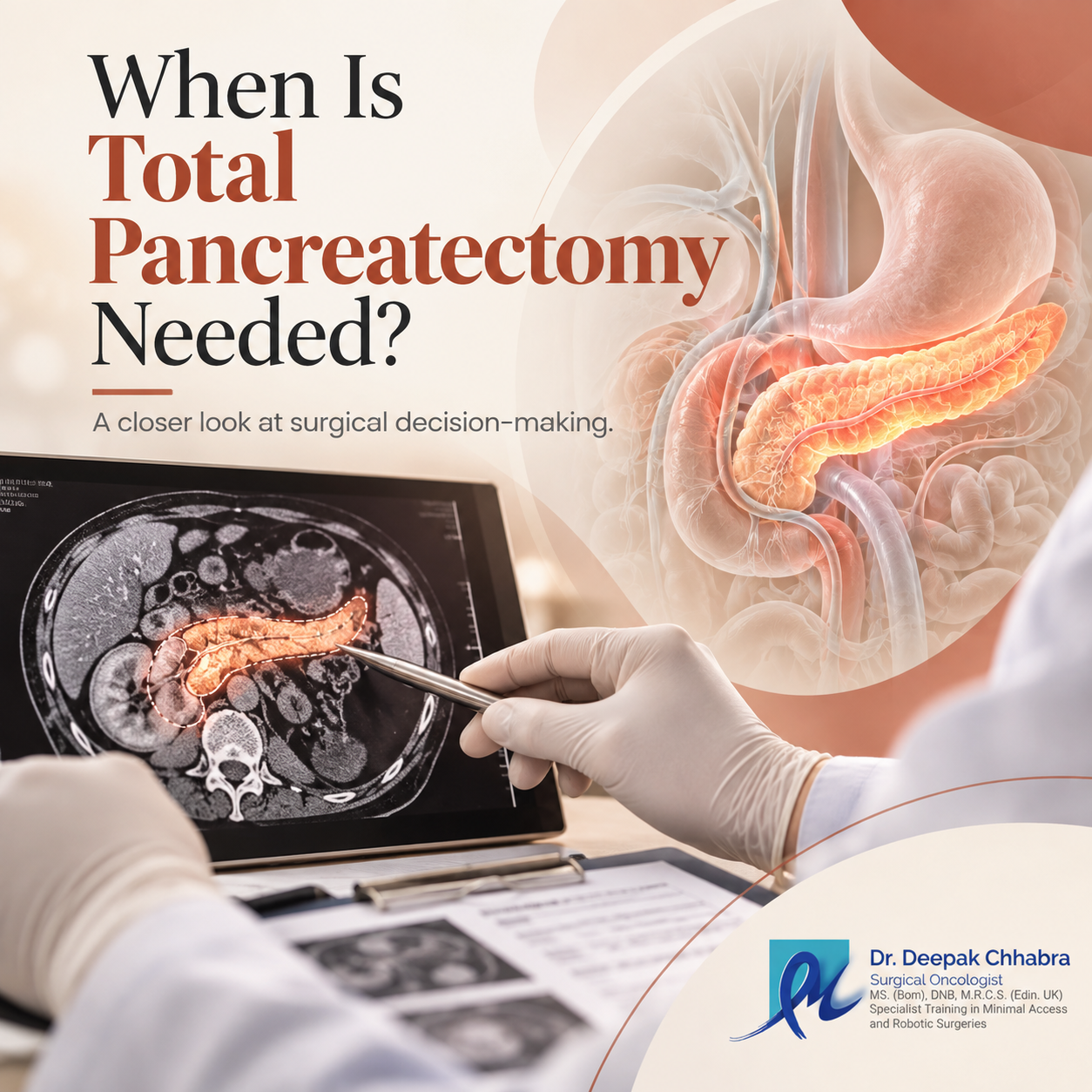
Total pancreatectomy is not the routine operation for pancreatic cancer. It is considered only in selected situations where preserving part of the pancreas may prevent the surgeon from achieving an appropriate cancer resection.
For patients exploring pancreatic cancer treatment in Mumbai, understanding that distinction matters. The operation is chosen according to the tumour’s location, its relationship with the rest of the gland and nearby structures, and whether the cancer appears removable with a clear surgical margin.
Removing more pancreas is not automatically better cancer surgery. The goal is to remove what needs to be removed—no less, but also no more than the cancer operation requires.
Total pancreatectomy may be considered when pancreatic cancer can still be surgically removed, but preserving part of the gland would not allow an adequate oncological resection. It is used selectively because removing the entire pancreas creates permanent consequences for blood-sugar control and digestion.
The decision usually depends on a combination of:
That makes total pancreatectomy very different from simply choosing a “bigger” operation.
The pancreas is a relatively small organ, but it performs two jobs that affect everyday life.
One part of its function is hormonal. Pancreatic cells produce insulin and other hormones that help regulate blood glucose.
The other is digestive. The gland produces enzymes that enter the small intestine and help the body digest and absorb nutrients.
When only part of the pancreas is removed, some of this function may remain. How much function is retained varies from patient to patient and depends partly on how much healthy gland is left behind.
Once the entire pancreas is removed, however, there is no residual pancreatic tissue to take over either role.
That is one reason surgeons do not remove the whole gland simply to perform a wider operation.The American Cancer Society guidance on pancreatic cancer surgery notes that total pancreatectomy is used less frequently than other pancreatic operations and can have major long-term effects.Preserving pancreatic tissue has value—but only when that preservation remains compatible with safe cancer surgery.
Pancreatic operations are closely tied to anatomy.
A tumour arising in the head of the pancreas is usually approached differently from one arising in the body or tail. The pancreatic head lies beside the duodenum and is closely connected to the bile duct and surrounding structures, while the body and tail extend towards the spleen.
For cancer in the pancreatic head, the standard operation may be a pancreaticoduodenectomy, commonly called a Whipple procedure. Part of the pancreas remains after this surgery.
Tumours in the body or tail may instead require a distal pancreatectomy, which removes the affected distal portion of the pancreas and commonly the spleen.
These location-based procedures are already explained on Dr. Deepak Chhabra’s pancreatic cancer treatment page.
Total pancreatectomy becomes relevant when the disease pattern makes preservation of the remaining gland unsuitable for the intended cancer operation.
That is a different surgical problem.
One of the clearest reasons for considering a total pancreatectomy is the inability to obtain an adequate margin while leaving part of the pancreas behind.
The National Cancer Institute pancreatic cancer treatment guidance lists total pancreatectomy when necessary for adequate margins among surgical options for selected resectable or borderline-resectable pancreatic cancers.
A cancer confined to one end of the gland may allow the unaffected pancreas to remain.
A tumour that extends much farther through the pancreas can change that calculation.
The surgeon has to consider whether the portion that would be left behind is genuinely uninvolved and whether retaining it compromises the planned resection. This decision is based on imaging, tumour anatomy and, in some situations, findings during the operation itself.
There is no useful oncological benefit in preserving a small piece of pancreas simply for the sake of saying that the gland was not completely removed.
At the same time, a total pancreatectomy should not be performed merely because it is technically possible.
The benefit must justify the permanent physiological changes that follow.
Pre-operative imaging provides much of the surgical map, but pancreatic cancer can occasionally prove more extensive than expected once the operation begins.
This is particularly relevant in pancreatic surgery because the gland sits close to major blood vessels and other important structures.
A tumour that appears removable on scans may sometimes be found to have a different relationship with surrounding tissues during surgery. The American Cancer Society notes that even cancers initially thought to be resectable can occasionally prove impossible to remove completely once the operation has started.
In selected cases, the extent of pancreatic resection may also need to change if the operative findings show that the originally planned partial resection would not provide the intended margin.
This is why consent for pancreatic surgery needs to cover not only the expected operation but also reasonable changes that may become necessary during surgery.
A patient should know beforehand whether total pancreatectomy is the planned procedure or a possibility that could arise depending on the operative findings.
A total pancreatectomy only makes sense when removing the cancer surgically is expected to provide meaningful oncological benefit.
It is not an automatic solution for pancreatic cancer simply because the whole pancreas can technically be removed.
Before major pancreatic surgery, imaging is reviewed to determine whether the tumour appears resectable and whether major nearby vessels are involved. The surgeon also looks for evidence that disease has spread beyond the area that can reasonably be treated through resection.
NCI guidance distinguishes resectable and borderline-resectable disease from more advanced situations because the ability to obtain an adequate resection is fundamental to surgical planning.
This is why a pancreatic cancer specialist in Mumbai will usually want to review the actual pancreatic-protocol CT images, not just a short written report.
The anatomy often tells the story more clearly than the procedure name.
Removing the entire pancreas means replacing the two major functions the gland previously performed.
These are not short-term postoperative measures. They become part of long-term care.
After total pancreatectomy, the body no longer has pancreatic cells that produce insulin.
Diabetes is therefore an expected consequence, and insulin replacement becomes necessary.
Blood glucose can require careful management around meals, activity, illness and recovery. Patients need a clear plan for glucose monitoring, insulin administration and follow-up before they leave hospital.
The ACS specifically notes that people become fully dependent on insulin after removal of the entire pancreas.
Modern glucose-monitoring systems and structured diabetes care can make this easier to manage, but it still represents a major permanent change.
The pancreas normally releases enzymes that help digest fats, proteins and carbohydrates.
After total pancreatectomy, those enzymes are no longer produced.
Patients therefore require pancreatic enzyme replacement therapy, commonly taken with meals and snacks. The amount required can vary according to meal size, food composition, body weight and symptoms.
Persistent loose stools, greasy stools, bloating or unexplained weight loss may suggest that enzyme replacement needs review.
Successful recovery is therefore not only about healing from surgery. Nutrition and digestion need active follow-up as well.
Total pancreatectomy generally involves removal of the spleen along with other closely connected structures. Both ACS and NCI descriptions of the operation include splenectomy.
The spleen contributes to the body’s defence against certain infections.
When it is removed, vaccination becomes an important part of preparation and long-term care. ACS notes that patients are advised to receive specific vaccines around the time of surgery because of the infection risk associated with splenectomy.
This is a practical detail that deserves attention before surgery rather than being discovered during recovery.
Tumour anatomy may determine whether total pancreatectomy is technically appropriate, but anatomy is only part of the decision.
This is major abdominal surgery.
Nutritional condition, physical fitness, diabetes risk, other illnesses and the ability to manage lifelong insulin and enzyme replacement all matter when weighing expected benefit against surgical burden.
That balance is especially relevant in someone who has already lost substantial weight or has other serious medical conditions.
A technically possible procedure is not necessarily the most appropriate procedure for every patient.
Good pancreatic cancer surgery is therefore not defined by how extensive the operation is.
It is defined by whether the chosen operation makes oncological and clinical sense for that individual patient.
A useful consultation should leave the patient understanding why the proposed extent of surgery is necessary.
The surgeon should be able to show where the cancer lies on the scan and explain why pancreatic tissue can or cannot reasonably be preserved.
Patients seeking a pancreatic cancer doctor in Mumbai for a surgical opinion should ideally bring their pancreatic-protocol CT or MRI images, radiology report, biopsy or pathology findings and details of treatment already received.
This helps the consultation move beyond the procedure name and towards the anatomy that determines the procedure.
Dr. Deepak Chhabra is a Consultant Surgical Oncologist with specialist HPB training from Nagoya University, Japan, and fellowship training in GI Surgical Oncology and Robotics in Seoul, Korea. His published profile lists pancreatic and other hepatopancreatobiliary cancer surgery among his areas of specialist practice.
For most operable pancreatic cancers, the starting aim is not to remove the maximum possible amount of pancreas.
It is to perform the right cancer operation for the tumour’s location and extent.
When a partial pancreatectomy can achieve the intended oncological result, preserving functioning pancreatic tissue has meaningful advantages. When preservation would compromise the resection, total pancreatectomy may become appropriate in a carefully selected patient.
The distinction is important because the operation changes life permanently. Insulin and digestive enzymes become essential, nutritional follow-up matters, and splenectomy may add vaccination requirements.
That is why the decision should make sense on both sides of the operation: why the whole pancreas needs to be removed, and how life will be managed afterwards.
Yes, a person can live without the pancreas, but its hormonal and digestive functions must be replaced permanently. Total pancreatectomy results in lifelong insulin dependence and the need for pancreatic enzyme replacement with meals. A diabetes and nutrition plan should therefore be established as part of postoperative care.
Yes, lifelong insulin treatment is required because no pancreatic tissue remains to produce insulin. Glucose control can require close monitoring, particularly during recovery and while diet and activity levels are changing. Diabetes-management planning should begin before discharge after surgery.
Total pancreatectomy may be considered when retaining the remaining pancreas would not allow an adequate oncological resection. NCI guidance specifically includes total pancreatectomy when necessary to obtain adequate margins in selected surgically treatable disease. The patient’s imaging and expected resection margins therefore determine whether a partial operation remains appropriate.
Yes, pancreatic enzyme replacement is needed because the body can no longer produce pancreatic digestive enzymes. The dose is taken with food and may need adjustment if digestion, stool pattern, nutrition or body weight changes. Ongoing nutritional follow-up helps ensure that enzyme replacement remains adequate.
Medical Disclaimer: This article is intended for patient education and does not replace an individual diagnosis or treatment recommendation. Whether pancreatic cancer is surgically removable, and whether partial or total pancreatectomy is appropriate, depends on tumour anatomy, staging, imaging, overall health and specialist clinical assessment.
Stay up-to-date with the latest developments in cancer research, treatment, and patient stories through our curated collection of cancer blogs and news articles. From breakthrough discoveries to inspiring survivor journeys.
Discover first hand accounts from patients who have experienced compassionate care and expert treatment at our clinic. Read their reviews to get to know their journey.

5 Out of 5 from 92 Reviews






 VIDEO CONSULTATION
 Phone Calls
 Physical visit