
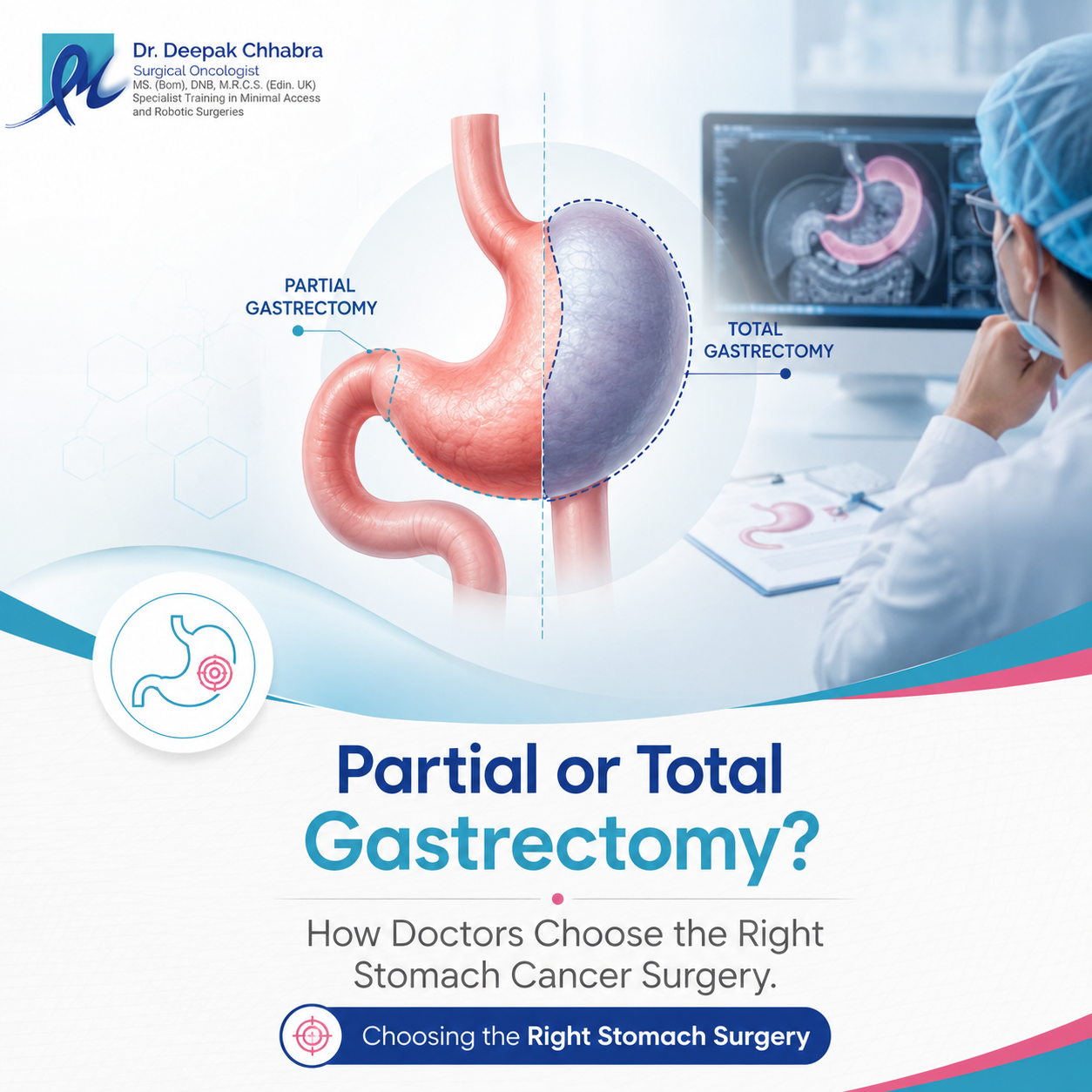
Partial gastrectomy removes only the cancer-affected part of the stomach. Total gastrectomy removes the full stomach. The choice depends mainly on where the tumour is located, whether clear margins are possible, whether lymph nodes are involved, and how safely the patient can recover.
For families considering stomach cancer surgery in Mumbai, this decision can feel frightening. A patient may ask, “Why can’t only the tumour be removed?” A caregiver may worry, “If the full stomach is removed, how will eating be possible?”
At Mumbai Cancer, we often see that the fear is not only about the operation. It is also about life after surgery — eating, weight loss, weakness, chemotherapy, and recovery.
Patients trying to understand tumour location, gastrectomy type, lymph node removal, and recovery planning may find this guide on stomach cancer surgery planning around tumour location useful before discussing the operation with their treating team.
The choice between partial and total gastrectomy depends on whether the cancer can be removed safely while preserving enough useful stomach function. Doctors do not choose a bigger operation casually. They choose the operation that gives safe cancer clearance while keeping recovery and long-term nutrition in mind.
Doctors usually review:
The goal is to remove enough stomach and lymph tissue for safe cancer clearance while preserving function where medically appropriate.
Partial gastrectomy means removing only part of the stomach. It may be considered when the tumour is located in an area where the remaining stomach can still be safely preserved.
This does not mean the surgeon removes only the visible lump.
In cancer surgery, the operation usually removes the tumour-bearing part of the stomach along with a surrounding margin of healthy-looking tissue. Nearby lymph nodes are also removed because they help doctors understand the stage and plan further treatment.
Cancer Research UK explains that stomach cancer surgery may involve either subtotal or total gastrectomy, and that lymph nodes are removed because they may contain cancer cells that have spread from the main cancer. Cancer Research UK
For patients, partial removal may sound less frightening than full stomach removal. Still, it is major cancer surgery. Eating habits, weight, recovery, and chemotherapy planning still need careful discussion.
Total gastrectomy means removing the entire stomach. Doctors may advise it when the tumour is high in the stomach, spread across a wider area, close to the food pipe junction, or positioned in a way where keeping part of the stomach may not give a safe cancer operation.
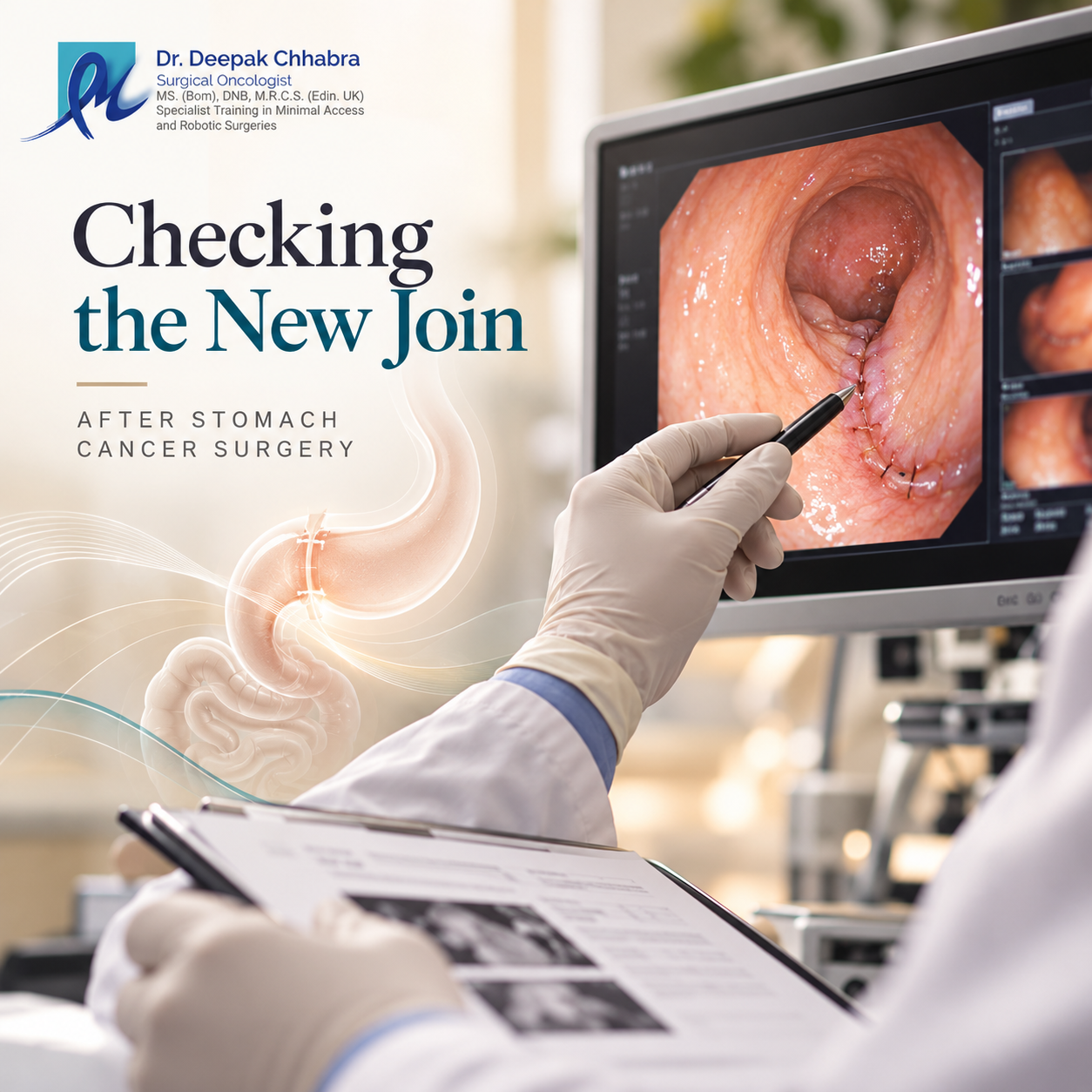
After a total gastrectomy, the food pipe is connected to the small intestine. Food no longer collects in the stomach before moving forward. This changes how a person eats.
The patient can still eat, but not in the old pattern.
Meals usually become smaller and more frequent. Some patients need nutrition guidance, protein support, vitamin supplementation, and regular follow-up. Weight loss can happen, especially during the early recovery period.
A patient may agree to surgery but still feel scared about the word “total.” That fear deserves a proper explanation, not a rushed answer. The better question is not only, “Can I live without a stomach?” The better question is, “What changes will I need to make, and how will the team support my nutrition after surgery?”
Tumour location is one of the biggest deciding factors.
If the cancer is in the lower part of the stomach, partial gastrectomy may sometimes be possible. If the tumour is in the upper stomach, near the food pipe junction, or spread widely, total gastrectomy may be safer from a cancer-clearance point of view.
This is why doctors study endoscopy reports, biopsy location, CT images, and sometimes staging laparoscopy findings before finalizing the operation.
A small tumour in a difficult location may need a larger operation. A bigger-looking tumour in a more favourable location may still allow partial removal.
Size matters, but location often matters more.
Patients comparing options for gastric cancer surgery in Mumbai often need clarity on whether tumour location allows partial removal or whether total gastrectomy is safer.
Lymph node removal is a planned part of stomach cancer surgery. It is not an unnecessary extra step.
Lymph nodes are small filtering structures. Cancer cells may travel there before spreading further. When lymph nodes are removed and tested, the pathology report can show whether the cancer was limited or had started moving beyond the main tumour.
The National Cancer Institute describes subtotal gastrectomy as removal of the cancer-containing part of the stomach along with nearby lymph nodes, while total gastrectomy removes the entire stomach with nearby lymph nodes and related tissues when needed. National Cancer Institute
For families, this part of the surgery report is important. The number of lymph nodes removed, the number involved, tumour depth, margins, and final stage can all affect the next treatment decision.
The surgery is not only about removing the tumour. It also gives doctors the staging information needed to plan the next step properly.
Some patients may need chemotherapy before surgery. Some may need it after surgery. Some may need both, depending on stage, tumour biology, lymph node findings, recovery, and overall fitness.
Chemotherapy before surgery may be discussed when doctors want to treat possible microscopic disease early, reduce tumour burden, or improve the chance of a better-planned operation.
Chemotherapy after surgery may be discussed when the pathology report shows lymph node involvement, deeper tumour spread, or other higher-risk features.
This does not mean surgery has failed.
It means the treatment plan is being built around the full cancer picture, not only the visible tumour. A stomach cancer specialist in Mumbai may explain whether the patient needs surgery first or whether chemotherapy should be part of the sequence.
Eating after gastrectomy needs patience. The body has to adjust.
After partial gastrectomy, the remaining stomach may hold less food than before. After total gastrectomy, there is no stomach reservoir, so food moves more directly into the intestine.
Patients may need:
Some patients feel full quickly. Some may have nausea, loose motions, dumping symptoms, reflux, or food intolerance. These problems should be discussed early instead of silently tolerated.
For many families, this is the most personal part of recovery. The surgery may happen in the operation theatre, but the real adjustment often begins at the dining table.
The goal after surgery is not only to recover from the wound. It is to rebuild strength, maintain nutrition, and create a realistic eating routine.
Recovery is different for every patient. Age, nutrition, diabetes, anaemia, surgical complexity, chemotherapy, and complications can all change the pace.
In the first few days, doctors focus on pain control, walking, breathing exercises, wound monitoring, fluid balance, and gradual feeding. After discharge, the focus shifts to eating, weight, bowel pattern, strength, and follow-up reports.
Families often ask, “When will the patient eat normally?”
The answer is not always simple. Eating after gastrectomy is usually a gradual process. The patient may not return to the old meal pattern, but many people learn a new routine with guidance.
A stomach cancer doctor will usually explain the operation after reviewing the endoscopy, biopsy, scan findings, nutrition status, and expected margins. That discussion should also include what to eat, what symptoms to watch for, when to call the doctor, and when chemotherapy may be considered.
A specialist opinion becomes important when biopsy confirms stomach cancer, when endoscopy shows a tumour, when scans suggest lymph node involvement, or when the family is unsure why part or all of the stomach may need removal.
It is also useful when patients are told chemotherapy may come before surgery or when nutrition is already poor before the operation.
Dr. Deepak Chhabra is associated with surgical oncology and gastrointestinal cancer surgery. His relevance becomes important when the decision depends on tumour location, surgical margins, lymph node clearance, staging, and recovery planning.
At Mumbai Cancer, the discussion should help patients understand the reason behind the operation, not just the name of the operation.
A partial gastrectomy removes only the cancer-affected part of the stomach, while a total gastrectomy removes the entire stomach. Doctors usually decide between the two based on tumour location, tumour spread, lymph node involvement, and whether enough healthy stomach can safely remain after surgery. After total gastrectomy, the food pipe is connected to the small intestine, so eating habits change more significantly than after partial removal.
Eating usually changes after partial gastrectomy because the remaining stomach may hold less food. Many patients need smaller, more frequent meals and may require nutrition support depending on weight loss, symptoms, and recovery. Patients should ask their treating team for a clear diet plan before discharge.
How long is recovery from a partial gastrectomy?
Recovery after partial gastrectomy is gradual. Many patients need around 6 to 8 weeks to heal and return to usual daily activities, but full adjustment can take longer, especially if chemotherapy, weakness, weight loss, or nutrition problems are involved. Eating smaller meals, rebuilding strength, and attending follow-up visits are all part of recovery.
What happens when you have a total gastrectomy?
In a total gastrectomy, the whole stomach is removed, usually along with nearby lymph nodes. The surgeon then connects the food pipe directly to the small intestine so food can still pass through the digestive system. After this surgery, patients can eat, but they usually need smaller, more frequent meals, nutrition monitoring, and long-term follow-up for weight, vitamins, and strength.
A person can live without a stomach after total gastrectomy, but eating habits must change. Food passes from the food pipe into the small intestine, so meals are usually smaller, slower, and more frequent. Patients should discuss vitamin monitoring, weight loss prevention, and long-term nutrition follow-up.
What are the types of partial gastrectomy?
The common types of partial gastrectomy depend on which part of the stomach is removed. A distal or subtotal gastrectomy removes the lower part of the stomach, while a proximal gastrectomy removes the upper part near the food pipe in selected cases. The final choice depends on where the tumour is located, whether clear margins are possible, and whether lymph nodes also need removal for staging.
Lymph nodes are removed because they help doctors check whether cancer cells have travelled beyond the main tumour. The pathology report uses lymph node findings, tumour depth, and margins to confirm stage and guide chemotherapy decisions. Patients should ask how many nodes were removed and whether any contained cancer.
After gastrectomy, many patients need to limit foods that are very sugary, very fatty, hard to digest, or likely to trigger dumping symptoms, nausea, reflux, bloating, or loose motions. Tolerance varies from person to person, so the safer approach is to eat small, frequent meals, chew slowly, focus on protein, and reintroduce foods carefully under medical or dietitian guidance. Patients should ask their treating team for a personalized diet plan, especially after total gastrectomy or if weight loss is ongoing.
Partial and total gastrectomy are not chosen randomly. The decision depends on where the stomach cancer is located, how far it has grown, whether lymph nodes are involved, whether clear margins are possible, and how safely the patient can recover.
Partial gastrectomy may preserve part of the stomach when cancer clearance is safe. Total gastrectomy may be needed when removing the whole stomach gives a safer cancer operation. Both surgeries need careful planning, nutrition support, staging review, and follow-up.
For families, the most useful question is not only, “Can less stomach be removed?” A better question is, “Which operation gives safe cancer clearance and the best recovery plan for this patient?”
A consultation with Dr. Deepak Chhabra may help patients understand whether partial or total gastrectomy is appropriate, what lymph node removal means, and how nutrition and recovery should be planned after stomach cancer surgery.
Medical Disclaimer:
This article is for general educational purposes only and should not replace medical advice, diagnosis, or treatment. Stomach cancer surgery decisions depend on tumour location, stage, biopsy findings, scan reports, lymph node involvement, margins, nutrition, age, fitness, and multidisciplinary medical evaluation. Please consult a qualified surgical oncologist, gastrointestinal surgeon, medical oncologist, or treating cancer team for personalised guidance.
Stay up-to-date with the latest developments in cancer research, treatment, and patient stories through our curated collection of cancer blogs and news articles. From breakthrough discoveries to inspiring survivor journeys.
Discover first hand accounts from patients who have experienced compassionate care and expert treatment at our clinic. Read their reviews to get to know their journey.

5 Out of 5 from 92 Reviews




 VIDEO CONSULTATION
 Phone Calls
 Physical visit