
A family may come prepared to discuss pancreatic cancer surgery, but the doctor may first talk about jaundice, bilirubin, bile duct blockage, or stenting. That can feel confusing. If the cancer needs surgery, why treat the blockage first?
For patients looking for a pancreatic cancer doctor in Mumbai, this is a common and important pre-surgery discussion. Jaundice may not only change how a patient looks from the outside; it can also affect liver function, infection risk, nutrition, and recovery after a major operation.
Families trying to understand scan findings, bilirubin reports, bile duct blockage, and Whipple surgery timing may find this guide on pancreatic cancer surgery planning useful before speaking with their treating team.
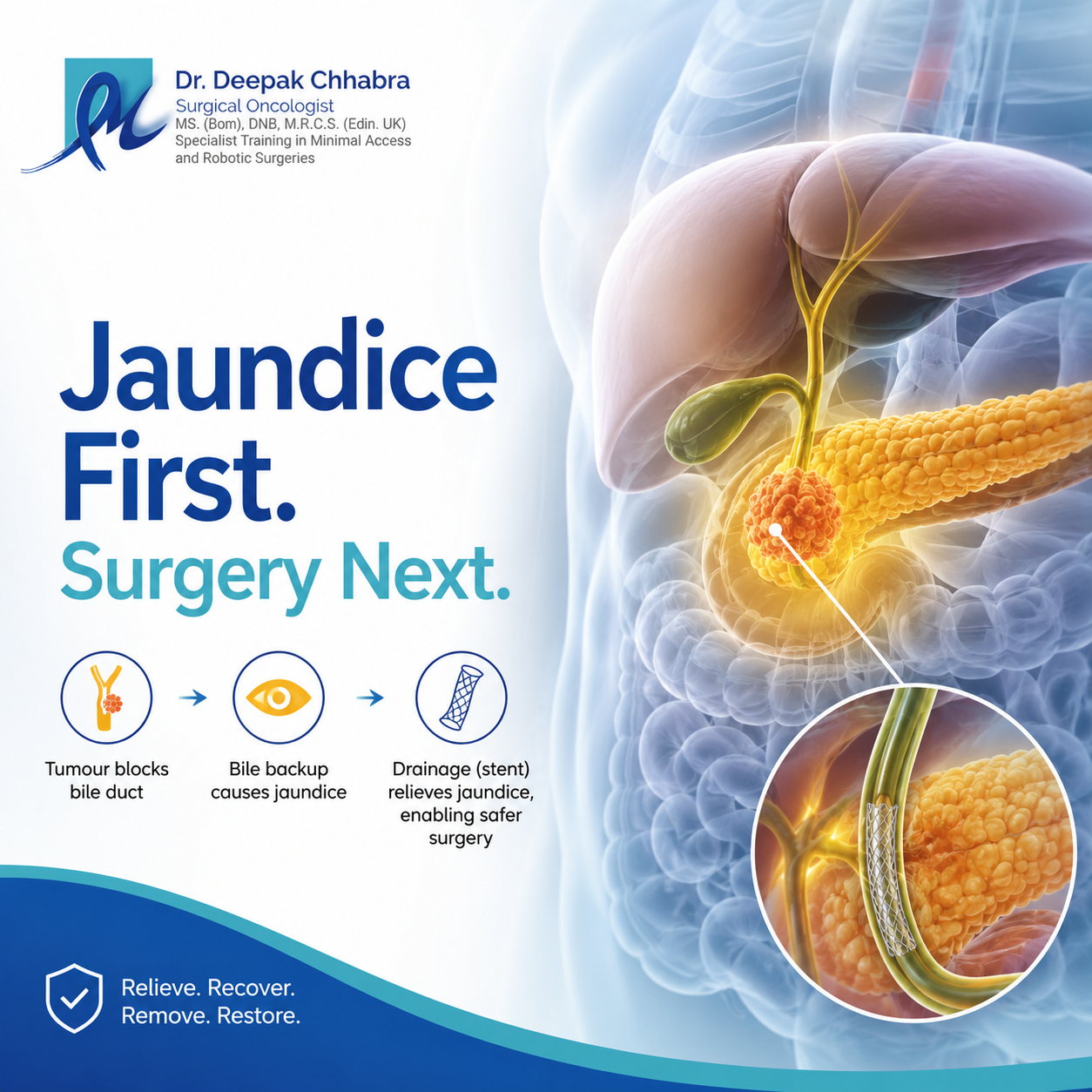
Jaundice can happen when a pancreatic tumour blocks the bile duct and bile cannot drain properly. Before major surgery, doctors may need to reduce bilirubin, treat infection risk, and improve the patient’s general condition. Drainage or stenting may be advised first so the body is better prepared for surgery.
Doctors usually review:
The practical message is simple: jaundice does not always cancel surgery, but uncontrolled jaundice can make surgery riskier.
Jaundice means bilirubin has built up in the blood. Patients may notice yellowing of the eyes or skin, dark urine, pale stools, itching, tiredness, or loss of appetite.
In pancreatic cancer, this often happens when a tumour in the head of the pancreas presses on or blocks the bile duct. The bile duct normally carries bile from the liver and gallbladder into the intestine. When that pathway is blocked, bile starts building up instead of draining normally.
Cancer Research UK explains that pancreatic cancer can block the bile duct, and a stent may be placed to keep the duct open so bile does not build up and cause jaundice. Cancer Research UK
For patients, the yellow colour is only the visible sign. Doctors are also concerned about what is happening inside the body: liver stress, infection risk, poor digestion, weakness, and whether the patient can tolerate surgery.
Bilirubin is not just another blood test value. It helps doctors understand how serious the bile blockage may be.
When bilirubin is high, the liver may be under pressure. The patient may not be eating well, may feel weak, and may be at higher risk of infection. These issues matter before pancreatic surgery because operations such as Whipple surgery are major procedures. The body needs enough reserve to recover.
This is why the surgical decision is not based only on whether the tumour can be removed.
Doctors also ask: Is the patient ready for the operation? Is the liver coping? Is there infection? Will recovery become more difficult if surgery is done too early?
That is why a better scan alone may not immediately lead to an operation date. The blood reports and the patient’s condition must match the surgical plan.
Bile duct drainage is done to help bile flow again. One common method is ERCP-guided stenting, where a small tube is placed inside the bile duct using an endoscope. In some cases, drainage may be done through the skin by an interventional radiology team.
The aim is to reduce bile build-up, improve bilirubin trends, relieve symptoms, and lower infection risk before the team reassesses surgery timing.
This step does not remove the cancer. That distinction matters.
A stent or drain is used to manage the blockage. Surgery is used to remove the cancer when the tumour is operable and the patient is fit enough. These are different steps, but they may belong to the same treatment plan.
Families sometimes feel disappointed when drainage is advised first. They may feel the main treatment is being pushed back. A clear explanation helps: drainage may be the step that makes the next treatment safer.
Stenting may change the timing, but it should not automatically be seen as an unnecessary delay.
If the patient has severe jaundice, high bilirubin, fever, infection, poor nutrition, or marked weakness, drainage may help stabilize the body before surgery. If chemotherapy is planned first, drainage may also be needed because high bilirubin can affect whether treatment can be given safely.
The National Cancer Institute notes jaundice as a possible sign of pancreatic cancer and explains that endoscopic stent placement may be used when a tumour is blocking the bile duct.
The real concern is not whether stenting changes the surgery date by a few days. The real concern is whether the patient reaches surgery in a safer condition.
A rushed operation in an unstable patient can create more risk. A planned operation after jaundice control may be more medically sound.
Whipple surgery or another pancreatic operation may be reconsidered once jaundice improves, but there is no fixed timeline that applies to every patient.
Doctors usually review the bilirubin trend, liver function, infection markers, nutrition, diabetes control, scan findings, and overall strength. They also check whether the tumour is still operable and whether there are any new findings that change the plan.
Some patients improve quickly after stenting. Others need more time because of infection, poor appetite, low albumin, weakness, diabetes issues, or a blocked stent.
So the useful question is not only, “When will surgery happen?”
A better question is: “What needs to improve before surgery becomes safe?”
That answer is personal. It depends on the tumour, the bile duct blockage, the blood reports, and the patient’s overall condition.
Patients should seek specialist review promptly when jaundice appears with suspected or confirmed pancreatic cancer. Yellow eyes, dark urine, pale stools, severe itching, fever, chills, abdominal pain, loss of appetite, or increasing weakness should not be ignored.
A pancreatic cancer specialist in Mumbai may review whether the jaundice is due to bile duct blockage, whether urgent drainage is needed, and whether surgery, chemotherapy, or reassessment should come next.
For a useful consultation, families should carry the latest CT, MRI, or PET-CT images, liver function test reports, bilirubin trends, ERCP or stent details if already done, biopsy report if available, discharge summaries, current medicines, diabetes records, and symptom history.
Old reports matter. They help the doctor compare whether the condition is improving, worsening, or becoming more urgent.
Bile duct blockage can sometimes lead to infection. Fever, chills, abdominal pain, sudden weakness, or worsening jaundice may suggest that the situation needs urgent attention.
When infection is suspected, doctors may prioritize antibiotics, drainage, fluids, monitoring, and stabilization before surgery planning.
This can be frustrating for families. They may feel that the cancer treatment has stopped. But controlling infection is part of safe cancer care. Surgery is not just about reaching the operation theatre; it is also about reaching it in the right condition.
A patient who is weak, infected, or not eating well may not recover the same way as someone who has been stabilized first.
Dr. Deepak Chhabra is associated with surgical oncology and gastrointestinal/hepato-pancreato-biliary cancer care. His relevance becomes important when pancreatic cancer surgery timing depends on jaundice, bilirubin level, bile duct drainage, scan findings, and patient fitness.
At Mumbai Cancer, the discussion is not limited to saying “stent first” or “surgery first.” The focus is on why jaundice has happened, whether the blockage needs urgent treatment, how bilirubin is changing, and when surgery can be planned more safely.
This kind of review helps families move from report-based anxiety to a clearer next step.
Jaundice can be risky before pancreatic cancer surgery because it may show bile duct blockage, high bilirubin, liver stress, or infection risk. The concern is higher when fever, chills, severe itching, poor appetite, dark urine, or rising bilirubin is present. Patients should share fresh liver function tests and scan reports with their treating team before surgery timing is finalized.
A bile duct stent does not automatically mean Whipple surgery is cancelled. Stenting may be used to reduce bilirubin, relieve blockage, control infection risk, or prepare the patient for surgery or chemotherapy. The next step depends on repeat blood tests, scan review, tumour stage, and overall fitness.
Pancreatic cancer surgery can be done after jaundice improves in selected patients when the tumour remains operable and the patient is fit for a major procedure. Doctors usually review bilirubin levels, liver function, infection status, nutrition, diabetes control, and imaging before confirming surgery. Patients should ask what specific findings need to improve before an operation date is fixed.
Doctors check bilirubin because high levels can show that bile is not draining properly and the liver is under stress. Very high bilirubin may affect surgery readiness, chemotherapy safety, digestion, infection risk, and recovery. A bilirubin trend is often more useful than one isolated number when doctors decide between drainage, reassessment, and surgery planning.
Jaundice before pancreatic cancer surgery can be alarming, especially when a family is already preparing for a major operation. But jaundice does not always mean surgery is impossible. In many cases, it means the bile duct is blocked and the patient needs careful preparation before surgery.
Drainage or stenting may come first because doctors want to reduce bile build-up, improve bilirubin levels, manage infection risk, and help the body become stronger for the next step. This is not about delaying care without reason. It is about choosing the safest possible timing.
The most helpful approach is to ask what is causing the jaundice, how bilirubin is changing, whether the bile duct needs drainage, and when surgery will be reassessed. A consultation with Dr. Deepak Chhabra through Mumbai Cancer may help patients and families understand how jaundice affects pancreatic surgery planning and what reports should be reviewed before moving ahead.
Medical Disclaimer:
This article is for general educational purposes only and should not replace medical advice, diagnosis, or treatment. Pancreatic cancer care depends on tumour location, stage, bile duct blockage, bilirubin level, infection status, scan findings, patient fitness, and multidisciplinary evaluation. Please consult a qualified surgical oncologist, gastroenterologist, medical oncologist, or treating cancer team for personalised guidance.
Stay up-to-date with the latest developments in cancer research, treatment, and patient stories through our curated collection of cancer blogs and news articles. From breakthrough discoveries to inspiring survivor journeys.
Discover first hand accounts from patients who have experienced compassionate care and expert treatment at our clinic. Read their reviews to get to know their journey.

5 Out of 5 from 92 Reviews







 VIDEO CONSULTATION
 Phone Calls
 Physical visit