
Most families do not search for cancer surgery information casually. They search because a biopsy has confirmed cancer, a scan report looks worrying, or someone has been told that a major operation may be needed.
For patients and families trying to understand complex cancer surgery in Mumbai, the main question is often not “Who can operate?” The more important question is: “Who should decide whether surgery is the right step at all?”
At Mumbai Cancer, we often see patients who come with CT scans, PET-CT reports, MRI films, endoscopy findings, colonoscopy reports, biopsy slides, or discharge summaries from a previous procedure. The reports may be complete, but the direction may still be unclear. That is where a surgical oncology opinion becomes important, especially when the cancer involves the stomach, colon, pancreas, liver, gallbladder, bile duct, appendix, or nearby major structures.
A surgical oncologist should be consulted when cancer surgery is being considered, when the tumour is close to vital organs or blood vessels, or when the timing of surgery can affect the final treatment outcome. In complex GI and HPB cancers, surgery is not planned only by looking at tumour size; it is planned by studying tumour location, stage, spread, patient fitness, and the safest treatment sequence.
In practical terms, a surgical opinion becomes important when the scan mentions vessel involvement, lymph nodes, obstruction, local spread, recurrence, or “borderline operable” disease. It is also important when one doctor has advised surgery first, while another has suggested chemotherapy before surgery.
The National Cancer Institute explains that surgery works best for many solid tumours when the cancer is contained in one area, although many patients may also need other treatments before or after surgery.
Cancer reports are difficult for families to interpret. A line like “lesion abutting vessel” or “regional lymph nodes noted” may sound frightening, but its meaning depends on the exact cancer type and location.
A patient may ask, “If the tumour is touching a blood vessel, does that mean it cannot be removed?”
A son may ask, “Should we start chemotherapy quickly, or will that delay the surgery?”
A spouse may ask, “If part of the stomach or colon is removed, how will daily life change after the operation?”
These are not ordinary doubts. These questions decide the treatment path.
In complex abdominal cancers, a biopsy report confirms the diagnosis, but it does not always decide the sequence of treatment. A CT scan or MRI may show whether the tumour is near major vessels. A PET-CT may help check if disease has spread elsewhere. Endoscopy or colonoscopy may explain where the tumour starts. Blood tests show whether the liver, kidney, blood count, and nutrition levels are strong enough for a major procedure.
A cancer specialist in Mumbai may coordinate the overall treatment journey, but when the central question is whether a tumour can be removed safely and meaningfully, the cancer surgeon’s assessment becomes critical.
A good surgical opinion is not a quick yes or no. It is a layered assessment.
The first thing a surgical oncologist studies is whether the tumour is removable with proper cancer margins. This is different from simply asking whether the tumour can be “taken out.” In cancer surgery, the aim is to remove the disease in a way that gives the patient the best possible cancer control while protecting important organs and structures.
The second concern is whether surgery is the right first step. Some cancers should go to surgery upfront. Some respond better when chemotherapy or radiation is given first. Some need jaundice, obstruction, infection, or nutrition problems corrected before a major operation can be planned safely.
The third concern is the patient’s ability to recover. Age matters, but it is not the only deciding factor. Diabetes, heart condition, liver function, kidney function, weight loss, weakness, albumin level, blood count, and general stamina all matter. A technically possible surgery may still be unsafe if the body is not ready for it.
Then comes the bigger question: what is the intent of surgery?
For some patients, the intent is curative. For others, surgery may be done to relieve obstruction, reduce bleeding, manage jaundice, obtain tissue, or improve quality of life. Families should understand this clearly before agreeing to a major operation.
Cancers of the stomach, colon, pancreas, liver, gallbladder, and bile duct are often complex because these organs sit close to one another. A few millimetres can change the surgical approach.
In stomach cancer, the surgeon may need to decide whether part of the stomach or the entire stomach needs removal. Lymph node clearance is also planned carefully because it affects staging and further treatment.
In colon cancer, the exact location of the tumour changes the operation. A right-sided colon tumour, left-sided colon tumour, sigmoid tumour, or rectosigmoid tumour may need different planning. The surgeon also discusses bowel joining, recovery, and whether a temporary or permanent stoma is likely.
In pancreatic cancer, the planning becomes even more delicate because the pancreas lies close to major blood vessels and the bile duct. A pancreatic cancer surgeon has to assess whether the tumour is clearly operable, borderline operable, or better treated first with chemotherapy.
In liver cancer or liver tumour surgery, the issue is not only tumour removal. The remaining liver must be enough and healthy enough for the patient to survive and recover.
Gallbladder cancer can be especially challenging when it is found unexpectedly after routine gallbladder removal. In that situation, the next step depends on the pathology report, depth of tumour invasion, margin status, lymph node risk, and staging scans. A gallbladder cancer specialist will usually review whether further surgery is required or whether another treatment route is safer.
This is why complex cancer surgery is not just an operation. It is a treatment strategy.
A surgical oncology opinion is useful when the diagnosis is confirmed, when surgery has been advised, or when there is confusion about the next step.
You do not have to wait until every treatment decision is already made. In fact, early consultation can prevent unnecessary delay and avoid poorly sequenced treatment.
Families should consider meeting a cancer surgeon in Mumbai when the report mentions words like “resectable,” “locally advanced,” “borderline,” “lymph node,” “vascular involvement,” “metastasis,” “obstruction,” or “recurrence.”
Second opinions are also reasonable before major surgery. It does not mean the earlier doctor was wrong. It simply means the decision is important enough to review from every angle.
A patient can ask direct questions during the consultation:
“What exactly will be removed?”
“Will lymph nodes also be removed?”
“Is this surgery being planned for cure, control, or symptom relief?”
“Do I need chemotherapy before surgery?”
“What are the chances of needing ICU care?”
“Will I need a stoma, drain, feeding tube, or another procedure?”
“How long may recovery take?”
“What will decide treatment after surgery?”
These questions are not negative. They are necessary. A good consultation should make the patient feel more informed, not more frightened.
A consultation becomes more useful when the surgeon can review the actual evidence, not just verbal summaries.
Patients should ideally carry the biopsy report, CT scan, MRI, PET-CT, endoscopy or colonoscopy report, blood tests, previous surgery notes, discharge summary, and current medicine list. If cancer was found after an earlier operation, the pathology report and operative notes become especially important.
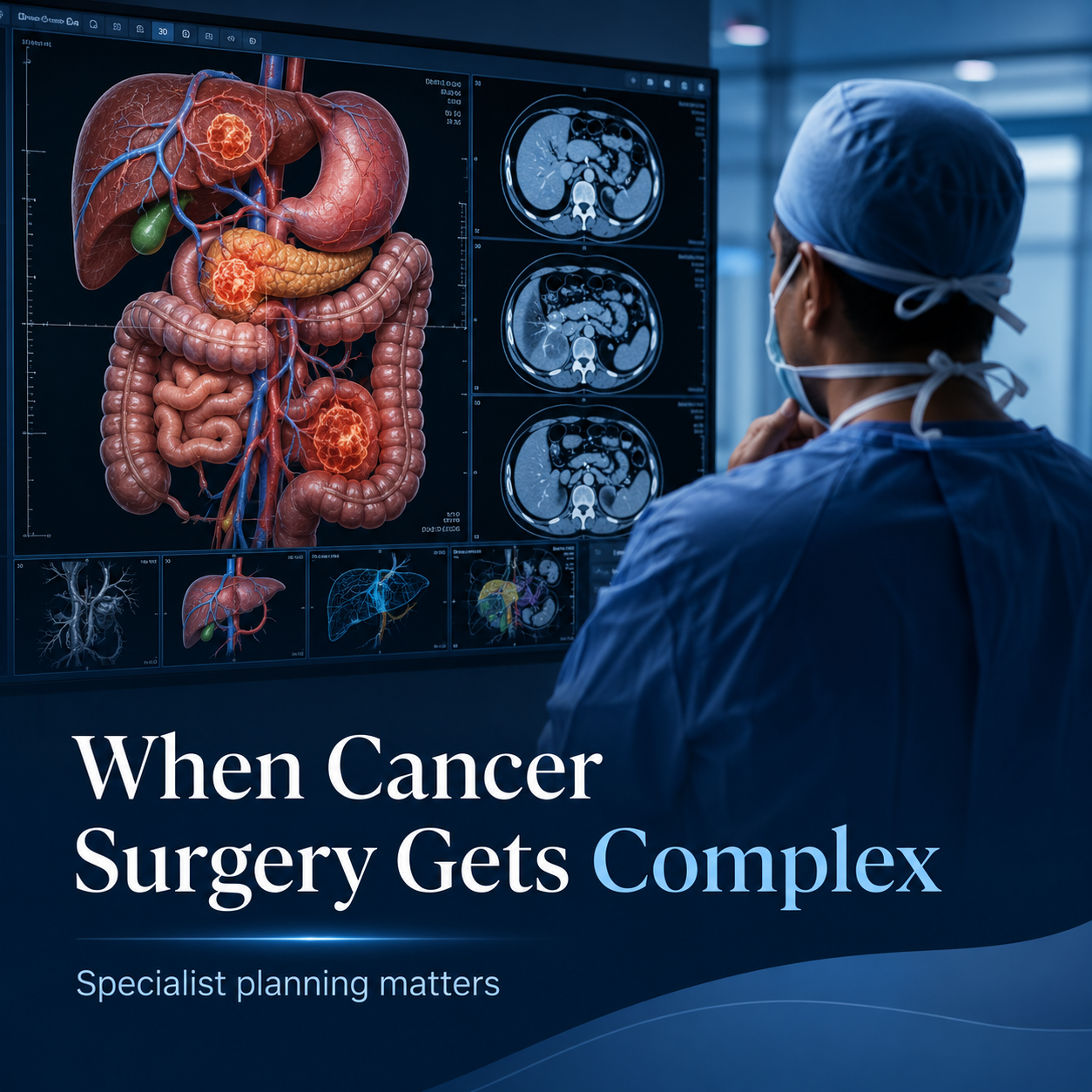
It also helps to scan films or CDs, not only printed reports. Sometimes the exact surgical decision depends on seeing the tumour’s relationship with vessels, ducts, bowel, liver, pancreas, or lymph nodes directly on the images.
If chemotherapy or radiation has already started, those records should also be shared. Treatment response can change whether surgery is possible and when it should be planned.
Dr. Deepak Chhabra is a consultant surgical oncologist with experience in cancer surgeries, with focused expertise in gastrointestinal and hepato-pancreato-biliary cancer surgery. His training includes MS, DNB, MRCS, fellowship in GI Surgical Oncology and Robotics, and specialist HPB training from Nagoya University, Japan.
This background matters because complex abdominal cancer surgery needs more than operating skill. It needs judgment about timing, tumour biology, staging, lymph node clearance, organ preservation, reconstruction, and recovery.
At Mumbai Cancer, the focus is on helping patients understand whether surgery is appropriate, what the operation involves, and how it fits into the complete cancer treatment plan. For families already dealing with fear, urgency, and multiple opinions, this clarity can make the next step easier to decide.
In many cases, a surgical oncologist works with a medical oncologist, radiation oncologist, gastroenterologist, radiologist, pathologist, dietitian, anaesthesia team, and critical care team. The American Cancer Society explains that cancer care commonly involves different specialists working together, depending on the patient’s condition and cancer type.
Patients who want to understand Dr. Chhabra’s background, consultation focus, and surgical oncology expertise can review his profile through the main Mumbai Cancer surgical oncology page.
You should meet a surgical oncologist soon after cancer is confirmed or strongly suspected in a solid organ where surgery may be part of treatment. The opinion is most useful when biopsy, CT scan, MRI, PET-CT, endoscopy, colonoscopy, or blood test reports are available for review. Carry all reports, scan films, discharge summaries, and previous treatment records so the surgeon can assess the case properly.
An oncologist is a cancer specialist, while a surgical oncologist is trained to treat cancer through surgery. A medical oncologist usually manages chemotherapy, immunotherapy, targeted therapy, or hormonal therapy, while the surgical oncologist evaluates tumour removal, margins, lymph nodes, reconstruction, and operative risk. Many cancer patients need both specialists because treatment often works best when the sequence is planned together.
A doctor decides whether cancer surgery is possible by reviewing tumour stage, location, spread, vessel involvement, lymph nodes, organ function, and the patient’s fitness for anaesthesia. Surgery is usually considered when the tumour can be removed safely with meaningful cancer control and the patient can recover well enough for the next stage of treatment. A surgical oncology consultation helps clarify whether surgery should happen first, after chemotherapy, or not at all.
A second opinion is useful when the proposed cancer surgery is major, risky, urgent, or when different doctors have suggested different treatment plans. It is especially relevant for stomach, colon, pancreas, liver, gallbladder, bile duct, recurrent, or post-operative cancer findings. The second opinion should review the diagnosis, scan findings, surgical intent, alternatives, expected recovery, and likely next treatment.
If cancer surgery has been advised, do not rush only to find the earliest operation date. First understand the purpose of the surgery, the risks involved, whether another treatment should come before it, and what recovery may look like.
Bring the reports. Ask direct questions. Request a clear explanation of the treatment sequence.
For complex GI and HPB cancers, a surgical oncology opinion with Dr. Deepak Chhabra can help patients and families make the decision with better structure, stronger medical reasoning, and less uncertainty.
Stay up-to-date with the latest developments in cancer research, treatment, and patient stories through our curated collection of cancer blogs and news articles. From breakthrough discoveries to inspiring survivor journeys.
Discover first hand accounts from patients who have experienced compassionate care and expert treatment at our clinic. Read their reviews to get to know their journey.

5 Out of 5 from 92 Reviews








 VIDEO CONSULTATION
 Phone Calls
 Physical visit